North Berkshire Secondary Schools Study Group Hones RFP to Find Consultant
NORTH ADAMS, Mass. — The Northern Berkshire Secondary Sustainability task force Tuesday finalized the objectives it wants addressed in a study it plans to commission this winter.
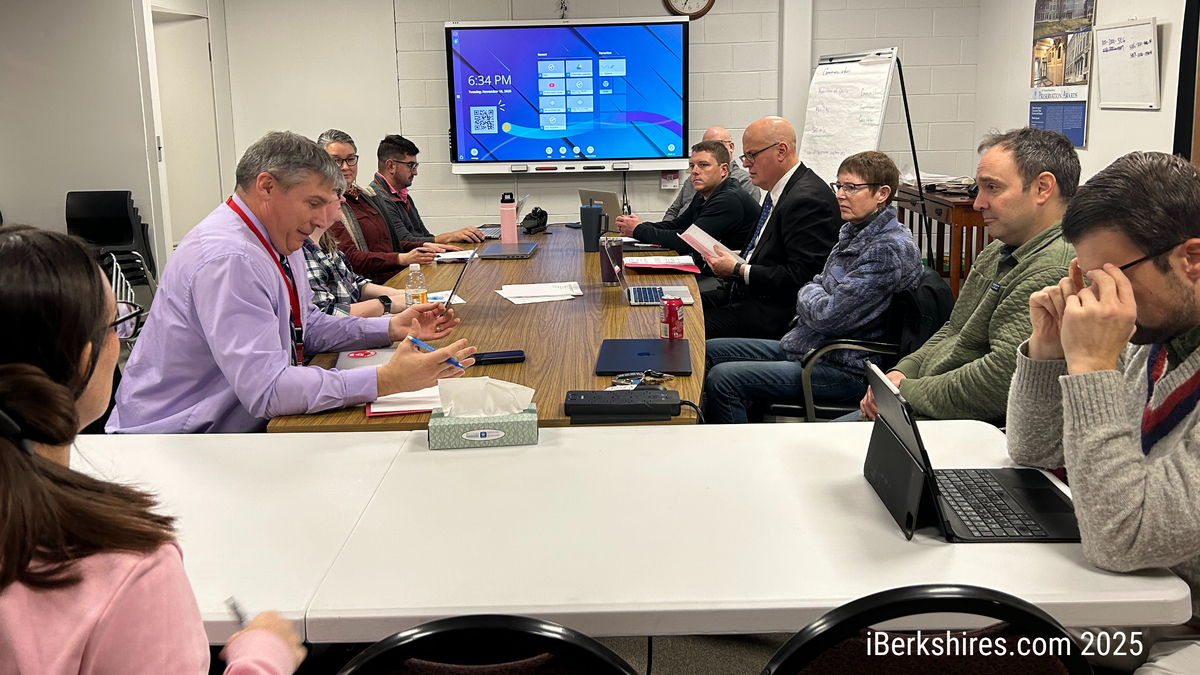
Representatives from three North County school districts plus the school union serving elementary schools in Clarksburg, Florida, Rowe and Savoy met for about an hour and a quarter in a City Hall conference room to craft the request for proposals they plan to issue to education consultants.
The group of administrators and school committee members from North Adams, Hoosac Valley, Mount Greylock and the North Berkshire School Union agreed to meet again on Tuesday, Dec.9, at 4:30 to finalize the RFP, which they hope to release by mid-December.
The plan is to get responses back by mid-January and get the study underway this winter.
On Tuesday, the task force agreed on what will be studied by the consultant in conjunction with a yet-to-be-appointed steering committee drawn from the local districts.
The study objectives outlined in the RFP are:
• Assessing current and projected enrollment, programs, staffing, facilities, and finances for
secondary education across the four districts, identifying strengths, opportunities, challenges, and inefficiencies
• Facilitating transparent, inclusive stakeholder engagement, prioritizing and incorporating
community identity in collaboration with the Steering Committee.
• Identifying at least four realistic sustainability models with a focus on the secondary level. These
models may follow past practice of regionalization efforts or employ creative, innovative
solutions. Models may include shared services, grade reconfiguration, and/or regionalization.
• Forecasting legal, fiscal, operational, programmatic, and governance implications of each
proposed model for discussion with the Steering Committee.
• Synthesizing findings into a comprehensive report.
The task force's work is focused on grades 6 through 12 even though, administrators acknowledged, its member districts define "secondary" education differently. Williamstown and Lanesborough, for example, send sixth-graders to their elementary schools; Hoosac Valley educates students in grades 4 through 7 at the middle school.
The collaboration initiative is working with a $100,000 state grant.
On Tuesday, the task force discussed whether that sum will be sufficient to move the project forward.
"I don't know how we know what $100,000 of the project looks like," North Adams Superintendent Timothy Callahan said.
"This RFP is for Phase 1," Hoosac Valley Superintendent Aaron Dean replied. "We'll know what $100,000 gets us when the bids come back.
"If we're getting bids that are all $200,000 or so, we'll have to cut the scope or look for other funding sources or both."
When the discussion turned to developing the initial scope, Mount Greylock School Committee member Carolyn Greene kicked off the conversation by looking to make sure the proposals that come from the study maximize options for the member districts.
"Even with the models that are listed in terms of collaboration or shared services or regionalization, we could end up with a hybrid of things: some districts sharing services while others are regionalizing," Greene said. "Keeping it as open as possible might be a way to express that."
Mount Greylock's superintendent said the study should address potential hurdles to any of the steps toward cooperation that are proposed.
"Trying to figure out to what extent the state is interested in adapting its regulations and approaches to regional collaboration to make it possible to do more things is something that can and should be in the discussion," Joseph Bergeron said. "Whether it's what do hybrid classrooms look like to allow for wider diversification of programs or, if it comes down to regional agreements, there are plenty of ways right now regional agreements are rigid and don't allow for flexibility.
"Coming up with things that would make collaboration more possible and being able to write that down with language that is both understood by our communities and [the Department of Elementary and Secondary Education] ends up being an integral part of the work."
Dean, who facilitated Tuesday's meeting and was chosen by the other task force members as the facilitator of December's meeting, agreed with Bergeron that obstacles to collaboration need to be addressed. But he argued that those obstacles are not part of the study's initial work.
The final set of objectives approved on Tuesday put those concerns fourth on a list of five goals for the study.
"I would think that's Phase 2," Dean said. "One model might be regionalizing in a unique way. Another might be creating a collaborative for special education programming. … If we focus in on, 'Here are two or three great options to consider,' what are some hurdles we're going to have and how do we work with communities and the Legislature, for that matter."
North Berkshire Superintendent John Franzoni agreed, emphasizing that Phase 1 is for looking at the issues facing the districts and identifying options.
"What I'm telling my districts now is all you're committed to is doing the study," Franzoni said. "I think that's what we've told all our districts."
Tags: regionalization,