image description
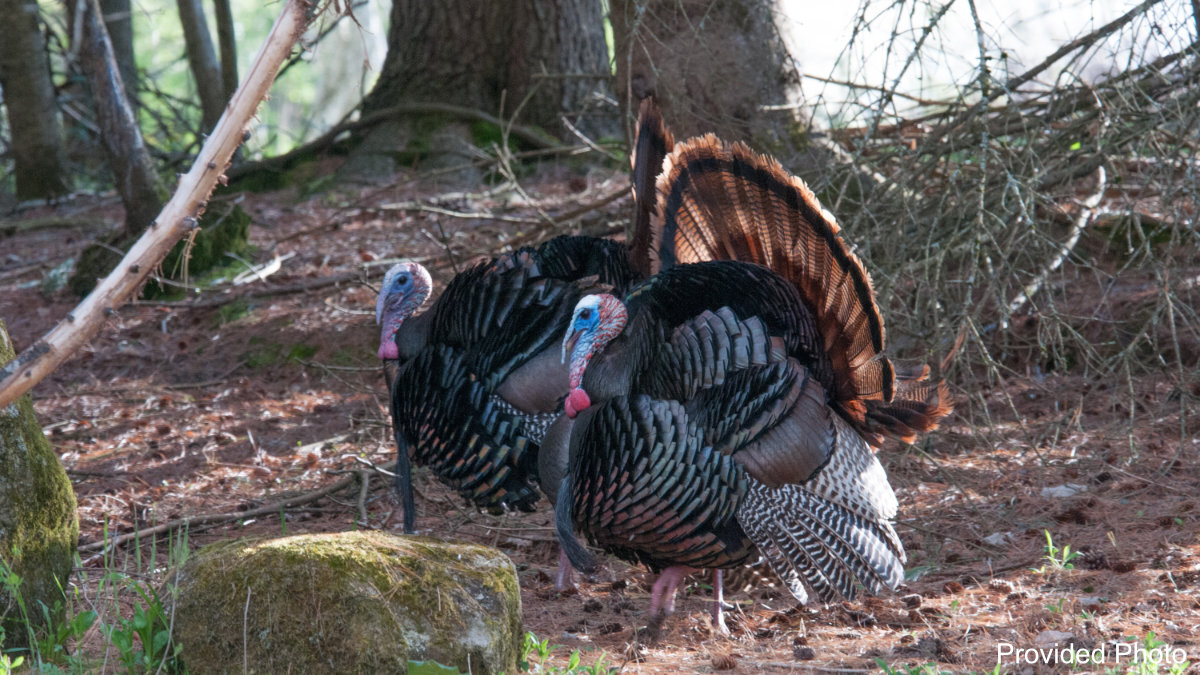
VTF&W photo by John Hall The Thanksgiving turkeys on our tables this holiday originated from native wild turkeys whose populations have been restored across much of North America thanks to scientific wildlife management by state fish and wildlife agencies.

The Wild Turkey's Contribution to Thanksgiving

Vermont Fish and WildlifePrint Story | Email Story
MONTPELIER, Vt.— One of our native wildlife species historically played an important role on Thanksgiving Day.   
 
North America's native wild turkeys were the ancestors of the Thanksgiving turkey on our dinner table. 
 
Originally found only in the wild, turkeys now exist as meat-producing domesticated varieties -- the broad breasted white, broad breasted bronze, white Holland, bourbon red, and a host of other breeds – all of them descended from our native wild turkey. 
 
More than 140,000 servings of Vermont wild turkeys are harvested each year – that's 140,000 servings of free-ranging, wild and sustainably harvested protein. 
 
Wild turkeys exist throughout Vermont today, but that was not always the case.  Wild turkeys disappeared from Vermont in the mid-to-late 1800s due to habitat destruction when land was cleared for farming and only 25 percent of the state was covered by forest.
 
The wild turkeys we see in Vermont today originated from just 31 wild turkeys stocked in Southwestern Vermont by the Vermont Fish and Wildlife Department in 1969 and 1970 when   Vermont's forest habitat was once again capable of supporting turkeys.  State wildlife biologists moved groups of these birds northward, and today Vermont's population of turkeys is estimated at close to 50,000.   
 
This is just one of many wildlife restoration success stories we can be thankful for in 2025.  Funding for Vermont's wild turkey restoration was derived from the sale of hunting licenses and a federal tax on hunting equipment. 
If you would like to contribute information on this article, contact us at info@iberkshires.com.

Dalton Police Facility Report Complete; Station Future Still Uncertain

By Sabrina DammsiBerkshires Staff
DALTON, Mass. — The Public Safety Facility Advisory Committee's final report is complete but the future of the station remains uncertain. 
 
Several members of the committee attended the Select Board meeting last week, as co-Chair Craig Wilbur presented four options delineated in the presentation — build on town-owned land, build on private land, renovate or repurpose the existing buildings, and do nothing. The full report can be found here
 
According to the report, addressing the station's needs coincides with the town facing significant financial challenges, with rising fixed costs and declining state aid straining its budget. 
 
These financial pressures restrict the town's ability to fund major capital projects and a new police station has to compete with a backlog of deferred infrastructure needs like water, sewer, roads, and Americans with Disabilities Act compliance.
 
In June 2024, Police Chief Deanna Strout informed the board of the station's dire condition — including issues with plumbing, mold, ventilation, mice, water damage, heating, and damaged cells — prompting the board to take action on two fronts. 
 
The board set aside American Rescue Plan Act funds to address the immediately dire issues, including the ventilation, and established the Public Safety Facility Advisory Committee to navigate long-term options
 
Very early on it was determined that the current facility is not adequate enough to meet the needs of a 21st-century Police Facility. This determination was backed up following a space needs assessment by Jacunski Humes Architects LLC
 
View Full Story

More Pittsfield Stories