Pittsfied Councilors See Dalton Ave. 'Walk Audit' for Safety Improvements
PITTSFIELD, Mass. — A walk audit done on Dalton Avenue over the summer has made recommendations for a safer corridor.
The City Council's public works subcommittee will review the Pittsfield Community Design Center's report on an area where a fatal vehicle-pedestrian crash occurred over the summer. It makes five recommendations to deter speeding and improve pedestrian facilities on the well-traveled, quarter-mile stretch.
There have been more than 90 reported crashes on the lower section of Dalton Avenue since 2020, 19 causing injury, and the June 20 fatality at the corner of Dartmouth Street that is still under investigation.
"The crash that killed Luis Chin in the summer of 2025 was the first known fatality to have occurred on that corridor. It is imperative that we take lessons learned from why this crash took place and take steps to prevent another from happening," the PCDC report reads.
"This is to both honor the life of Luis and to make sure that no further lives are lost unnecessarily."
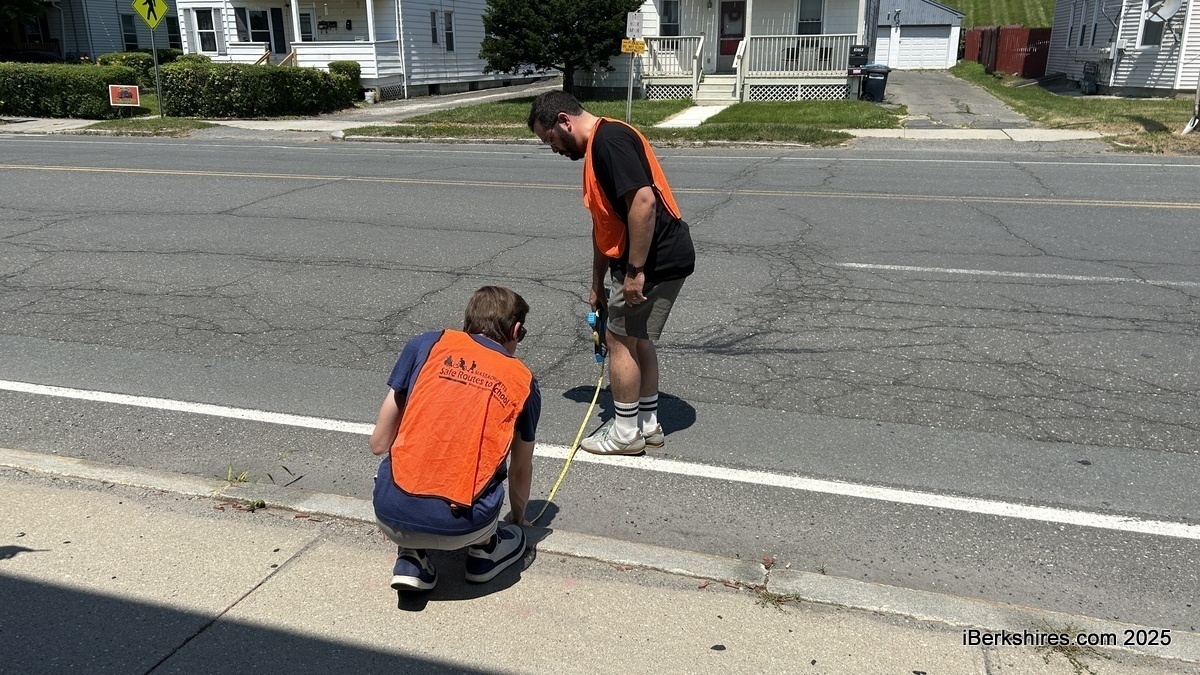
The AARP Walk Audit Toolkit guided the July audit. Community members identified areas needing improvement on clipboards from the intersection of Dalton Avenue and Benedict Road to the roundabout, studying the road and sidewalk conditions while observing traffic patterns.
Commissioner of Public Services and Utilities Ricardo Morales, as well as city councilors, were present.
The report recommends that Pittsfield formalize and enforce speed limits, mark all crosswalks, establish "daylighting" at corners with on-street parking regulations to improve visibility, establish right-sized travel lanes that discourage speeding, and improve the bus stop.
Nicholas Russo, founder of PCDC, asked that the City Council review the recommendations. It was referred to the subcommittee on public works.
"I'm sure we, either ourselves or we know someone who was affected by a traffic crash in one way or another, whether it was even just a minor accident or something that you're able to walk away from, or just a fender bender," Russo said at the Nov. 25 council meeting.
"It still affects us all, as that little bit of anxiety when you get out on the road makes you keep a watch on your back that much more often, because you never know what could be around the next corner. So I think we can all agree on that, that we want to be safer on the roads, all users and modes of transportation."
Russo and other community members marked the World Day of Remembrance for Road Traffic Victims, which is observed on Nov. 16, during the meeting.
The walk audit report identified the Dunkin' Donuts at 84 Dalton Ave. as a "major traffic generator" that frequently causes traffic to spill out onto the sidewalk and travel lane. From Harvard Street to Benedict Road, there is no signage allowing or prohibiting parking, and there are no posted speed limits from Benedict Road to Woodlawn Avenue.
While the citywide statutory speed limit applies to the corridor, not posting it "provides no clear guidance to motorists for consistent or predictable travel, especially on a gateway where travelers from outside the city are likely passing through," the report says.
The nearest posted limit reduces traffic to 35 mph.
Through records from the Massachusetts Department of Transportation, the PCDC found that Pittsfield, in 2017, adopted a section of Chapter 90 that allows the reduction of the citywide statutory speed limit to 25 mph. It is recommended that the city install "thickly settled" 25 mph speed limit signs in this area.
There are only three marked crossings on Dalton Avenue, and all others are unmarked. During the audit, planners saw a "sight triangle" at the intersection of Dartmouth Street where traffic parked to the curb impedes visibility between walkers and motorists.
"Daylighting," or leaving one car-length of clear space before the corner with signage, is suggested to ease this occurrence.
"While signage would be the first step to restricting parking nearby the street corners, a long-term solution would be to install curb extensions or other barriers to prevent parking too close to the street corner," the report reads.
"These should be considered at the next opportunity for street maintenance or reconstruction along this corridor. In the interim, epoxy gravel paint can be applied to the affected areas to create a contrasting surface that communicates that parking is not permitted within 20 feet of the street corner. Planters or flex posts could also be used as a light, quick, cheap solution in the interim."
It was also observed that the Berkshire Regional Transit Authority bus stop is just a bench at the corner of Harvard Street with no shelter from sun, rain, or snow. PCDC recommended that BRTA pursue a new bus shelter at this spot to encourage more transit use and protect passengers.
The Berkshire District Attorney will conduct the final investigation on Chin's death, and any released updates may be incorporated into the recommendations, the report explains.
Tags: traffic safety,