Elissa Tenny, new dean and provost at Bennington College

Print Story | Email Story
"We never thought about such a radical lifestyle change,” said Elissa Tenny. “But the more I learned about Bennington, the more it was just too hard to resist.” This summer, Tenny left New York City, where she was acting dean at the New School, to join Bennington College as dean and provost. On the surface, her new position is a dramatic departure — she has spent most of her professional career on an urban campus that serves 20,000 continuing education students. While Bennington presents a new environment and set of responsibilities, Tenny said the two schools share a similar philosophy and approach to learning. “It felt to me like there would be enough of a comfort zone but that there would also be a lot of excitement,” she said. Tenny said she was drawn to Bennington College in part because of its teacher/practitioner model. At the New School she worked on creating flexibility for faculty to both teach and remain active in their fields. Committed to this philosophy, Tenny was struck by a line on the Bennington College web site: "teachers teach what keeps them up at night." She noted that like the faculty of both institutions, students are given a special role: as partners in the design of their education. In every Bennington College commencement since 1936, a statement has been read that describes this founding principle: “...[Bennington] seeks to liberate and nurture the individuality, the creative intelligence, and the ethical and aesthetic sensibility of students...” While driven by similar goals, the schools’ student bodies are very different. In her work at the New School, Tenny focused on adult education programs that serve about 20,000 students. Whether completing a bachelors, getting a masters, or simply taking a class for the love of learning, these students were older, with professional lives and families, said Tenny. Bennington College has 600 undergraduate students who are “younger, traditional-aged, though by no means traditional.” Facing new challenges, such as issues of student life and housing, were part of the appeal of the job, she said. The innovative nature of the institution also appealed to Tenny. Bennington College uses its tradition and history for innovation and experimentation — it’s not stuck, she said. In a dramatic break with tradition, Bennington College issued a “symposium” report in 1994 that, among other things, eliminated tenure. Nearly a third of the faculty was fired, resulting in criticism from the academic community, lengthy law suits and a drop off in enrollment. In a May 2002 Boston Globe article, President Elizabeth Coleman is quoted as describing the reorganization as “designed to bring the college’s programs and resources more in line with its original philosophy and aims.” On the brink of bankruptcy in the years following the symposium, the college has made a remarkable recovery. According to the Globe, enrollment — at 750 students (600 undergraduate, 150 graduate) — is nearly double what it was five years ago. The financial picture is bright as well: Bennington College recently received the largest gift in its history, a $5 million unrestricted donation from Katharine and Albert Merck. “This place is alive and electric with energy and ideas,” said Tenny. She added that the college seems “poised for many more great things to happen." In spite of one misconception, Bennington College is not the most expensive school in the country, she said. Another notion the school has worked on is the perception that it was “up on the hill” and “disconnected from the community.” Quantum Leap, a program to get high schools students who have dropped out or who are at risk of dropping out excited about learning, demonstrates the college’s commitment to forging connections in Bennington County. “I feel like the outside world hasn’t quite caught up with all that’s gone on here...that it is as vital as it is right now,” she said. Tenny credited the graduate programs in teacher education and writing as adding to this vitality and to broadening the spectrum of the educational experience.While there are no specific plans yet, Tenny said she and the president are considering graduate programs for the future. In her last three years at the New School, as acting dean, she developed a masters degree program in International Affairs. Her goal was to integrate the World Policy Institute, a think tank of senior fellows doing their own individual research, more fully into the lifeblood of the school, she said. Started in the fall of 2001, the program now has 150 students. As for her own education, Tenny earned a B.A. from the Richard Stockton College of New Jersey and an M.A. in Media Studies at New School University; she completed graduate study in Higher Education at New York University. Tenny worked at the New School for most of her professional life. She started as assistant director of the graduate program in media studies, before moving to the dean’s office where she assumed a series of positions of increasing responsibility. “[The New School] was really a big part of my life but I was ready for a change, said Tenny. “It never occurred to me to leave New York.” Though her husband tossed around the idea of exploring another city like Chicago or San Francisco, it was an irresistible job at Bennington College that took her to the country. Tenny, who lives with her family in Manchester, noted the generosity of the people in her new home. “New York is the greatest city in the world”; but unlike the city, here people don’t need to have their guard up, she said. Along with settling into rural life, she intends to spend the fall term listening, talking to people, and absorbing input "like a sponge." She plans to begin prioritizing in the spring. “I want to connect out to the other schools in Vermont...to see how Bennington fits in with the rest of what’s happening in Vermont and get the good word out that way too. I think that’s important for us.” Tenny said she looks forward to finding venues to connect with students and faculty. “I wish I had enough hours in the day that I could actually take a couple of classes.” As for the literature class she attended that morning, "It was simply heaven."
If you would like to contribute information on this article, contact us at info@iberkshires.com.

Teacher of the Month: Kaylea Nocher

By Sabrina DammsiBerkshires Staff

NORTH ADAMS, Mass. — First-grade students in Kaylea Nocher's class feel secure and empowered in the classroom, confidently embracing mistakes as they take charge of their learning.
 
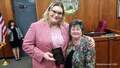
This safe and fun atmosphere has earned Nocher the iBerkshires Teacher of the Month designation. The Teacher of the Month series, in collaboration with Berkshire Community College, features distinguished teachers nominated by community members. You can nominate a teacher here
 
Nearly a dozen parents and colleagues nominated the Brayton Elementary School teacher, praising her dedication, connection to students, and engaging classroom environment — going above and beyond to foster growth in her students.
 
"My students are the most important part of the job, and instilling love and a love for learning with them is so valuable," she said. 
 
"We have these little minds that we get to mold in a safe and loving environment, and it's really special to be able to do that with them."
 
Nocher has built her classroom on the foundation of love, describing it as the umbrella for all learning. 
 
"If you have your students feel loved… in the sense that they have a love for learning, they have a love for taking risks, they have a love for themselves, and they can use that in everything that they do," she said. 
 
View Full Story

More North Adams Stories