Northern Berkshire United Way: 1950s Sees New Name, Same Mission
Northern Berkshire United Way is celebrating its 90th anniversary this year. Each month, we will take a look back at the agency's milestones over the decades. This first part looks at its successes and challenges during the war years.
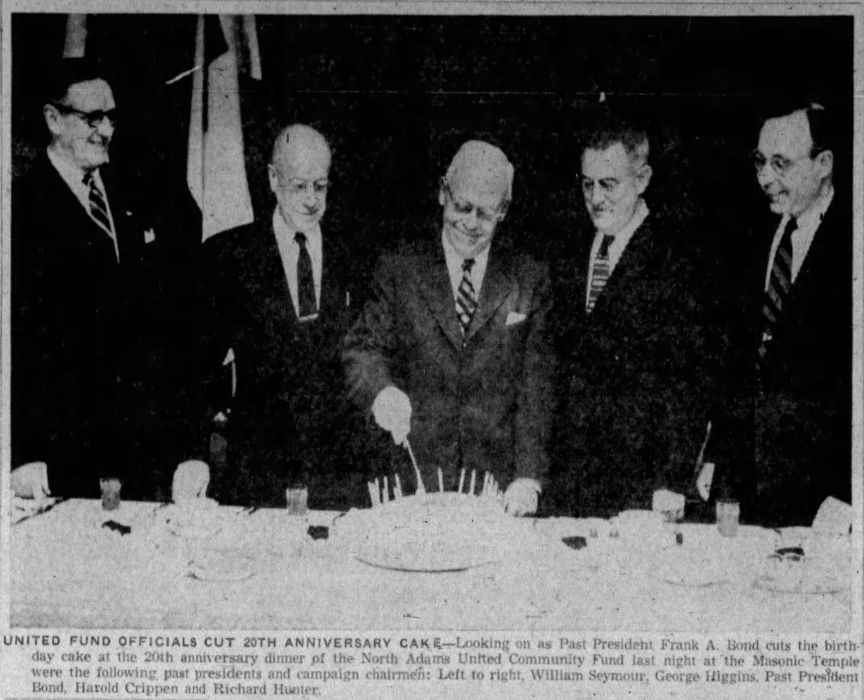
The organization had successfully grown over the past 20 years and, by the end of the decade, would see its campaign drives pass the $100,000 mark and the number of agencies under its umbrella grow to 17.
The community chest had also changed names, becoming a United Fund, a natural outgrowth of its establishment to bring multiple local social service campaigns under one umbrella, and would include both Clarksburg and Stamford, Vt.
But that impetus for its founding would continue to bedevil the United Fund as more organizations, some national, would continue to compete for local dollars.
At the beginning of the decade, Executive Secretary Estelle Howard said there were still too many independent appeals and that "serious thought must be given to this problem."
"Competition for the contributors' dollar, for volunteer workers' time and for publicity are getting out of bounds," she said.
The community chest had struggled to reach rising goals toward the end of the 1940s despite strong advertising campaigns about the benefits of its agencies within the community.
A committee was appointed to study the problem, though Howard saw the solution as the similar to that 15 years earlier — greater cooperation between campaign drives — as well a move toward payroll deductions.
That year saw the annual campaign kickoff dinner at the Richmond Hotel, with testimony from Mr. and Mrs. C. Stafford Slade of Hall's Ground, who spoke about their experience with the Berkshire School for Crippled Children for their 7-year-old daughter, who suffered from cerebral palsy.
The school was facing a deficit with rising costs but for the "assurance of its modest $1,000 from the Community Chest is the factor that can make continuation of operations certain," they said.
They were definitely assured as "happy hysteria gripped the 150 guests" at the final campaign dinner when the goal of $66,500 was exceed by more than $2,000.
"I have attended many gatherings, as you know, and some I never can forget," said Herbert Clark, described as the "dean of philanthropy." "We will stand as a beacon light among all the commuities of the old Bay State."
Two years later, Berkshire Eagle Editor Lawrence Miller advised the Community Chest on the year-old Pittsfield United Fund, created because too many drives had "made it unpleasant for Community Chest canvassers."
The community chest form was becoming obsolete, officials said, noting that the larger employers like Sprague Electric and Hunter Machine, had already signed up for payroll deductions.
On Jan 27, 1953, 110 chest representatives met at First Congregational Church to unanimously approve creating a United Fund chapter with possibly three new agencies — Red Cross, Heart and Cancer association — and boost the goal toward $100,000. Only the Red Cross joined.
"I believe very strongly that the right decision has been made and that together the United Fund and Red Cross are going to make this campaign successful," said Mrs. Ralph Dennett of the public relations committee.
Later that October, there were again cheers as the drive was topped by $631 to read $93,185, and officials hoped this would lay a firm foundation for future success. There had been some pessimism at the outset, but this was a "glowing answer to those who said it can't be done in North Adams," said Campaign Chair James Campbell.
Over the rest of the decade, the drive and the number of agencies would grow. The United Service Organization continued to be part of the drive, with officials noting some 350 North Adams men were serving overseas.
They also included Family and Children Service of Berkshire County (a merger of the Association for Family Service, the New England Home for Little Wanderers, and the Pittsfield Day Care Center); Coolidge Hill School (formerly the Crippled Children's School in Pittsfield); the Muscular Dystrophy Foundation; United Cerebral Palsy and the Arthritis & Rheumatism Foundation.
But not the American Heart Association or the American Cancer Society.
.jpg)
"In charity, as in everything else, first things must come first," the Transcript harrumphed.
United Fund, a bit more diplomatically, said it would keep an open door for national foundations.
But retiring President Richard Hunter was concerned that the United Fund's future would always be threatened by major charity drives. He, too, said North Adams charities should come first in budget planning with national organizations getting what's left over.
In 1959, the fund set a goal of $105,857, cut by $6,000 from what its agencies had requested. It came in $4,432 short of its goal but still hit a new high for the fund.
By the final years of the decade, some 250 to 300 canvassers were working over the two weeks. Record numbers of people were signing up, nearly 7,000, but the need kept growing.
The United Fund tried several novel ideas to educate on the benefits of its social service agencies. There was the tried and true of statistics, like how the Massachusetts Society for the Prevention of Cruelty to Children helped 83 children in North Berkshire, and by examples of where the money goes, showing Helan Toole, director of the Child and Family Center, counseling a young mother and her children with "advice and sympathy."
One year, "Mr. and Mrs. North Adams," five select couples, toured the the agencies to report back on their findings. Mrs. and Mrs. Richard O'Brien, for example, liked that the Salvation Army helped underprivileged children and also that "every penny was accounted for."
The United Fund had had a close relationship with Transcript since its inception but this decade found it reaching to radio. One kickoff dinner featured a "meet your community chest" radio show with Andrew S. Flagg, dean of North Adams State Teachers College as moderator. In 1954, the entire speaking portion of the opening dinner at the brand-new Fraternal Order of Eagles Hall was broadcast. It featured keynote speaker Dr. Robert Carpenter talking about the new hospital being built — and how it gets $13,000 from the United Fund.
Women had also become integral to the United Fund's success as campaign subchairs, board members and canvassers. Estelle Howard is referred to a couple times as "executive director," an editorial slip that may indicate what role she really played in the operations.
In 1957, eight women were named to the executive board of the Community Council, more than half the board's 15 members. Mary (Maurice) Spitzer presided as president, in addition to numerous other roles on social service and charity boards over the years.
Seven women were named chairs and subchairs for a late 1950s campaign, with the general chairs Catherine (Donald) Dean, Julia (Edward) Steuer and Florence (Donald) Tefft honored at its end. In keeping with the time, they were identified only by their husband's names.
Next up, the swinging '60s.
Tags: NBUW,