Williamstown CPC Sends Eight of 10 Applicants to Town Meeting
WILLIAMSTOWN, Mass. — The Community Preservation Committee on Wednesday voted to send eight of the 10 grant applications the town received for fiscal year 2027 to May's annual town meeting.
Most of those applications will be sent with the full funding sought by applicants. Two six-figure requests from municipal entities received no action from the committee, meaning the proposals will have to wait for another year if officials want to re-apply for funds generated under the Community Preservation Act.
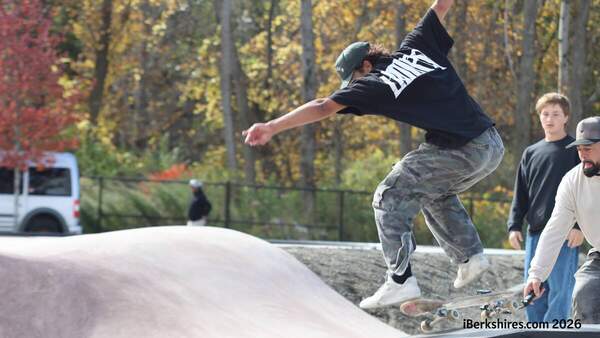
The three applications to be recommended to voters at less than full funding also included two in the six-figure range: Purple Valley Trails sought $366,911 for the completion of the new skate park on Stetson Road but was recommended at $350,000, 95 percent of its ask; the town's Affordable Housing Trust applied for $170,000 in FY27 funding, but the CPC recommended town meeting approve $145,000, about 85 percent of the request; Sand Springs Recreation Center asked for $59,500 to support several projects, but the committee voted to send its request at $20,000 to town meeting, a reduction of about two-thirds.
The two proposals that town meeting members will not see are the $250,000 sought by the town for a renovation and expansion of offerings at Broad Brook Park and the $100,000 sought by the Mount Greylock Regional School District to install bleachers and some paved paths around the recently completed athletic complex at the middle-high school.
Members of the committee said that each of those projects have merit, but the total dollar amount of applications came in well over the expected CPA funds available in the coming fiscal year for the second straight January.
Most of the discussion at Wednesday's meeting revolved around how to square that circle.
By trimming two requests in the CPA's open space and recreation category and taking some money out of the one community housing category request, the committee was able to fully fund two smaller open space and recreation projects: $7,700 to do design work for a renovated trail system at Margaret Lindley Park and $25,000 in "seed money" for a farmland protection fund administered by the town's Agricultural Commission.
As expected, all three of the applications under the act's historic preservation category were fully funded: $20,323 for work in the Images Cinema lobby; $25,000 for the restoration of buildings at Williamstown Rural Lands Foundation's Sheep Hill; and $4,000 to restore a 19th-century doctor's buggy in the Williamstown Historical Museum's collection.
The three historic preservation applications totaled just more than $49,000, well below the $62,400 set aside (10 percent of available funds) mandated for each of the three categories under the act.
All told, the CPC ended up allocating about $597,000 to FY27 projects out of the $624,000 in CPA funds the town expects to generate (through a local property tax surcharge and state matching funds) in the year that begins July 1.
The committee agreed to follow its custom by setting aside a reserve ($14,000 in FY27) in case those matching funds fall short. About $13,000 of the $624,000 will carry forward to FY28 in the historic preservation category to comply with the 10 percent set-aside rule in the act.
All eight grant requests ultimately will be decided by members at the May annual town meeting.
The Affordable Housing Trust did receive less than it asked for but was recommended by the CPC to receive more than twice the "minimum" $62,400 set aside for the community housing category.
"To me, this is one of the most important things we do, fund affordable housing," Molly Magavern told her colleagues. "It ultimately helps all these other things if we have people who can live here and send their kids to school here."
Ultimately, the CPC recommended the AHT receive $82,600 of $415,000 (20 percent) in the committee's "discretionary funds," those not claimed by one of the three categories under the act.
The largest grant recommended by the committee went to the non-profit with the largest ask. Purple Valley Trails told the committee it needed the $366,000 to combine with private donations — and previously awarded CPA money for design work — in order to complete the $750,000 skate park on town-owned land across from the youth baseball field.
As the committee began its deliberations on Wednesday, one member came out strongly for recommending the full $366,000 before carving up the remainder for other open space and recreation requests.
"I think my high bid would be to fund the skate park in its entirety," Nate Budington said. "That would mean that for the other proposals we'd encourage folks to resubmit next year.
"Here's my thinking: Ever since I've lived here, since 2000, people have been bemoaning the state of recreation. I think that was clearly addressed in the comprehensive plan. … It talked about the shortage of recreation for older kids. Once you graduated from a playground, we didn't have a lot.
"The skate park comes to us meeting the needs of the comprehensive plan. To me a side benefit is it meets the needs of older kids who are not necessarily team sports kids but they like to be active, like to build the community around skate parks."
Budington echoed some of the language from the presentation by Purple Valley Trails, which, like the other nine applicants, made their cases to the CPC in its meetings of Jan. 21 and Jan. 28.
Budington said that unlike the skate park, which is fully permitted and shovel-ready, the second-biggest grant request, $250,000 for Broad Brook Park, felt rushed.
"When the town came to us in the eligibility hearing for Broad Brook, it was for redoing the playground — a pretty simple, cut and dried project," Budington said. "It made perfect sense. It's an underutilized piece of property. We should be doing something about it. When the final proposal came in, it was completely different. It was a full-blown recreation park, the kind people have been talking about for a long time here, with pickleball and tennis and basketball and a pavilion.
"But there hadn't been any public input. It was created, at some point, between the time the eligibility proposal was delivered to us [in December] and the formal proposal was delivered to us [in January]. … The town says they did this online survey, which was put online at the time they asked for the money. And the survey is not about recreation, the survey is five questions about Broad Brook. So the assumption is, we're going to do all these things, and we're going to do them at Broad Brook."
Budington went on to argue that pickleball, in particular, can generate noise that is seen as a nuisance to neighborhoods like the one that rings Broad Brook and that this park only has six parking spaces attached to it.
Magavern later pushed back against Budington, saying if the CPC did not vote to recommend the Broad Brook Park or the Mount Greylock bleacher projects, "we're not funding the two most public projects on here."
The committee considered partially funding the Broad Brook project, perhaps to address only the out-of-date and failing playground equipment. But Peter Beck noted that the two-playground project at Williamstown Elementary School cost $1.5 million, so it was unlikely a smaller allotment to the town for Broad Brook would make much of an impact.
On the other hand, during the deliberation on Sand Springs Recreation Center, Beck pointed out that the $59,500 application spelled out three different projects each costing about $20,000 — the sum that the committee ultimately voted to send to town meeting.
As for the other project that will not be going to town meeting — the Mount Greylock Regional School application — a couple of issues were raised by the committee on Wednesday.
"During the [MGRSD] presentation, I asked about why it's not a jointly-funded project for a jointly-funded school, and the response, I believe, was, 'Because it's in Williamstown,' which I found completely … I mean, the whole school is in Williamstown," Beck said. "That [answer] is not responsive to the shared-cost agreement that we carefully worked out in a multi-town district."
It also was noted during the meeting that private fund-raising and sponsorship were among the alternative funding sources for the regional school district — not to mention its own borrowing capability.
After deciding what applications to send to the 2026 town meeting and at what level of funding, the CPC turned its attention to future years, voting 6-2 to recommend town meeting approve a 50 percent increase in the local CPA property tax surcharge.
The hike from a 2 percent surcharge to a 3 percent surcharge, in addition to raising more money locally, will make the town eligible for a dramatic increase in the state match, the committee believes.
Beck and Samantha Page voted in the minority in the 6-2 vote to send the question to town meeting in May.
Tags: CPA, historic preservation, open space, skate park, town meeting 2026,