MassWildLife: Watch for bald eagles this winter
Print Story | Email Story

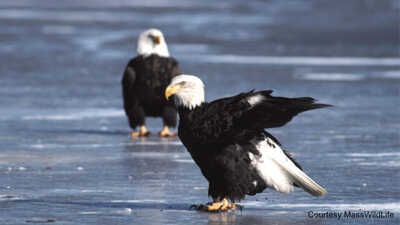
Many people are surprised to find out that winter is a prime time for birding. There are opportunities for beginner and experienced birders to spot our year-round resident birds as well as the seasonal "snowbirds" that visit Massachusetts for the winter months. Some veteran birders make an annual trek to the Massachusetts coast in winter catch a glimpse of seabirds and sea ducks. Other, more casual birders are content with the sight of back-capped chickadees, downy woodpeckers, or white-breasted nuthatches as they walk or ski along. One iconic bird—the bald eagle—is becoming easier for winter birders to spot.

Bald eagle restoration is one the best conservation success stories in Massachusetts. MassWildlife continues to document steady growth and expansion of the eagle population. That means that there may be more opportunities to see an eagle near you this winter.

Where to look for eagles in MA

Bald eagles usually live in coastal areas, estuaries, and larger inland waters. They need a lot of shoreline habitat with forested areas for nesting. They prefer areas where some trees project above the forest canopy for perching with an unimpeded view. Bald eagles typically choose waterbodies with a good supply of moderate- to large-sized fish.

Eagle-spotting tips:

  • Eagles are drawn to open waters. When lakes and ponds begin to freeze, there are fewer areas of open waters which may make eagles easier to find.
  • Eagles often gather below dams if water is being released.
  • If you see an eagle once, visit that site again. Eagles tend to return to the same section of shoreline or even the same tree throughout the season and year after year.
  • Look for large nests in big trees. Massachusetts is home to over 70 nesting pairs. If you do spot a nest, keep your distance and observe from afar.
  • If you see an eagle, watching with binoculars from inside your vehicle is a great way to observe the birds without disturbing them and you’ll stay warm.

What do eagles do in the winter?

Bald eagles become sexually mature when they are between 4–6 years old, but they may be considerably older before breeding for the first time. Courtship takes place in mid- to late winter. After courtship, a mated pair builds or adds to a large nest in December–February. The nest is built with large sticks and lined with sprigs of pine, grasses, and other soft materials. Male eagles collect the nest materials and deliver them to their mates, which are responsible for most of the actual nest construction.Once a nesting site is chosen, mated pairs usually return every year and add to the existing nest. Egg laying usually takes place from early March to early April.

If you see a bald eagle nest this winter, please report your observation to MassWildlife at mass.wildlife@mass.gov. Please include the location and date of the observation and your contact information. These observations help MassWildlife identify new nest locations and monitor our eagle population. 

Other tips for winter birding

  • Plan for the weather. Winter birding is a great activity for friends and family, but it won’t be fun for long if you're cold. Dress in layers of fleece or wool, wear warm, sturdy boots, and ensure your outer layer provides wind protection by choosing rain or wind pants and jacket. Don’t forget a scarf or face mask. Sunglasses (or clear safety glasses if it’s overcast) also provide wind protection. A few snacks and water along with coffee or hot chocolate tucked in a day pack will keep you going strong.
  • Remember birdwatching ethics. It’s critical for birders and photographers to resist the temptation to get too close. If you get too close to an animal its behavior will change; it may stop feeding, look at you, vocalize, appear nervous, or flee. If you notice a change in behavior, slowly back away. Always follow marked trails where indicated, speak quietly, and move cautiously. Use your binoculars and spotting scope rather than your feet to get "closer" to your subject.
  • Use the right equipment. Your main apparatus in birdwatching are your eyes and ears. Binoculars and simple bird identification guide are the minimal gear needed to aid your senses. A spotting scope helps when birding along the coast or in open meadows and fields but not necessary. If you are in a popular birding area, birders are generous and will often offer you a view through their scopes. It might be difficult photographing birds with a camera, but you can capture your birding buddies' excitement and the scenery.

Tags: MassWildlife,   

If you would like to contribute information on this article, contact us at info@iberkshires.com.

BRPC Exec Search Panel Picks Brennan

By Breanna SteeleiBerkshires Staff

PITTSFIELD, Mass. — The Executive Director Search Committee voted Wednesday to move both finalists to the full Berkshire Regional Planning Commission, with a recommendation that Laura Brennan was the preferred candidate. 

Brennan, BRPC's assistant director, and Jason Zogg were interviewed by the committee on Saturday.

Brennan is also the economic development program manager for the BRPC. She has been in the role since July 2023 but has been with BRPC since 2017, first serving as the senior planner of economic development. 

She earned her bachelor's degree from Franklin & Marshall College in Pennsylvania and earned a graduate-level certificate in local government leadership and management from Suffolk University.

Zogg is vice president of place and transportation for Tysons Community Alliance, a nonprofit that is committed to transforming Tysons, Va., into a more attractive urban center. 

He previously was the director of planning, design, and construction at Georgetown Heritage in Virginia, where he directed the reimagining of Georgetown's C&O Canal National Historic Park.

They each had 45 minutes to answer a series of questions on Saturday, and the search committee said they were both great candidates. Meeting virtually on Wednesday, the members discussed which they preferred.

"In my own personal opinion, I think both candidates could do the job and actually had different skills. But I do favor Laura, because she can hit the ground running and with the time we have now, I think she is very familiar with the organization and its strengths and weaknesses and where we go from here," said Malcolm Fick.

"I would concur with Malcolm, especially because she was the only candidate who could speak directly to what's currently going on in the Berkshires, and really had a handle on every aspect of what BRPC does, could use examples, and showed that she actually understood the demographic information when that information was clearly available on the BRPC website, and through other means, and she was the only candidate who was able to integrate our regional data, our regional demographics, into her answers, and so I find her more highly qualified," said Marybeth Mitts.

Brennan was able to discus the comprehensive regional strategy the BRPC has worked on for Berkshire County and said she made sure they included voices from all over the region instead of what she referred to as the "usual suspects."

"That was an enormous priority of ours to make sure that the outreach that we did and the input that we gathered was not from only the usual suspects, but community groups that were emerging in a lot of different corners of the region and with a lot of different missions of their own, and try to encompass and embrace as many voices as we could in that," Brennan said in her interview.

Member Sheila Irvin said she liked Brennan’s knowledge of Berkshires Tomorrow Inc.

"I think that her knowledge of the BTI, for example, was important, because that's going to play a role in the questioning that we did on funding. And she had some interesting insights, I think on how to use that," said Irvin. "And in addition, I just thought her style was important. 

"She didn't need to rush into an answer. She was willing to take a minute to think about how she wanted to move on and she did."

In her interview, Brennan was asked her plans to help expand funding opportunities since the financial structure is mainly grants and the government has recently been withdrawing some interest.

"With Berkshires Tomorrow already established, I would like to see us take a closer look at that and find ways to refine its statement of purpose, to develop a mission statement, to look at ways that that mechanism can help to diversify revenue," she said. "I think, that we have over the last several years, particularly with pandemic response efforts, had our movement to the potential of Berkshire's Tomorrow as a tool that we should be using more, and so I would like to see that be a big part of how we handle the volatility of government funding."

Member John Duval said she has excelled in her role over the years.

"Laura just rose above every other candidate through her preliminary interview and her final interview, she's been the assistant executive director for maybe a couple of years and definitely had that experience, and also being part of this BRPC, over several years, have seen what she's capable of doing, what she's accomplished, and embedded in meetings and settings where I've seen how she's responded to questions, presented information, and also had to deal with some tough customers sometimes when she came up to Adams," said Duval.

"She's done an excellent job, and then in the interviews she's just calm and thought through her answers and just rose above everyone else."

Buck Donovan said he respected all those who applied and said Zogg is a strong candidate.

"I think both and all candidates were very strong, two we ended up were extremely strong," he said.  "Jason, I liked his charisma and his way. I really could tell that there was some goals and targets and that's kind of my life."

The full commission will meet on Thursday, March 19, to vote on the replacement of retiring Executive Director Thomas Matuszko.

View Full Story

More Pittsfield Stories