DA's Office Clears Hinsdale Officer in Fatal Kauvil Shooting
Kauvil's family was notified of the findings prior to the press conference.
The DA's Office divided the incident into three time periods: when police arrived one hour from Kauvil's abandoned 911 calls, 17 minutes inside the residence when Kauvil spoke to an officer through a bedroom door while officers waited for an ambulance to conduct an involuntary mental health commitment, and the less than a minute long struggle after police breached the door to contain and disarm Kauvil, which included friendly fire.
According to the DA:
-
When the ambulance arrived to take Kauvil in for a Chapter 123, Section 12, or a three-day hold for psychiatric evaluation, Kauvil had a gun in his left hand, a .380 Smith and Wesson, which he maintained possession of throughout the struggle, saying "kill me" when police breached the room.
-
Sometime before the door was breached, his mother told police that Kauvil had a license to carry a firearm, but didn't believe he had one, and asked Kauvil through the door if he had a gun, to which he said "no."
-
Sgt. Dominic Crupi attempted to restrain Kauvil, getting him face down on the bed, but when officers attempted to place handcuffs on his right hand, his left hand, along with the firearm, remained under his body. During the struggle, Kauvil's gun discharged and hit Crupi through the hand, then lodged into Chief Shawn Boyne's bulletproof vest.
-
Crupi then stated, "gun, gun, gun," and Spratt discharged his weapon, accidentally striking Crupi in the elbow.
-
Kauvil continued to struggle, and Officer Chelsea Eichstedt deployed a taser twice to try to immobilize him. Boyne then said he was hit in response to the bullet hitting his vest, and Spratt fired his gun a second time, striking Kauvil in the head and ultimately leading to his death.
- This interaction was 43 seconds long.
Five officers were involved in the incident, but only the two who discharged guns and tasers were subjects of the legal determination of self-defense.
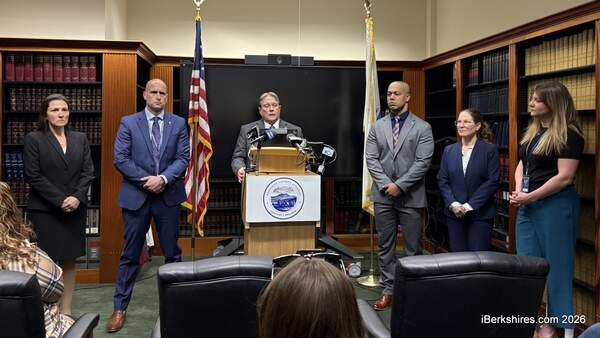
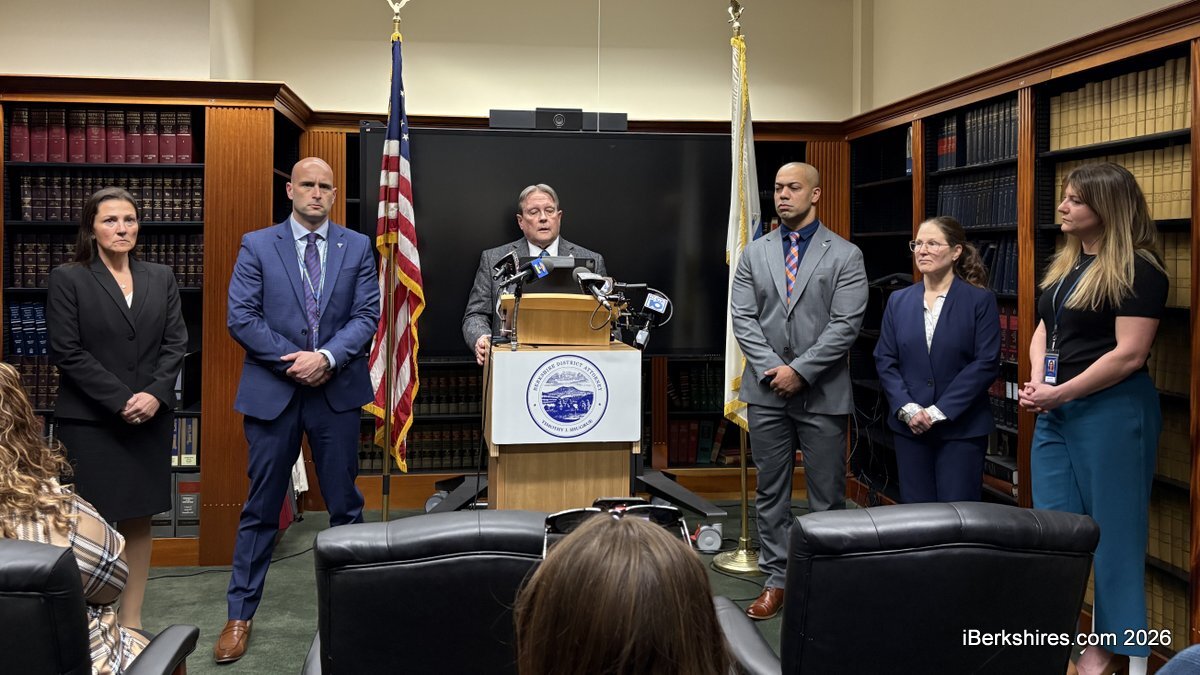
"The Berkshire District Dttorney's office finds that the first firing of Officer Spratt's service weapon was a lawful use of force as it was necessary to prevent an imminent serious or deadly harm to himself or another," Shugrue said.
"Following the first firing of his service weapon, Officer Spratt believed he heard another muffled shot, and Chief Boyne said, 'I'm hit.' The body camera footage audio only captured one muffled pop. This was later confirmed in the April 10 ballistics report. The recipient review of the ballistics report was imperative to the findings of this investigation. Officer Spratt also heard a taser deployment at this time. Mr. Kauvil continued to struggle, and officers were unable to gain control of his arms. Officer Spratt fired a second round towards Mr. Kauvil, striking Mr. Kauvil in the head."
"The Berkshire District Attorney's Office finds that the second firing of Officer Spratt's service weapon was a lawful use of force, and it was necessary to prevent an imminent series of deadly harm to himself or another. Mr. Kauvil succumbed to injuries he sustained from being struck in the head."
The DA said his office met with the Kauvil's family for more than two hours that morning, explaining the findings and going over the reports with them. They were asked if they were aware that it was Kauvil's mother's birthday.
Spokesperson Julia Sabourin said Kauvil's mother was frustrated and disappointed with the first press conference on Jan. 9. She felt it painted her son in an inaccurate light.
Sabourin noted that, in the summary of events, the DA's office has no way to determine the intent of Kauvil's firearm discharge.
"We held the press conference for transparency's sake, especially as Biagio's death followed the death of a person in Minnesota at the hands of ICE. It was not our intention to paint Biagio's character in an inaccurate light while we held the initial press conference for transparency," she said.
"I would like to apologize to Biagio's mother for how it impacted her."
Press had questions about the decision to breach the door, the lack of mental health co-responders, and the investigation's focus on events that occurred after the door was breached.
"I understand that by focusing very tightly on the narrative of what happened after the breach, this concept of dubious intent, that seems to be the crux of what's going on lawfully here," asked Josh Landes, WAMC's Berkshire Bureau chief.
"It seems to me that the obvious question is still going to be, how can you confidently talk about lawful actions after a decision was made without mental health co-responders in a very clearly telegraphed situation of someone reaching out to law enforcement for mental health support, who sat with this person for hours and isn't that decision in and of itself — that seems to threaten the credibility of the finding."
The FBI's threat operation center contacted Dalton dispatch the day before the incident to report that Kauvil was making claims that sparked mental health concerns, as they believed he was residing in that town.
Shugrue said the law deals with the two officers who use force in this situation, and that they were not involved in the decision-making process in the initial stages.
"I was concerned about it. I'm still concerned about now. I think there has to be an investigation into those policies, procedures, and what they did," he added.
The DA feels that most of the lessons can be learned from the first part of the situation, such as finding out if a person has a license to carry and/or a mental health condition before breaching the door, and having mental health supports present.
"The takedown method, I don't think, was appropriate," he said, but that is not under his office's purview.
Tags: fatal, shooting,