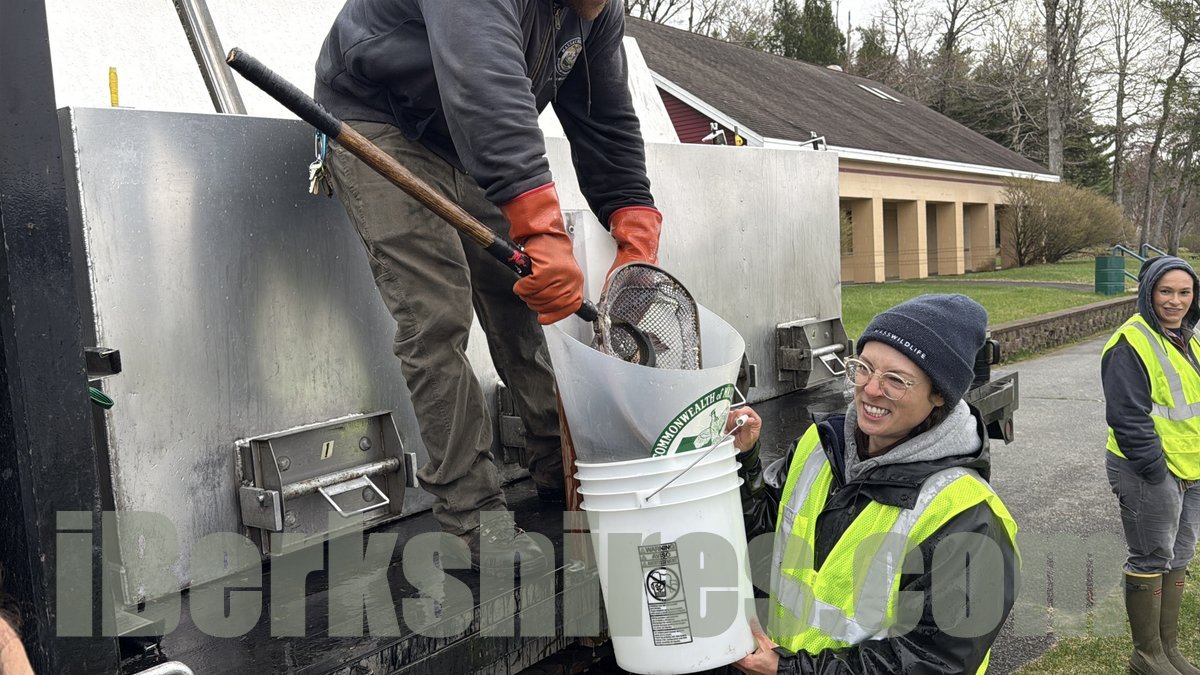
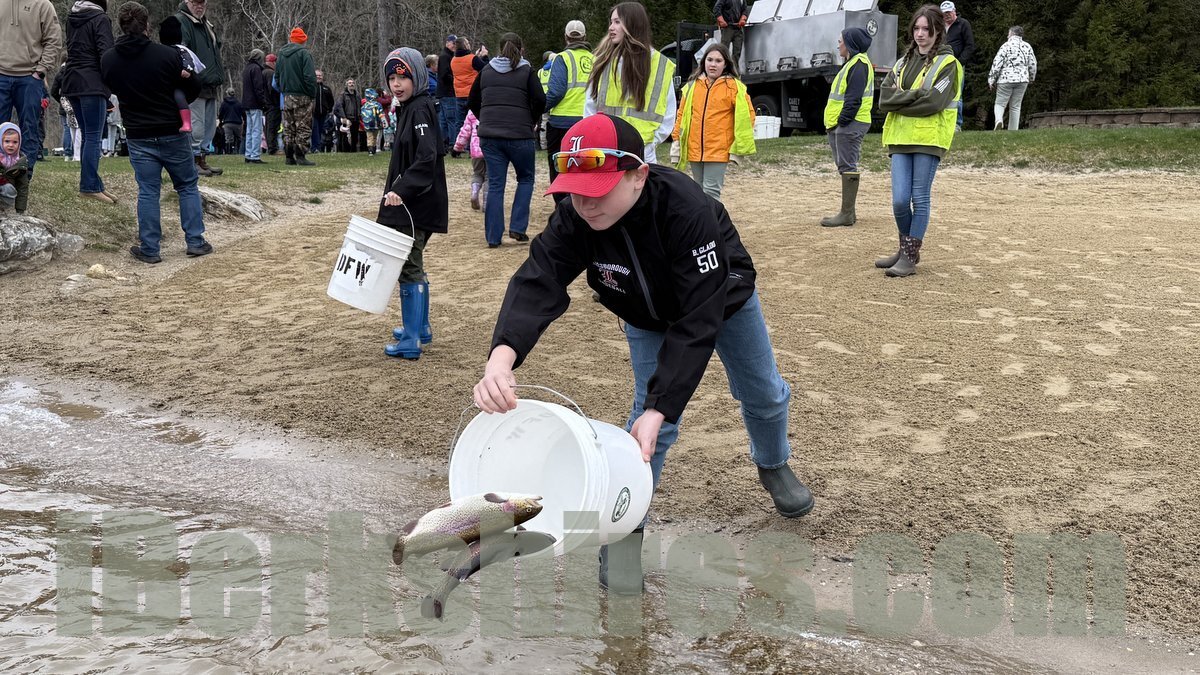


Some 800 adult rainbow trout were released in the lake for fishermen. Each spring, MassWildlife stocks 350 of the state's waterways. See more photos here.
PITTSFIELD, Mass. — Not even the cloudy, chilly weather could dampen the excitement as hundreds of people visited Onota Lake for MassWildlife's annual spring trout stocking event.
This is one of the district's most popular stocking events, as more than 150 community members release about 800 rainbow trout into the lake.
The fish, hailing from the Division of Fisheries and Wildlife's McLaughlin Hatchery in Belchertown, will provide angling opportunities.
"This lake will get a couple thousand. So, this lake being one of our deepest, largest and most popular, it does get a lot of fish throughout the season," Leanna Fontaine, an aquatic biologist for Masswildlife's Western District, said last week.
The 14-plus-inch trout are grade-eating so fishers can decide whether to catch and release or take the trout home and grill them up.
MassWildlife stocks trout twice a year: in the spring from mid- to late March through Memorial Day and for two weeks in the fall at the end of September and early October. It will stock 350 waterbodies statewide with four types of trout: brook, brown, rainbow, and tiger.
The event not only promotes fishing opportunities but also connects people with other programs MassWildlife offers for natural resource management, preservation and conservation, Fontaine said.
"This helps to get people more involved with the environment, with our resources, and also helping with some of the management, too," she said.
MassWildlife is largely funded by anglers and hunters through license sales, along with federal grants that support conservation efforts such as habitat management, rare species protection, and water quality projects.
Stocking helps attract new participants to the sport while enhancing opportunities for those already involved to enjoy available resources, Fontaine said.
Introducing the trout to the environment has little impact to the predation or natural populations that are already there, she said.
"We're not doing it as a restoration action. We're putting them in as adult fish. They're usually either fished out or will last throughout the season, and sometimes they'll make it through to the next season, but typically not," Fontaine said.
The event may inspire people to pursue careers in the field, serving as a starting point for learning more about the environment, she said.
"I have a few friends here that were in line with me, and what happened was so incredible. We really did a lot of things, and that's how it really went for us," said 9-year-old, Eleanor Pious.
Four-year-old Lilly Siegel was excited she was able to pet one of the fish before it was tossed in the water. The event gave her a glimpse into the work her father, Jacob Morris-Siegel, has been doing for 20 years in land stewardship.
Climate change is affecting natural resources through issues like droughts and wildfires, making it essential for people to stay connected to the environment and understand their impact, Fontaine said.
"It's really important for people to be connected to their landscapes and to know that their actions can have an impact on it," she said.
"As well as being able to foster future conservationists and environmentalists, to be able to come out and to see what is changing with the landscape, and to give some more attention to it, and to know that they can actually make a difference.
"It's such a technologically driven age where everybody is on a phone– we tend to forget what's going on around us and noticing life around us and nature around us, so it kind of helps to shift that focus a little bit."
The trout are raised in concrete raceways and have never experienced open water, so tossing them in triggers a harmless stimulus response that wakes them up and encourages them to move freely and adapt to their new environment, she said.
If you would like to contribute information on this article, contact us at info@iberkshires.com.
Your Comments
iBerkshires.com welcomes critical, respectful dialogue. Name-calling, personal attacks, libel, slander or foul language is not allowed. All comments are reviewed before posting and will be deleted or edited as necessary.
No Comments
Dalton Planners Hold Public Hearing on Tiny Homes Bylaw
By Breanna SteeleiBerkshires Staff
DALTON, Mass. — The Planning Board held a public hearing last week on a bylaw for mobile accessory dwelling units (ADU) that will be brought before a special town meeting.
For nearly two years, Amy Turnbull has been trying to amend the current ADU bylaws to allow mobile tiny homes.
A movable tiny home is defined as a unit under 400 square feet that meets all of someone's daily needs, including sanitation, cooking, and other facilities, and which is also mobile. Most homes considered "tiny" are built on a trailer so they can be towed.
Her proposal defines a movable tiny house as a "residential property with an existing primary house, intended for year-round living," and outlines eight conditions for approval.
Among these conditions: the unit must adhere to accessory dwelling unit regulations, undergo site plan review, be licensed and registered with the state Registry of Motor Vehicles, have approved energy, water, and wastewater systems, and comply with American National Standards Institute 119.5 and National Fire Protection Association 1192 safety requirements.
Additionally, the unit must be certified for ANSI or NFPA compliance by a manufacturer or third-party inspector, including adherence to Appendix Q and the International Residential Code's structural guidelines and energy efficiency standards. The tiny house cannot move under its own power, and its undercarriage, wheels, axles, tongue, and hitch must be concealed from view. Wheels and leveling or support jacks are required to rest on a level gravel or paved surface.
Turnbull has gotten enough signatures for her petition to amend the current bylaws to add her definition of the mobile ADUs. Last Wednesday, the board held a public hearing on the petitions, which will be voted on at a special meeting.
Turnbull says she has two reasons for wanting to add this to the town's bylaws: aging in place and affordable housing.
"We need a variety of housing types in Dalton, and that we also need to address the idea that you know nearly 30 percent of our population by 2035 is going to be over 65 years old, and it's problematic because ... there's not enough choice for these people to to age in place,"she said. "What movable tiny houses does, is it provides a less restrictive ADU. It's much cheaper to place, and it's easier to place, less time consuming. And what it offers to people is it offers people who are owners a place for their children to come and live, or a caregiver to come and live, or for the people who own their own house to come and live while they rent out their maybe their three bedroom home to a new family who wants to attend to Craneville simultaneously."
She said people need to move away from calling and treating the tiny homes as though they are trailers, as one former Planning Board member has voiced opinions on.
"That is an opinion, and I think we need to get over that, because I want to say that these are foundation homes, and that the chassis is a foundation, and it's a stick-built home on a chassis, and in very many ways it's like a modular house. I think we will not be surprised in the next 10 years if we see the market turn around and start to make smaller, tiny modular homes, but that is not the case right now, and we have a dire need for affordable housing," she said.
At a former Fire District meeting the Water Department drafted regulations for water hook-ups for these types of homes. The superintendent sent a letter to the Planning Board to be read at the meeting stating it will not be a hindrance for sewer system connection.
"The Department of Public Works does not feel that mobile ADUs will be an issue with the town sewer system. The homeowners will be responsible for any issues outside of the sewer main and connect and responsible for connecting in, so that would address any permits, fees, or anything like that would be added to that," the letter states.
"The Water Department, as we've stated previous, and as you stated, the water department has come up with their own set of SOPs, standard operating procedures, for hooking up a an adu and a mobile adu, which will then have to meet winterization and all those, but they've laid out a plan for that, that they have, so I'd like to point that out," board Chair Robert Collins said.
One concern was raised that if someone can have a mobile ADU could they also have another tiny home on their property, including the main house. That situation is not likely, said Turnbull, as it would cost a considerable amount of money. Town Manager Eric Anderson also stated that in his former community when they adopted similar laws their first one wasn’t put in until a couple years later and then maybe one a year.
The Nonprofit Center of the Berkshires held its ninth annual nonprofit awards last week honoring the contributions of those who have helped the community in their own way. click for more
Jason Codey struck out 13, walked two and allowed just an infield single as the Generals earned a 7-1 win over Wahconah to claim their third straight regional title. click for more
Gracelyn Wright struck out eight, and Genevieve Lagess went 3-for-5 with four runs batted in as the Hurricanes beat Monson, 17-3, to claim their first Western Mass title in four years. click for more