Norman Rockwell Museum Appoints Director and CEO
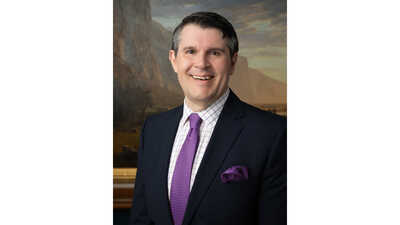 |
STOCKBRIDGE, Mass.—The Board of Trustees of the Norman Rockwell Museum (NRM) announced the appointment of Graham C. Boettcher, Ph.D., as the Museum's new Director and CEO.
Boettcher joins NRM at a moment when it is embarking on its next chapter of strategic growth, capital improvements, and expanded national and international influence.
Boettcher comes to the Museum following a 20-year tenure at the Birmingham Museum of Art (BMA), where he has served as the R. Hugh Daniel Director and CEO since 2017. Under his leadership, the BMA experienced sustained institutional growth, including the endowment of key positions, the gift of major new collections, and national recognition for innovative exhibitions, digital initiatives, and community-centered programming.
Boettcher succeeds NRM Director and CEO Laurie Norton Moffatt, who is retiring this summer. Under her leadership of over 40 years, Norman Rockwell Museum has grown into a nationally recognized center for American illustration—expanding its collections, preserving Norman Rockwell's archive and studio, and advancing scholarship, traveling exhibitions, and engagement with the nation's top illustrators and millions of visitors.
"We are excited to welcome Graham Boettcher to lead the Norman Rockwell Museum," said Dolf Berle, Chair and President of the Board of Trustees. "After conducting a nationwide search for a leader who possesses both the scholarly as well as executive qualities needed to grow our mission, we were delighted to find Graham."
Boettcher's appointment reflects the Museum's commitment to its mission as a leading center for American illustration that advances the values of kindness, respect, and social equity Norman Rockwell portrayed, stated a press release.
A Yale-educated art historian, Boettcher has dedicated much of his career to exploring how visual storytelling shapes civic values and American identity. His specific expertise in the work of Norman Rockwell is well-established; in 2012, he curated the Birmingham presentation of Norman Rockwell's America and organized the concurrent exhibitions "Norman Rockwell and Coca-Cola: Two American Classics" and "The Golden Age: American Illustration from the Collection of the BMA."
"Illustration is 'the people's art,' providing a critical lens through which we might better understand our nation's ideals, aspirations, and contradictions," said Boettcher. "As an artist responding to a period of rapid social, political, and technological change, Rockwell's work is more relevant than ever."
At the Birmingham Museum of Art, Boettcher was recognized for his open leadership style, successively navigating complex municipal systems while prioritizing the museum's financial stability and long-term sustainability. He also championed accessibility, transparency, and inclusivity, helping to position the BMA as a national model for community-centered programming and collections that broaden the art-historical canon, according to a press release.
Additionally, Boettcher's experience in capital planning and facilities management—including securing significant funding for deferred maintenance and accessibility improvements—will be valuable as the Norman Rockwell Museum advances its goals for campus enhancements and continued international growth.
Boettcher earned his Ph.D. and M.Phil. in the History of Art from Yale University, where his research focused on the politics of family and nation in antebellum American art. He also holds an M.A. from the University of Washington and a B.A. from Yale. An active member of the Association of Art Museum Directors (AAMD), he has served on numerous national committees and boards, reinforcing his reputation as a trusted and respected voice in the global museum community.
"Norman Rockwell Museum occupies a singular place in the American landscape," Boettcher noted. "With its rich and iconic collections, the Museum is uniquely positioned to play a significant role in fostering civic dialogue on a national level, and I'm excited to join in that important work."
Boettcher will officially assume his role on August 31. Having spent 11 years in New England, Boettcher added that he is looking forward to returning to the region, noting, "The Berkshires' extraordinary concentration of arts institutions provides a space rife with possibilities for unique and meaningful collaborations."