Williamstown Select Board Evaluates Town Manager
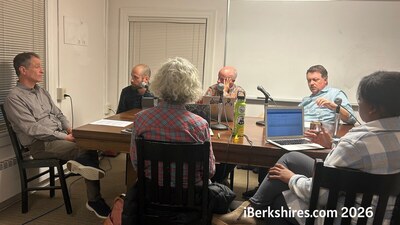 |
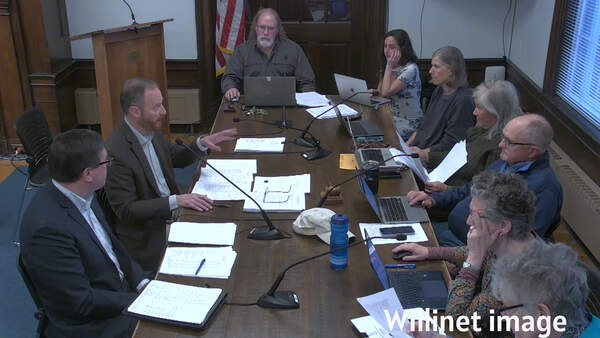
| The Williamstown Select Board meets with Town Manager Robert Menicocci, left, for his evaluation in a third-floor conference room at town hall. |
WILLIAMSTOWN, Mass. — In 2022, the town still was recovering from the twin blows of a global pandemic and a lawsuit that exposed disturbing allegations against the town's police department.
The latter ultimately led to the resignation of the police chief and the town manager. To replace the manager, the Select Board at the time turned to Robert Menicocci.
Menicocci represented a break in style from his immediate predecessor, who was a more prominent voice in town government. That prominence, in part, was a product of the times: When town boards and committees were not meeting in-person and access to town hall itself was limited at the height of the pandemic, the manager's voice in Zoom meetings was more front and center.
In his four years in the corner office, Menicocci has helped shepherd the police department on its path to certification and helped the town weather the fiscal storm of skyrocketing costs linked to inflation – particularly sharp increases in the cost of health insurance that hit hard for a labor-intensive endeavor like municipal government. All the while, he has been a little more taciturn, while always willing to participate, when appropriate, with responsive answers in discussions of the Select Board and Finance Committee.
On Monday, the current Select Board – completely turned over from the 2022 edition – pushed Menicocci to be more of a cheerleader for the town.
"Do you see your role more as a behind-the-scenes guy and our role is to be out in public?" board member Matthew Neely asked Menicocci during the board's review of the manager's job performance. "Or is there more of a role for you in that? So many people, if I say your name, they're like, ‘Who?'
"I would have assumed your role would be more public facing as well, and more, for lack of a better word, leading the charge as opposed to running day-to-day operations. I feel you're strong running day-to-day. But something we all wish is we had a little more of a proactive [manager] …. Since we need development, need all these things in town so much. … I'd love to see more outward energy, I guess.
"But maybe that's not how you see the role."
It is not how the town charter sees the role, either.
The charter spends two and a half pages laying out the duties of the town manager. It talks about the manager's role in hiring and firing town employees, maintaining town records, preparing the town budget and presenting it to the Finance Committee each year, appointing members of certain town committees and, "other duties consistent with the town manager's office, as may be required of the town manager by the bylaws or by vote of the select board." It does not mention the term "public relations."
Menicocci said he sees the town manager's remit as a little different than that of an elected official, like a Select Board member.
"A mayor [in a city] is an elected position," Menicocci replied to Neely. "Towns chose to have paid professional staff handle the professional aspects of running a place.
"A manager runs operations and has to be responsible for a significant amount of decision-making. The nuance of what you do in public … to be successful, you have to know what's going on and have to be connected to the public. We do some of that [in town government] with our communications. My approach is maybe a little different. I'm not going to be the politician who is gathering people to garner votes."
Back in 2022, Menicocci, a longtime bureaucrat, was chosen by the Select Board over another finalist whose resume included being elected mayor of a town of 17,000 in northern New Jersey.
A year after skipping the annual evaluation, the Select Board completed its review of Menicocci on Monday in a special meeting held on the third floor of town hall after the panel's regular twice-monthly meeting in the first floor meeting room.
Generally, the board gave Menicocci high marks, both in person and on a rating scale completed before the meeting.
Two areas on the evaluation rubric with the lowest scores relative to the rest of Menicocci's report card were "public representation" (3.0 average score on a scale of 1 to 5) and "public information" (2.7). Both were identified as "growth opportunities" on the evaluation scoresheet the board agreed to put in Menicocci's personnel file.
To reiterate, while other items on the rubric (budget preparation, departmental oversight, personnel and labor) directly refer to elements of the town manager's duties outlined in the town charter, the charter makes no reference to either "public representation" or "public information."
Monday's discussion of Menicocci's PR skills led to a more general conversation about the need for economic development in town and how a louder megaphone from town hall can help in that effort.
Neely at one point said town government needs to present a positive face to potential investors, sending the message that "we're open for business."
Menicocci took credit for working with Finance Director David Fierro Jr. to spread the message that the town is eroding its excess levy capacity, raising the spectre of a proposition 2-½ override vote in the foreseeable future if current trends – including stagnant growth in the tax base – continue.
He talked about how he is working – behind the scenes – to increase the tax base by focusing on efforts to optimize existing commercial property. And Menicocci pointed to a development that came to light in the Select Board's 7 p.m. meeting earlier Monday evening.
During that meeting, the board approved a change of manager application for the 6 House Pub on Cold Spring Road, whose new owners, through their attorney, told the board they plan to make it part of a "premier flagship hospitality and restaurant destination" along with the adjacent 1896 House Inn.
"My approach, I think, is not loud in the sense of doing stuff," Menicocci said. "For example, the 6 House tonight, along with the Orchards and Stay Berkshires – three properties that were way underutilized. We did a lot of work, quietly, to achieve some of the things we need to do. There's some argument to be made for an approach that's quiet, nuanced, taking advantage of leverage we have – which isn't much – to move those properties along.
"In each case, we're working with property owners who weren't optimizing."
During the third-floor session, Stephanie Boyd called out one of the highest scores Menicocci received in the written evaluation, an average of 4.3 (on the 1-5 scale) for, "Promot[ing] an equitable, inclusive, professional, and safe workplace." And Boyd said that perhaps the board can play a role in ensuring the town manager has a platform to promote the town at its meetings.
"I do think the staff across town hall and the DPW feels good working under your leadership," Boyd said. "I want to commend you on that.
"I feel badly that whenever we have a board meeting and it goes late, we say, ‘Never mind the town manager's report.' Maybe we need to have a more formal, quarterly report. We have to have those celebratory things we were talking about."
Tags: town manager,