More Than Memorizing: How Pine Cobble School is Redefining Literacy and Math Instruction
 |
When parents evaluate their children's early school years, a central question often emerges: how do we cultivate a genuine love of learning?
At Pine Cobble School, which serves students from age 2.5 through Grade 8 on its 18+-acre campus in Williamstown, the answer lies in an intentional, research-backed approach to foundational academics.
Literacy: Diagnostic, Multisensory, and Collaborative
The Pine Cobble literacy curriculum recognizes that every child learns differently. Literacy at Pine Cobble is guided by the science of learning research and enhanced by the expertise of Reading Specialist Kristine McGrath, who has taught at Pine Cobble for more than 25 years. This year, McGrath has integrated the Orton-Gillingham (OG) approach into the literacy program in Grades 1-4. Developed from the foundational work of neuropsychiatrist Dr. Samuel T. Orton and educator Anna Gillingham, the OG approach is a direct, explicit, and sequential way to teach literacy that is rooted in cognitive science.
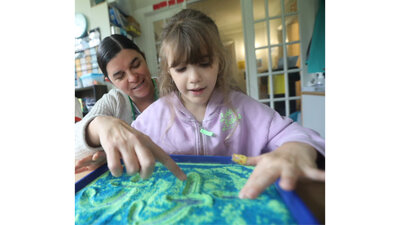
McGrath, who is certified as an OG Associate Level Practitioner, worked closely with Head of School Dr. Jill Romans (a clinical neuropsychologist with an extensive background in educational pedagogy) to reimagine how the Lower School literacy curriculum addresses the learning styles of all students. Their collaboration led to the new “push-in” model for literacy instruction, in which McGrath goes into each homeroom in Grades 1-4 to work with a cohort of learners who benefit from OG instruction. She partners with homeroom teachers to assess student progress in reading, identify cohorts for instruction, and deliver the personalized approach within the homeroom. Her work is heavily individualized and multisensory; McGrath's students engage their senses by tracing letters in sand trays, tapping out sounds, and reading stories custom-tailored to their exact skill levels.
"What I love most about Orton-Gillingham is that it is diagnostic and prescriptive," McGrath said. "You look carefully at the child in front of you, identify the strengths and gaps, and design instruction around their specific needs. It allows me to truly teach the child rather than simply teach a lesson."
This approach builds a strong foundation for fluent readers while transforming the experience for students who encounter challenges along the way. "When a student who once struggled begins to say, 'I can read this,' it changes how they approach challenges throughout their life," McGrath said. "We are helping children experience themselves as capable, joyful learners."
Mathematics: "Rigor for All" Through Collaborative Inquiry
In parallel with its approach to literacy, Pine Cobble's quantitative curriculum centers on building genuine mathematical reasoning. Now in its fourth year of implementing the Illustrative Mathematics (IM) curriculum—one of the nation's highest-rated problem-based K-12 math programs—Pine Cobble's approach to math prioritizes conceptual understanding over memorization.
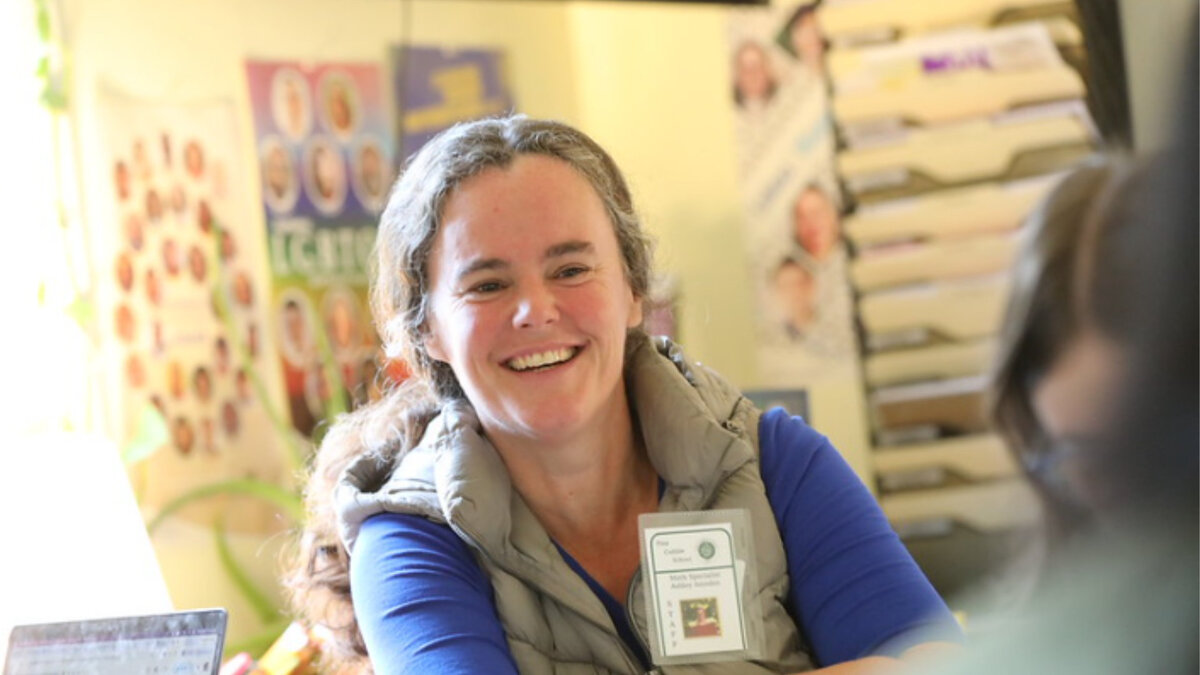
Middle School teacher and Math Specialist Ashley Amsden, who has taught at Pine Cobble for 8 years, is a huge proponent of the IM approach. This past summer, Amsden took advantage of Pine Cobble's new Cluett Innovation Grant program (a donor-funded professional development initiative) to further adapt the IM materials to fit Pine Cobble's schedule and incorporate a workshop-style structure.
Amsden's approach is rooted in a "Rigor for All” philosophy of learning: "Our goal is to cultivate lifelong mathematical thinkers, not just fact-memorizers and procedure-followers," says Amsden. "Every child is capable of engaging with challenging math concepts when given the right entry points, tools, and support.”
Tasks in the IM curriculum are expertly scaffolded with a "low floor and a high ceiling," according to Amsden. This allows every student to approach mathematical reasoning using concrete strategies—such as tape diagrams, visual models, or hands-on tools—while giving advanced learners ample space to explore more sophisticated problems.
"When students realize that math is about making sense of ideas and learning through doing, their confidence skyrockets," Amsden notes. "Visual thinking strategies and hands-on tools aren't just for students who need extra support—they help all of our students think more deeply and make stronger connections."
This conceptual strength lays the groundwork for a high academic trajectory. The Lower and Middle School math curriculum is carefully constructed so that every Pine Cobble student has the opportunity to complete Algebra 1 in Grade 8, paving the way for advanced coursework, including Calculus, in high school. For students ready for further acceleration, advanced offerings such as 8th-grade Geometry are built directly into the program.
A Foundation for Life
By pairing diagnostic, multisensory literacy with inquiry-based, collaborative mathematics, Pine Cobble honors how children naturally learn and grow. Supported by extraordinarily low 4:1 student-to-faculty ratios, Pine Cobble's master educators know every child deeply—by name, by strength, and by story.
To learn more about Pine Cobble School's academic programs, tour the campus, or inquire about admission for Beginners (age 2.5) through Grade 8, visit www.pinecobble.org or contact Associate Director of Admission Sue Gundrum at (413) 458-4680.