The Everett Mansion, built almost a century ago to resemble a feudal castle, has served over time as a summer home, a novitiate and a property of Southern Vermont College. Several years ago, in an effort to preserve this Bennington landmark, the college launched a long-term Mansion Restoration Project.
To date, a cascade waterfall and portions of the mansion’s roof have been restored. Now, through a $5,000 award from the Preservation Trust of Vermont, Everett Mansion moves into Phase II, aimed at addressing the terrace and windows. A brochure explaining the Mansion Restoration Project will also be produced.
Raising public awareness about Everett Mansion is important; it’s a “personal building for the community,†said Director of Development P.J. Van Houten. In 1911 when ‘bottle barren’ Edward H. Everett started construction of the estate — it took four years to build and cost more than $2 million — he employed Italian, as well as local, stone masons. Bennington remains the home of families whose ancestors built the mansion, said Van Houten. She noted that many people recall spending time as children on the beautiful property.
In the spring of 1994, restoration of the 371-acre Everett Estate — and the mansion in particular — began. The first significant project began in 1996, when a $15,000 award from the Preservation Trust of Vermont allowed for restoration of areas of the cascade waterfall.
The direction of this work grew from a 1998 diagnostic report by Keefe Wesner Architects, explained Van Houten. In areas of the mansion the stone and mortar “is not holding up to the harsh Vermont weather,†she explained. The report described where leaking and cracks occurred and ranked stabilization needs based on high, medium and low priority — corresponding with the project’s three phases.
Along with providing the college with a restoration plan, the report allowed for application to the national registry. Southern Vermont College — “The Orchards†— was placed on National Register of Historic Places on April 24, 2000. In Everett’s day, the mansion was known as “The Orchard House,†surrounded as it was by 75,000 apple, 3,000 plum, and 2,000 quince trees.
Based on the report, Phase I also included the stabilization of the porte-cochere, a stone covered entranceway. Doxsee Roofing worked with Southern Vermont College to restore approximately 300 linear feet of the 721 linear feet of roof. Deteriorated tiles from the roof were removed and reinstalled, as was a 6’ bithuthene ice and water shield and a new copper gutter system. The deck sheathing and elements of the roof system were repaired, and custom mill work and fabrication of the wooden roof brackets was performed.
The work of Phase I was accomplished primarily through state funding and private donations, said Van Houten. The college received two significant grant-in-aids in September of 2001 and February of 2002 for $10,000 and $15,000, respectively, from the State of Vermont Division for Historic Preservation. The latter was also supported by the Vermont Advisory Council on Historic Preservation and, in November of 2001, the Vermont Legislature allocated $40,000 to fund work in the Courtyard phase of the project.
Another fundraising vehicle for the Mansion Restoration Project is the October Soiree, she said. This year 300 people attended the increasingly popular function, raising $15,000 for the project.
With the December award from the Preservation Trust of Vermont through the Preservation Trust of Bennington County Fund, the college is planning for Phase II. The grant supports an assessment by the Vermont-based Breadloaf Corporation of the terrace and window restoration. By testing patches for terrace repair and producing a report, Breadloaf will provide the college with “solid figures†for next steps, said Van Houten. The report will be completed in spring ‘03 and work on the approximately 6,000 square foot deck should be finished by early next year.
To keep the community informed about the Mansion Restoration Project, a brochure will be produced through this grant. A section of the college’s web site describes the project as well.
Future plans include the installation of high-quality, energy efficient, insulated storm windows/doors for 140 openings and the repair and repointing of the chimneys. In Phase III the college will also rebuild the deck and ceiling structure of the stone entranceway, and work on waterproofing, drainage, and stucco paint surfaces.
In 1911 Edward H. Everett commissioned architect George Totten to design the mansion in the style of 14th century English and Norman castles. Everett made the mansion his summer home until his death in 1929. A little more than 20 years later his wife Grace sold the estate to the Order of the Holy Cross to use as a novitiate. Holy Cross exchanged properties with the Sisters of St. Joseph in 1974; later that same year St. Joseph College became Southern Vermont College, an educational institution without religious affiliation.
For more information about the Mansion Restoration Project, contact Van Houten at (802) 447-6327 or development@svc.edu or visit the college’s web site at www.svc.edu.
If you would like to contribute information on this article, contact us at info@iberkshires.com.
Your Comments
iBerkshires.com welcomes critical, respectful dialogue. Name-calling, personal attacks, libel, slander or foul language is not allowed. All comments are reviewed before posting and will be deleted or edited as necessary.
No Comments
Companion Corner: Weber at No Paws Left Behind
By Breanna SteeleiBerkshires Staff
NORTH ADAMS, Mass. — There's a young cat waiting for a family to play with him.
iBerkshire's Companion Corner is a weekly series spotlighting an animal in our local shelters that is ready to find a home.
Weber is a 10-month-old domestic shorthair. He has been at No Paws Left Behind since November.
Volunteer Claire Morin introduced us to him.
"He came in with an abundance of cats that were in a crowded situation in the home," she said. "Most of his brothers and sisters are gone, but Weber is still here."
Weber loves the attention and if you aren't giving him enough he will let you know.
"Weber is very, very sweet. As you can see, he's very needy for attention. He loves his treats, and he can get a little overstimulated. He's very attention seeking. And if you don't give him attention right away, he nips at you a little bit, not a bite, more like a tender here I am — pay attention to me," Morin said. "But he's very engaging, and he's a very, very sweet boy."
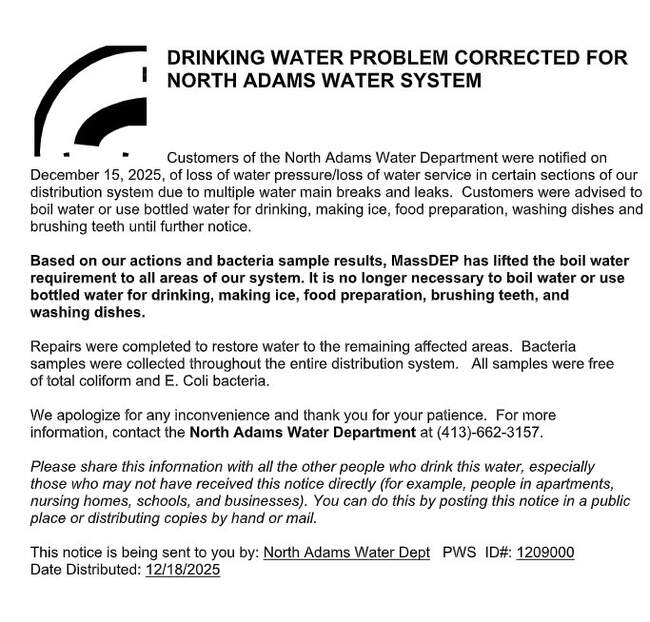
The city has lifted a boil water order — with several exceptions — that was issued late Monday morning following several water line breaks over the weekend. click for more