Polly Ogle’s Ash and Reed Baskets

Print Story | Email Story
When Polly Ogle prepares to work on a black ash basket, she picks up a two-man cross cut saw. Basket weaving is a dying art, she said, because there is so much physical labor involved. Ogle tracks down ash stands in Berkshire swamps and sparingly cuts the trees that will become her baskets. She weaves reed baskets as well, from imported Chinese palm, for the craft fairs. But there are not many people left, she said, who still make ash strips from scratch and weave ash baskets as the Mohawks, and after them the Shakers did. Ash grow in North Eastern swamps, no farther west than Michigan or south than Pennsylvania. They are getting harder to find, she said; they have suffered a blight, beavers have flooded swamps, and people who own swamp land do not always know what they have. Ogle never cuts a tree unless she can find a stand of healthy trees nearby. And she has taught herself to recognize trees that will make good baskets. Bob Coker, her mentor and a native of Michigan, spent a day giving her pointers. She can read bark, she said. "You look at the buds. they can tell you how a tree has grown. You look at how much sun hits it. In an open swamp, the tree grows too slowly. It has too many knots, and the growth rings are too thin." It is hard to find a good tree, she said; she does not recommend that people simply cut them down. Ogle has to keep the ash logs wet, once she cuts them. She floats them in the quarry lake out back, and takes a canoe out to haul them in, when she needs them. She pointed out a cathook among her tools, used to turn heavy logs, and a peavy, hooks swinging on a long pole, used to carry them. She quarters the logs and saws them into billets, rectangles about an inch square. These she soaks and pounds with a mallet. She said in Chatham NY, at the Chatham Sheepherders, they demonstrate the real pounding with root balls, as local Native Americans would have done it, and make big baskets that last 200 years. When she pounds the wet wood, the growth rings naturally separate into long, flexible rectangular strips of wood. With a froe, a flat spatula-like blade and perpendicular handle, she controls the way the strips split, and keeps them even. Once the growth rings separate, Ogle uses a Shaker tool, a split planer, to split them half again as thin. This exposes the satin inside. She lets these strips dry and hangs them, in coils, from her livingroom ceiling, until she is ready for them. Before she weaves with them, she soaks them again. In summer, she said, she takes ash strips out back to the boat dock to weave, and floats them in the lake. Basket weaving is a messy job, she said. She gets wet, and covered with wood chips. It has gotten a bad name for being easy. It is not as easy as it looks. Ogle makes her own handles as well. She shapes ash or hickory rods on a shaving horse Coker made for her: a seat with a clamp kept closed by a foot peddle. Then she steams them and bends them over a frame. She demonstrated using a draw knife, a blade with handles at each end, to square the handle, or a spokeshave to round it. Spokeshaves got their name from the wheel spokes they shaped. Ogle has collected her tools gradually, from antique stores and friends. Her piano tuner, she said, gave her the cross cut saw. Ogle's fascination with baskets began with a basket kit that her son abandoned. She made the basket. She has taken one class since, she said. The rest she owes to Coker, experience, and research. She has seen the Shaker collections at the Albany Museum and Canterbury. She has worked at Hancock Shaker Village, and given workshops there. And she has been to New Lebanon, the king of the Shaker basket industry, that turned out 34,000 baskets a year at its peak. John McGuire and Martha Whetherby, she adds, have written good books on Shaker baskets. Recently, she has been studying Native American basketry and the tribal signs found Native Americans painted on their baskets. They chewed the ends of twigs for brushes. "Some of the signs are flat out ornamental," she said; some are symbolic. They chase each other around the baskets in chain designs, or come in medallions, in diamond shaped patterns of four. Ogle uses powdered pigment paints, kinds the local Mohawk and Stockbridge people would have used. They are natural dyes, but very colorful, she said; she still wants to know how the Mohawk mixed their traditional bright pink. Native Americans used more variation in their weaving than the Shakers. They wove darker and lighter strips of bark together and experimented with shapes. The Taconic basket weavers in later history became known for similar baskets, weaving oak with the ash and shearing off the basket rims. The Berkshires also produced Higgins baskets of white ash, and tens of thousands of Shaker baskets. Basket weaving lends itself to great variety, and Ogle's living room offers a range of samples. Among the local fare are a few southern baskets: a heavy oak frame for drying tobacco, and small round baskets with looped patterns, called coiling, made of sweet grass and yucca. Ogle described other weaves aside from the over and under plaiting: twill, a flat plaiting, and wicker, which is a round material and a different technique. She turned several baskets over to show the beginning weaves at the base. She had square, baskets with open weaves, baskets woven over two under two, round baskets with the vertical reeds raying out from the center, and an egg basket with a God's-eye, a diamond weave securing the handle at both sides. Handles add to the variations. Swing handles rotate from wooden joints where they meet the rim. Ear handles stick up in loops. Leather handles weave in among the ash strips. And there are many techniques, Ogle said, she has never tried, like Tennessee handles that go around the whole basket. "If you go out in the woods, anything flexible you see you can make a basket out of," Ogle said. Basketry does not have to involve tools and long processes. Ogle has made rustic baskets from birch bark from fallen trees, or the bast, the inner bark, of elm or cedar. Elm bast is like leather, she said. Grapevine or honeysuckle make handles. These baskets do not wear as well as ash. But Ogle said modern machine-made baskets use oak, and turn the wood by machine. They plane the wood across the end grain instead of following it, the way the hand process does, so the baskets are more brittle. Shakers made their baskets by mass production too, but they believed in quality. Along with Ogle's tools, they used water-powered trip hammers to pound the logs. They also believed in division of labor: the brothers cut the trees, pounded them, and processed the strips. The sisters did the weaving. The shakers wove baskets over wooden molds, to ensure that they all came out the same size and shape. They wrote up a memorandum of baskets detailing their standards. They wove black ash only, with flattened bonnet handles, with a double notch holding the half-round basket rim. They did allow themselves artistic freedom when it came to sizes, though. Shaker baskets range from fist sized to table sized. They wove brick-sized squared off knife baskets and rounded spoon baskets. They made fancy baskets with double satin ash strips and a very delicate weave over narrow bands. They wove lids for these. They were famous for their cathead baskets, named for their pointed bases, like cat's ears. They wove garden baskets, bushel baskets, laundry baskets, and large open cheese baskets with a loose hexagonal weave, like so many Stars of David. These baskets they lined with cheesecloth and used to drain the cheese curds. Ogle does not weave many large ash baskets, because ash is so scarce. She does have enough ash on hand from her last tree to finish a hundred small ones. She has woven large reed baskets for Hancock Shaker Village. She reinforced the bottoms of these baskets with ash runners. The farmers drag one of these baskets behind their wagons, and it has lasted for five years already. By 1890, ash became scarce in Shaker communities. So did Shaker brothers, to do the heavy work of chopping and hauling trees. The sisters began to weave with imported reed. Between the scarcity of material and the work involved, Ogle's ash baskets are fairly expensive. So for local craft fairs, she also weaves reed baskets. She paints them, or weaves in colored bands. She even weaves basket backpacks. Ogle designs her own baskets; people can tell her what kind of basket they want, where they will use it and how, and she can invent one for them, she said. She repairs baskets. And she gives workshops. People will sometimes get a group together and ask Ogle to teach them. "They bring the cookies," she said; "We have a party, really, and make baskets." Among the Shakers, she added, basketry and music often went together; basket weavers were often song writers. Ogle also plays violin, and pounding ash logs can be tough on the hands. She gets pounding parties together in the summer, turns the music on and lets her friends swing mallets. She can weave a medium-sized reed basket in four or five hours, and an ash basket in eight or nine, if she has the materials ready. Classes usually take three to four hours. "Hand a kid a partially made basket to finish, and they love it," she said. She would love to see people in wheelchairs, with strength in their hands, take up basket weaving. And she would love to see kids learn crafts, she said. It is wonderful for young people to create things: like baskets, or shaker boxes, or fresh braids of bread. She has worked with school groups: when she get out their and starts ripping trees apart, she said, she gets their attention pretty quickly. She has the half-formed dream of starting a craft school in the Berkshires. She knows many talented local crafts people, she said.
If you would like to contribute information on this article, contact us at info@iberkshires.com.

McCann Recognizes Superintendent Award Recipient

By Tammy DanielsiBerkshires Staff
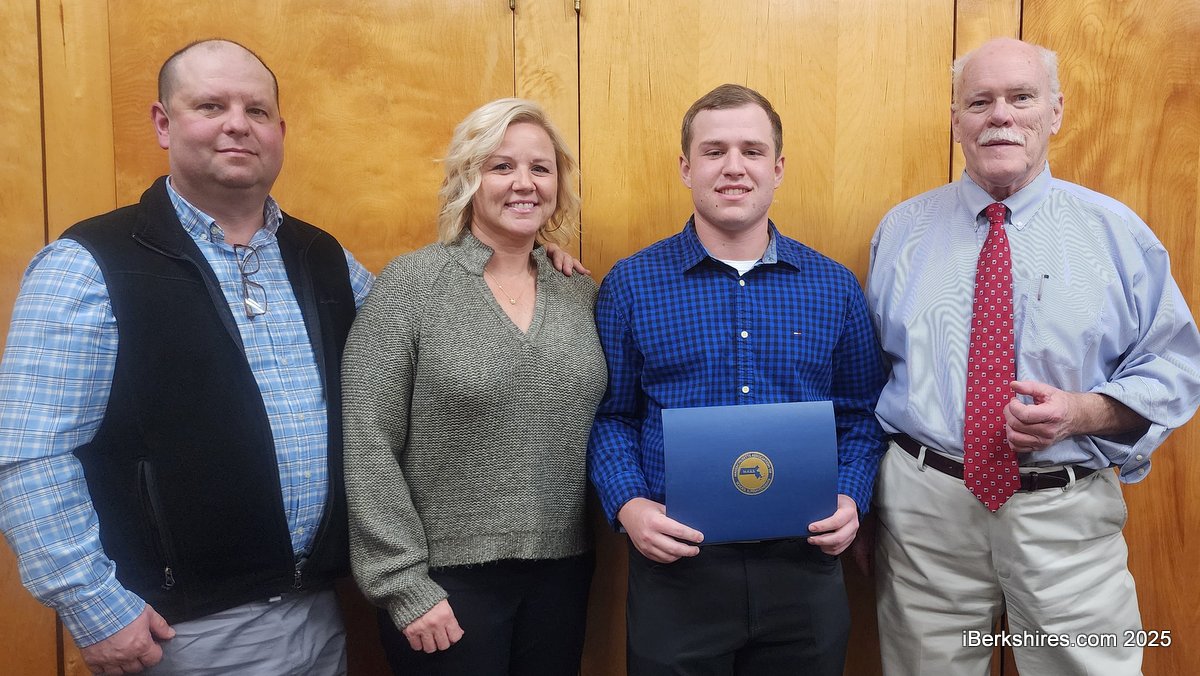
Landon LeClair and Superintendent James Brosnan with Landon's parents Eric and Susan LeClair, who is a teacher at McCann. 
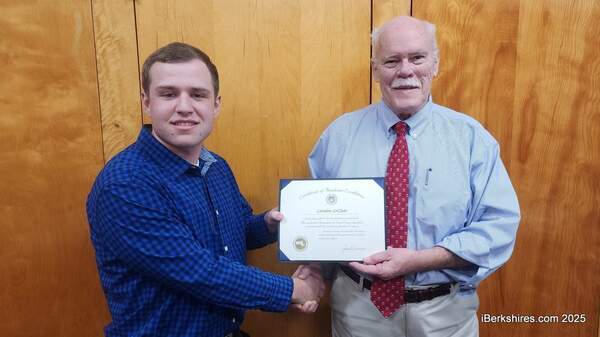
NORTH ADAMS, Mass. — The Superintendent's Award has been presented to Landon LeClair, a senior in McCann Technical School's advanced manufacturing course. 
 
The presentation was made last Thursday by Superintendent Jame Brosnan after Principal Justin Kratz read from teachers' letters extolling LeClair's school work, leadership and dedication. 
 
"He's become somewhat legendary at the Fall State Leadership Conference for trying to be a leader at his dinner table, getting an entire plate of cookies for him and all his friends," read Kratz to chuckles from the School Committee. "Landon was always a dedicated student and a quiet leader who cared about mastering the content."
 
LeClair was also recognized for his participation on the school's golf team and for mentoring younger teammates. 
 
"Landon jumped in tutoring the student so thoroughly that the freshman was able to demonstrate proficiency on an assessment despite the missed class time for golf matches," read Kratz.
 
The principal noted that the school also received feedback from LeClair's co-op employer, who rated him with all fours.
 
"This week, we sent Landon to our other machine shop to help load and run parts in the CNC mill," his employer wrote to the school. LeClair was so competent the supervisor advised the central shop might not get him back. 
 
View Full Story

More North Adams Stories