Clarksburg OK's Budget Articles, Pulls Litter Bylaw
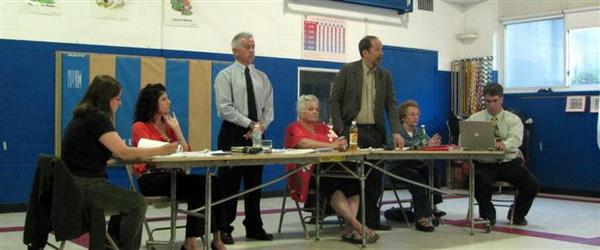
  Clarksburg voters approved 17 articles at Wednesday night's annual town meeting. Left, Selectman Carl McKinney answers a question. Clarksburg voters approved 17 articles at Wednesday night's annual town meeting. Left, Selectman Carl McKinney answers a question. |
In the end, all the articles passed as written with the exception of a littering bylaw that the Selectmen motioned to take no action on because of the many questions raised about it. Nearly 100 voters participated, a far cry from the dozen or so who showed up last year.
The town approved a town budget of $917,655.50, a school budget of $2,410,245 and a McCann Technical School assessment $160,652 for fiscal 2010.
The tight town budget included reductions in every department, cut town officials' stipends in half and set two weeks of unpaid days for the 11 full-time town workers. They would be able to file for unemployment for the second week.
"Everybody's got a two-week furlough with no pay," said Selectmen Chairwoman Debra LeFave. "Every office in the town of Clarksburg, every full-time employee is taking a cut — everybody, across the board."
"We have no money. The alternative was to lay people off," she continued. "Unless we want to go broke."
But several voters objected to the furloughs, saying it wasn't fair to the hard-working employees.
"You're dealing with people's lives," said Arthur Lemaire. "You do have people in town who are doing excellent jobs ... you can see from the budget they're not getting paid a lot."
Selectman Carl McKinney said town meeting had the right to make any changes but that replacing the estimated $20,000 would mean raising the tax rate. Town Manager Michael Canales said restoring the cuts would add about $30 or so to the average tax bill.
Even with cuts, the average taxpayer will see his or her payments rise $130 for the coming year; with the restored furlough cuts it would be closer to $160.
Some voters questioned why school employees weren't also subject to reductions; others why teachers' salaries were no longer published in the town report.
School Committee Chairman David Berger said the school district has contract obligations but may begin talks for concessions. The School Committee did spend a lot of time finding savings, he said, adding he was not aware that the school district published the salaries but that that information is readily available at Town Hall.
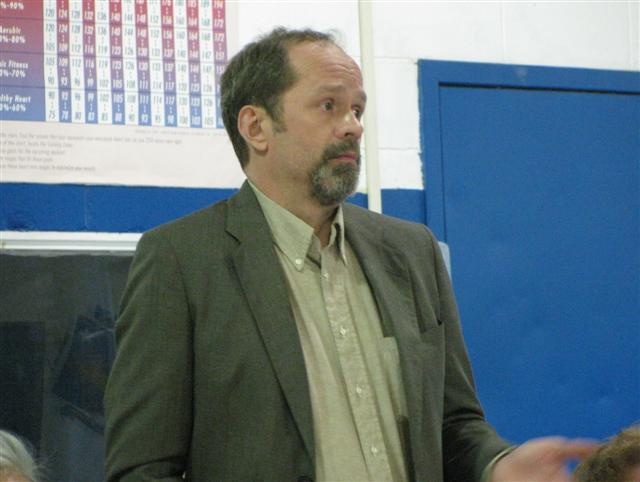
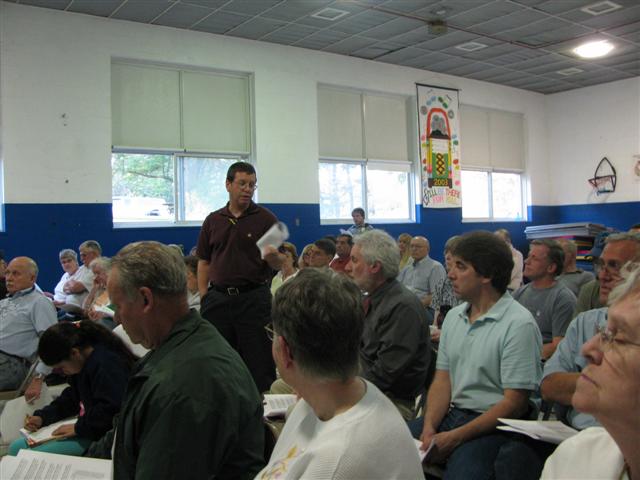 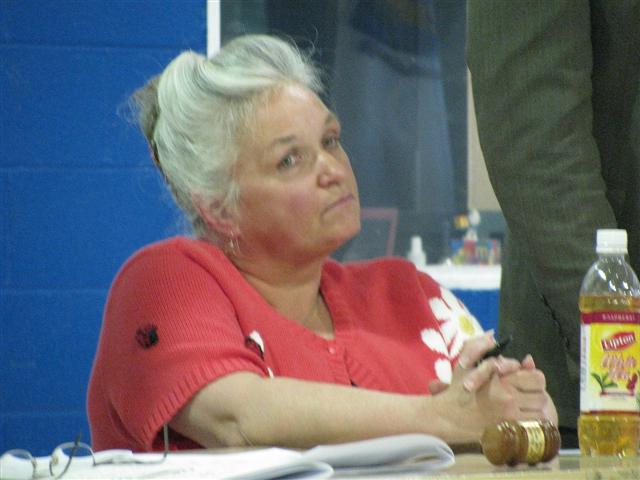 Above, School Committee Chairman David Berger talks to voters. Right, Selectmen Chairwoman Debra LeFave. Above, School Committee Chairman David Berger talks to voters. Right, Selectmen Chairwoman Debra LeFave. |
Schoolteachers received a 3 percent raise according to their contract. Superintendent Jonathon Lev, in response to a question, said the teachers were aware that taking the raise would cost colleagues their jobs.
Robert Norcross said he didn't want to pit town workers against school employees but education always seemed to be a sacred cow and "that's not fair to the town ... we got to all suffer together."
McKinney warned that the state's worsening financial condition could mean the board could be back in July asking to cut the budget again. "We don't know where the numbers are going to fall. Ultimately, it's your town — if you want to vote it in and raise your taxes it's your right."
While some voters suggested raising the tax rate to restore the funding, Robert Bona protested vehemently, saying his son and other residents around him had lost their jobs and asking them to pay extra so others wouldn't lose out wasn't fair.
An attempt to amend the town budget to restore the funding never made it to a vote when Bona moved to amend it again to vote it as written. It took several minutes of confusion before Moderator Bryan Tanner said the vote had to be taken on Bona's amendment, which essentially restored the article to its original version.
That amendment passed 42-14, passing the budget as it stood. A few minutes later, the discussion continued over an article to authorize $30,000 in free cash to reduce the tax rate. Again, voters were told that using those funds to prevent furloughs would also raise the tax rate.
Cate Chesbro said she, too, had had her hours and wages reduced at Crane & Co. and seen 70 of her co-workers laid off. Asking town employees to take a week off with no pay, she said, "I don't think that's asking a real lot."
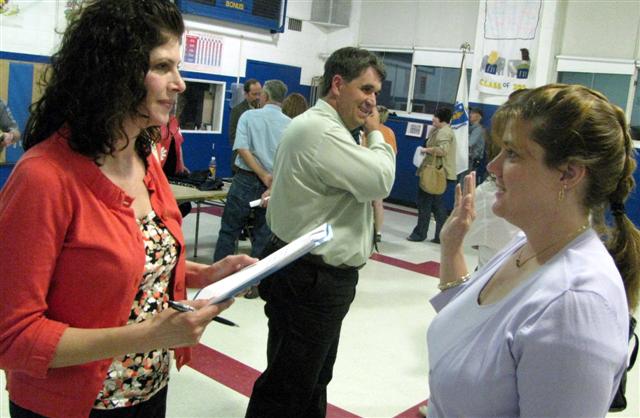 Town Clerk Carol Jammalo, left, swears in new town Treasurer Christa Marsh. |
Mary Giron, who placed the petition on the warrant, said it wasn't targeted at any individual but rather over concerns that anyone serving in those positions be answerable to someone.
Making the jobs appointed would mean their holders would have to be interviewed, qualified and abide by a job description and set hours. "If they don't, you can fire them." Her explanation was greeted with applause and it passed without a single "no" vote.
The litter bylaw was picked apart by voters who wondered if they were going to be ticketed for having backyard fires. The language, taken from a North Adams ordinance, needed to be reworked, admitted LeFave.
"We're going to vote it down and rework it," she said. "We'll try again next year.
In other action, voters:
■ Authorized the Selectmen to pursue a Small-Town Road Assistance Program in the sum of $350,000 to be matched by $150,000 in town funds to be taken over 10 years from cherry sheet funds.
■ Approved a zoning change on town land off Cross Road to allow the construction of affordable housing for senior citizens near the Senior Center.
■ Approved raising the sewer operations budget from $17,500 to $27,500 to allow $10,000 to be set aside toward repayment of $30,000 the town was forced to lend to the sewer enterprise fund.
Berger introduced Lev, the North Berkshire School Union's new superintendent, to town meeting. Lev's former position as special education director was filled by Deb Rosselli of Clarksburg two months ago. Rosselli had most recently worked in the North Adams School System.