Carver Buys Former St. Mary's in Pittsfield; Plans 29 Housing Units
.JPG)
Developer David Carver and Mayor Linda Tyer announced the purchase Thursday.
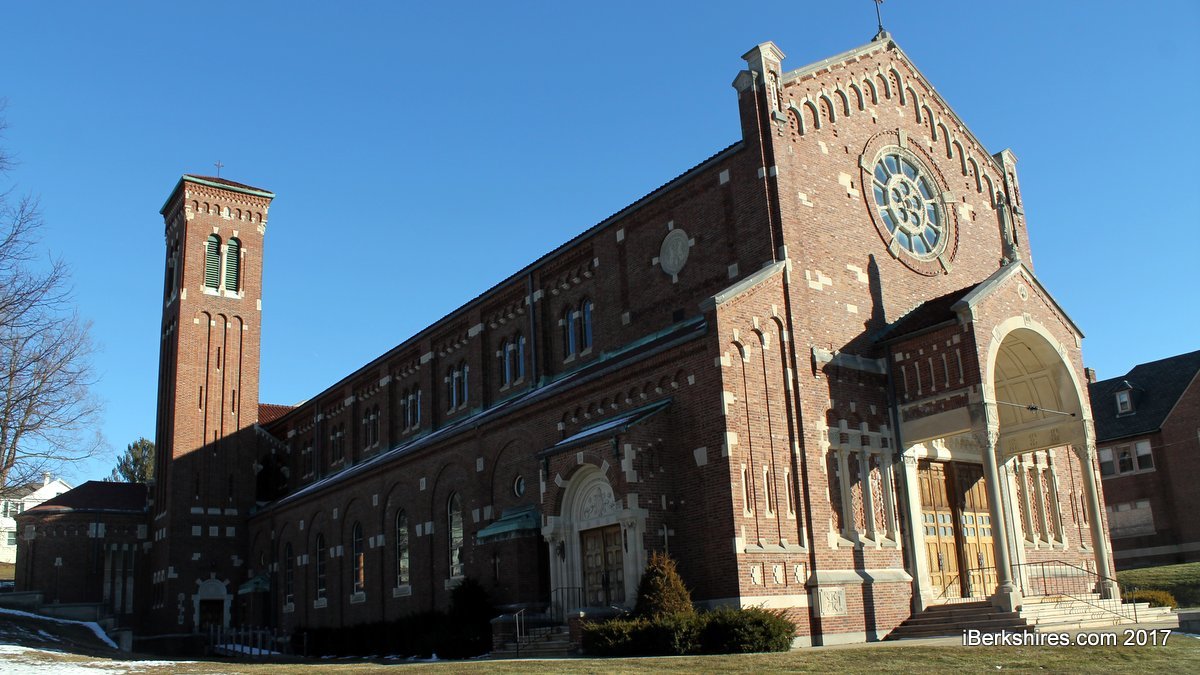
The 75-year-old church had nearly been demolished a few years ago to make way for a Dunkin' Donuts.
That plan triggered outrage throughout the community, which didn't want to see what was considered a Tyler Street landmark be destroyed.
Eventually, Cafua Management backed off the plan and the St. Mary the Morningstar Church and its adjacent buildings were in limbo.
On Thursday, that uncertainty was relieved somewhat as CT Management Group purchased the property from the Springfield Diocese for $500,000.
Now, developer David Carver is planning to take all of the buildings and completely renovate the interiors into 29 market-rate rental units.
"We are planning 29 units in all four buildings — the church, the rectory, the convent, and the school on the hill. The school on the hill is an extraordinary challenge. I understand it has been empty for about 35 years perhaps, in that range. The inside is not in great condition but we think it is structurally sound and we are willing to explore its redevelopment," Carver said.
"We think it is structurally sound and can be rebuilt."
Carver had made a proposal to purchase the property early this year but the diocese had multiple offers it was considering. Ultimately, Carver's offer was accepted and he will now spend the next year developing the specific floor plans for the buildings.
The company says it will make very few changes to the exterior — preserving the architecture — and keep the parking areas where they are. It will create a campus-like setting with units of various sizes.
"I am absolutely thrilled one of our city's most cherished and beautiful landmarks will have a new lease on life through its conversion to market-rate housing. We know this development will meet the ever-growing need for this type of housing. But moreover, we know that revitalized properties will add to the vibrant energy and enthusiasm that is already part of Tyler Street," Mayor Linda Tyer said.
MassDevelopment provided Carver with a loan to purchase the property. He said he will be working on a permanent financing for the entire redevelopment, which will take the place of the MassDevelopment loan. Tyer will be asking the City Council to support that financing with a tax increment exemption, forgiving new taxes on the property for five years and phasing in the value at 5 percent each year.
"These exemptions are a vital component to the success of the overall financing package for a redevelopment of this nature," Tyer said.
Carver said the difficulty with historic redevelopments such as this one is balancing the construction costs with what the market can pay in rents.
"There is a big gap we try to close between the cost of a project like this and what the market can pay. We work with the city and other agencies to close that gap so we ultimately end up with a project that meets the level the market is at," Carver said.
But that isn't a challenge Carver hasn't faced before. This would be the fourth church in the county CT Management has redeveloped. The company first renovated the former St. Raphael's Church in Williamstown into an eight-unit affordable housing project. It then renovated the Our Lady of Mercy in North Adams into four market-rate units.
Currently, the company is renovating the former Holy Family Church on Seymour Street into 10 units, which are expected to be leased this spring. CT Management has also renovated the former Notre Dame School on Melville into 11 units.
"We're delighted to have the opportunity to do this. We enjoy working on these historic buildings; we've been doing it for many, many years and we've had a great relationship with the city," Carver said.
St. Mary's Parish was founded back in 1915 but the church wasn't built until the 1940s. The property consists of 2.6 acres and five current structures totaling 41,524 square feet. Those buildings include the church, rectory, convent, small garage, and school. The school was closed in 1973 and the church was decommissioned as part of numerous closures the diocese made in 2008. The property has been on the market since 2010.
.JPG)
Preliminary plans call for a variety of apartments in each building.
"It is called Morningside because this is the first neighborhood in the city that is kissed by the sunlight as it rises in the east. There is no better place to start rebuilding after a post-industrial decline than right here in Morningside," Tyer said.
A number of other parcels have been identified for redevelopment and eventually, a streetscape project is eyed. Earlier this year the city expanded the Housing Development Incentive Program into the Morningside neighborhood to help facilitate such projects as this one.
Tyer said there is a "gap in market-rate housing" and recent efforts throughout the city are aimed to fill that demand. She cited the restoration of the Howard and Onota buildings as two other market-rate projects in the city aimed to fill that gap.
While CT Management hasn't set a groundbreaking and there is still more work to be done on the St. Mary's property, Thursday's news was a welcome breath of relief for many who were anxious about what could happen to the church.
"For several years, St. Mary's was under contract to Cafua Management, a company located in the eastern part of our state, and their plans included demolishing some of the buildings to build a Dunkin' Donuts. And all of us gasped, held our breath, and prayed that wouldn't happen," Tyer said.
Tags: apartments, church reuse, market rate housing,