
Coach Questions Course Set-Up for High School Matches
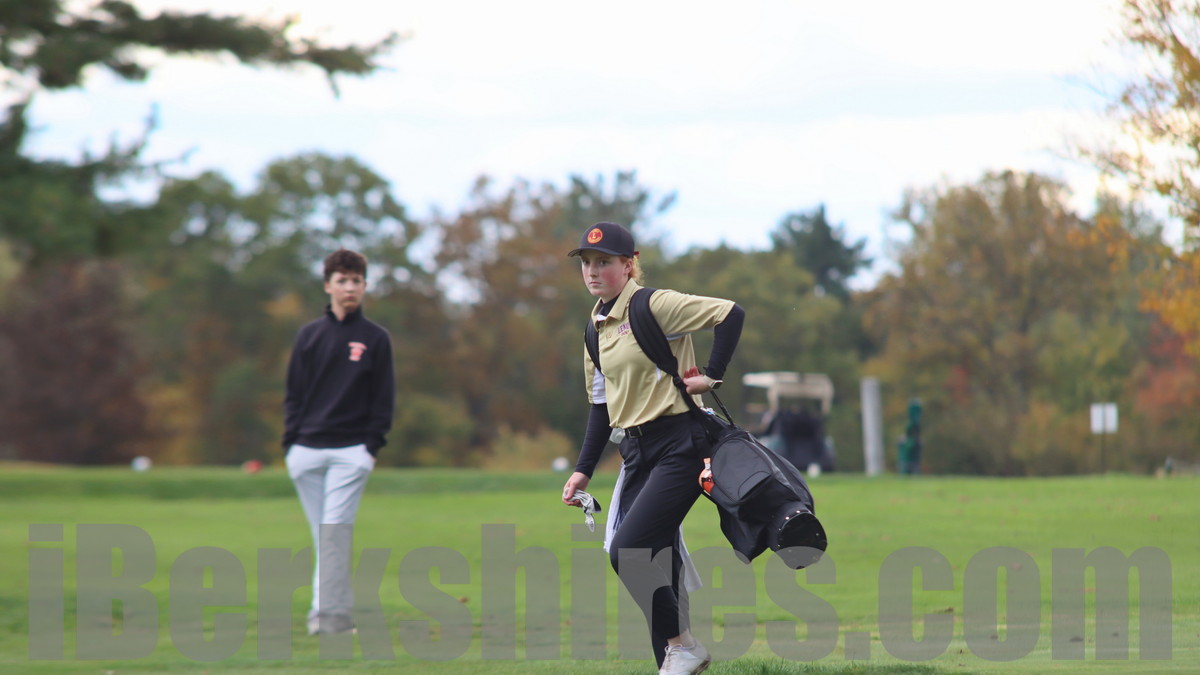 Wahconah golf coach Pete Terpak was not happy even before his team teed off in a match at Lenox on Sept. 18.
One week later, Terpak was still upset about how the eventual 173-182 Lenox win played out at Wyndhurst Golf and Club.
His issue is that the tee positions at the course gave the Millionaires, with two talented female golfers, a competitive advantage against his all-male Wahconah team.
Terpak stresses that his issue is not with the players themselves, who he respects, but with the integrity of the game.
After the match, Terpak said he returned to the Lenox course and compiled measurements using a rangefinder that confirmed his impression. He found that on just four holes, there was a combined 440-yard difference in the distances to the hole between the “ladies tees” and the tees used by the boys in the match.
Over the course of nine holes, the difference between the Green Tees (girls} and Gold Tees (boys) was 620 yards, Terpak said.
"I think highly of Mia Freeman's and Katie Shove's game,” Terpak said, referring to the two girls who have scored consistently for Lenox this fall. “But if I were in charge of their development during our golf season, I would be trying to prepare them for another level. I can assure you, no course they play will measure [as few as] 2,217 yards.
“A player like [Lenox’s] Oliver Kirby gets a bit overshadowed in that program. He plays and practices on an entirely different course. It's like night and day."
Terpak, who happened to arrive early for the Lenox match because of a half day at Wahconah High that Friday, said he looked at some of the holes before the match and raised the issue with Lenox’s head coach. Terpak said they agreed to move some of the tee positions to help address the issue he raised, but the Lenox coach changed his mind before the match.
Lenox coach Brian Shepardson confirmed that the initial conversation took place and he was inclined to make some changes to the set up but told Terpak before the match started that he had changed his mind after consulting with his assistant coach.
“The big thing you need to understand is I don’t set up the course for the match,” Shepardson said. “Pete [Terpak] does know that.”
One exception is No. 8.
“The only tee I move is the eighth hole, a par-5,” Shepardson said. “On the score card, it’s supposed to be 495 yards for men and 405 for the Green Tees. That’s a 90-yard difference. We don’t play it as a par-5; we play it as a par-3 – 110 [Gold] and 104 [Green] yards – not even a 10-yard difference. The only tee I actually control, I made [the difference] shorter.”
The Massachusetts Interscholastic Athletic Association is mute on the issue of whether boys and girls in coed regular season matches should use different tees.
Since the MIAA offers and runs championships for boys golf in the fall and girls golf in the spring, it does require that girls playing on “boys” teams in the fall play from the same tees as everyone else at sectional and state tournaments in the post-season.
That discrepancy raises an entirely different issue for coaches like Shepardson: how to decide which six golfers to enter in the Western Massachusetts Championship if Lenox qualifies, because two of his top scorers all season will be playing under different rules in the tournament.
Terpak said that his understanding is most of the leagues in the commonwealth have boys and girls playing from the same tees during regular season matches.
“Our league rule of playing the girls one tee forward never really was an issue until Mia and Katie's skill level advanced enough to really show a glaring flaw in the yardages at Wyndhurst,” Terpak said. “To their credit, they've worked hard. Unfortunately it has compromised the integrity of the league.”
Immediately after the Sept. 18 match, Terpak emailed local media to ask that the results not be published and that he was going to protest the match to the MIAA without specifying the issue. iBerkshires.com initially held off on publishing the result but later did so with a note mentioning Terpak’s planned protest.
In the week that followed, he learned that the MIAA does not have a protest procedure to cover issues like this. But he still wanted to raise the issue publicly.
Hoosac Valley Athletic Director Jeff Puleri, an accomplished amateur golfer in his own right who served as tournament director for the Berkshire County Individuals and the Western Mass Division 3 Championship last fall, offered a different take on how “most leagues” around the state handle the issue.
“It's in the MIAA handbook that girls typically play the tees one spot ahead of the boys,” Puleri wrote in an email responding to a request for comment on the situation.
The one conference other than the Berkshire County League in which county schools compete, McCann Tech’s Bi-County East, also has girls playing from the forward tees.
The U.S. Golf Association recommends that recreational players choose the appropriate tee based on their ability, rather than gender. But the group also notes that, “the average 7-iron hitting distance for female golfers is 100 yards and the average 7-iron distance for male golfers is 138 yards.”
And Terpak is not suggesting right now that the Berkshire County League alter its approach to the rule for girls and boys (no Berkshire County high school has had enough interest to field a full girls golf team in the spring).
He does argue that accomplished girls like Lenox’s Freeman and Shove or 2017 Wahconah grad Colette Basiliere, an individual Western Mass titlist in the spring 2016 tournament, should consider playing from the same tees as everyone else for their own sake.
And he argues that in the case of Wyndhurst, the difference between the Green and Gold Tees is particularly acute.
The club’s official scorecard lists a 488-yard difference between the two sets of tees for the front nine (3,217 yards versus 2,729). But the discrepancy goes beyond the numbers, Terpak said.
“Aside from the yardage, those tee positions have no obstacles to negotiate,” Terpak said. “No out of bounds, or red or yellow hazards. Blind tee shots are gone as well as a fairway bunker on No. 2. Nothing.”
Lenox Memorial’s Shepardson does disagree on this point. While some obstacles are taken out of play from the Green Tees, other issues remain.
“There’s trouble all around [at Wyndhurst],” Shepardson said. “It’s wood-lined pretty much the whole way. You’re not getting out of trouble. A bad golf shot is pretty punishing on that course, as anyone who has played it can attest.”
Going hole-by-hole through the front nine, Shepardson can cite reasons why some are harder from the Greens and some are trickier from the Golds.
“The first hole that day … Mia [Freeman] cannot reach it with a drive,” he said. “She can probably get 50 yards away, maybe 40. My biggest driver, Oliver Kirby, can almost drive the green. There’s an advantage for the boys … on my own team.
“No. 6 [a 426-yard par 4 from the Gold Tees] is one of the hardest holes. For the boys, they want to hit a driver, like a 5 wood. A good drive for the boys leaves 160 yards, 170 yards. The girls have a blind shot. They can get down maybe a little further, but I think it’s actually a more dangerous drive, totally blind. [Terpak] says they’re taking out trouble. I don’t think that’s true at all. Maybe there’s a slight advantage for the girls, but you have to figure the [second] shot, the boys still hit longer.”
It’s worth noting that in the season’s first match, Shove recorded the best round of the day for any golfer in Lenox’s win over Pittsfield at the Country Club of Pittsfield. And while Freeman earned medalist honors in the Wahconah match, Wahconah’s Kesler Anello was just one stroke behind her.
Shepardson points out that golf – perhaps more than any other high school sport – brings an inherent home team advantage because of familiarity with the course. That is why the MIAA does not schedule sectional tournaments on the home course of any team that plays in the division in question.
That home course advantage will not change even if all the players use the same tees.
“The other night, I had all of us [in practice] play from the women’s tees, the tees Katie [Shove] and Mia [Freeman] normally play from,” he said. “One of the boys who is probably our ninth or 10th golfer shot a 34 – 10 shots better than usual. But everyone else’s score was right around what they usually score.”
While Wahconah cannot appeal the results of the Sept. 18 match, Terpak said that perhaps the Berkshire league and its athletic directors can look at the issue for future years.
Shepardson respects Terpak as a coach and did not want to get into a back-and-forth about the outcome of a match between two teams likely to each go at least .500 in dual matches and qualify for their respective Western Mass Sectionals (Division 2 for Wahconah, Division 3 for Lenox). But he does say this is the first time he has run into the issue.
“[Longtime Lenox coach] Dick Salinetti had some good girls maybe 15 years ago and never got any complaints back then,” Shepardson said.
“It was a different nine they used to play [at then Cranwell Resort]. But I think it’s pretty similar all the way around. … I never heard of anyone raising a complaint about it. No one has made a formal complaint about it like this.”