North Adams Mayoral Candidates Meet Again
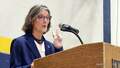
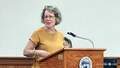
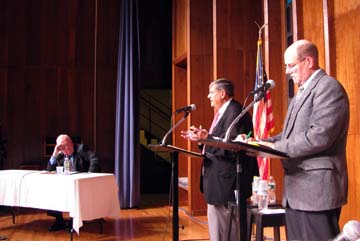 Mayoral candidates John Barrett III and Richard Alcombright debate the issues on Wednesday night at the Church Street Center as moderator Paul Hutchinson listens. |
This second matchup between incumbent Barrett and Alcombright, a three-term city councilor, focused heavily on jobs and economic growth. Barrett, running for a record 14th term, pointed to past successes; Alcombright to looking at new paths to economic growth.
While both agreed that expanding the commercial base was imperative, they differed greatly on their visions of how the city should do so and how much could actually be done.
Barrett has prided himself on shepherding North Adams from mill town to artists' haven, frequently noting the dire circumstances the city found itself in when he first took office in 1984. In his book, maintaining infrastructure and creating an attractive environment is the way to lure new residents and business.
"What brings jobs to a community, what brings new business to a community, is the image of a community," he said, adding that more than 20 new businesses have been established as the Massachusetts Museum of Contemporary Art continues to act as a catalyst.
 Adams Town Clerk Paul Hutchinson moderated the debate and posed questions from the audience. Video can be found here. |
Alcombright, however, said the Windsor Mill may be fulfilling its role as an incubator, "but some of the businesses that have located there in the last few years have really been at the expense of private entities and commercial property owners."
Too many of the employers touted by the mayor — such as Morrison Berkshire and Excelsior — have been around for years, said the bank vice president, advocating a more aggressive marketing of the city's potential as a destination for recreation, residence and business.
"We have not seen a whole lot of growth," said Alcombright. "We need more business across the board. ... When [I have been] walking through the poorest parts of the city, these people are saying, 'we need jobs.'"
Barrett said the city has been marketing, holding aloft a brochure from Mass MoCA touting business and community leaders. But the ability to pull in businesses is limited, he said. "We don't have a lot of room for growth in this city."
Alcombright disagreed, saying there was plenty of room in the empty storefronts, buildings and the industrial park.
Originally planned for the American Legion, the debate was held in the same place as the first one on Sept. 30 at Massachusetts College of Liberal Arts' Church Street Center. The last-minute venue change was made over concerns that the Legion hall wouldn't be able to handle the crowd.
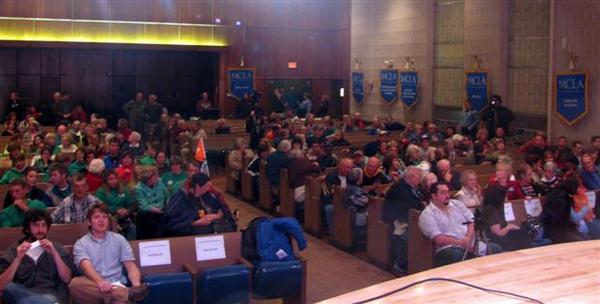
It would have been close; while not nearly as packed as the first debate, many of the pews in the main hall at the center were filled. Candidates' supporters also weren't ushered to specific sides as happened last time (apparently through a miscommunication with the student volunteers), which had given the debate the atmosphere of a Hatfield-McCoy wedding.
Moderator Paul Hutchinson kept things on track and cautioned backers against outbursts. The time format was the same but questions were provided by a media panel — Charlie Dietz from WAMC, Jennifer Huberdeau of the North Adams Transcript, Tammy Daniels of iBerkshires and Larry Kratka from WNAW — and from the audience.
The debate was sponsored by the Transcript and will be the second and last for the candidates. Both men were invited to a radio forum on WNAW next week but Alcombright declined citing scheduling and the prior agreement to two debates.
It was a question by Kratka — what would they see in a photograph of North Adams — that distinguished the men's perspectives. Where Barrett saw a flourishing city that, if not perfect, could boast of good schools and roads, low taxes and affordable living, Alcombright saw progress but also an underpinning of poverty, crime, empty stores and unemployment.
| For Another Perspective | |
| BerkshireFineArts: Second North Adams Mayoral Debate a Tie WAMC Public Radio: North Adams Final Mayoral Debate North Adams Transcript Closing Arguments (This link may be archived behind a pay wall.) |
"What I want to see is a comparison shot from 1963 to today," said Alcombright, who wanted to paint a picture of "what people here see. ... I wouldn't see as many jobs. There is no growth."
Barrett countered by channeling President Reagan with the shot "There you go again, Dick." His administration hasn't been ignoring problems but tackling them, said Barrett. "We deal with the problems of the poor, we don't stick our heads in the sand."
The two also disagreed about the level of crime. Barrett applauded the work of the Police Department and its collaboration with Berkshire County Drug Task Force.
"Every time we've had an unfortunate murder it's been drug-related," he said. "As soon as a drug dealer shows up in the city the drug task force shows up at their door. ... I'm proud of the work they've been doing. We're on top of it; we're proactive. Believe me when I say we're on it."
Alcombright countered that the city is in one of the highest crime areas in the state and rates for drug-related offenses and property crimes are up; his own home was broken into in June.
"We do have a police force that's on top of it," he said. "But our compaign has walked every street in this city and crime continues to be the No. 1 concern of these people."
When questioned if he'd been active enough on the City Council, Alcombright defended his service by noting the stands he'd taken on veterans' benefits and city employees' insurance issues, along with his work on several council committees.
Barrett again taunted him for failing to ask hard questions on the budget; Alcombright responded that the council isn't given enough detailed information and had little time to review the numbers.
The councilor pointed to the blue-ribbon commission he was appointed to by Barrett to review the city's housing stock and submit a report with recommendations. The mayor claimed "that commission really came back with nothing." The report has never been released.
Where Alcombright said he would work regionally with agencies and neighboring leaders, Barrett said he, too, is more than able to work with local leaders, using the city's collaboration with Williamstown to fight federal fines against the shared waste-water treatment plant as an example.
He also brought up two Alcombright supporters he'd worked with on projects. "It doesn't matter who they're supporting. It never did," he said as some in the audience tittered. "We work with them all the time."
"I guess I all can say to that, mayor, is if half the stories I hear are half true about people coming into your office with ideas, including me, then I don't feel as though people are well received in this community," Alcombright responded.
In their closing remarks, Barrett spoke the "labor of love" that has been tenure as mayor and the challenges ahead.
"It's going to be a difficult two years, it's going to be the most difficult two years in perhaps anytime in the history of this city," he said, asking for another term.
Alcombright said he had a vision to make the city safer and more productive.
"I have a plan for the city based on the hundreds of conversations I've had with residents over the past few months," he said. "I'm asking you for the chance to implement this plan."
The debate will be shown in full on NBCTV, Channel 15, on Thursday, Oct. 15, at 8; Friday, Oct. 16, at 7 and Saturday, Oct. 17, at 6. Video will be available later Thursday on iBerkshires.
 |
 |