David Auburn Is A Successful Playwright — He Has Proof

Print Story | Email Story
Not just creativity, but opportunism and careful research went into writing Proof, David Auburn’s play, just awarded the Pulitzer Prize, now on Broadway. “It’s an award for this production,” said Auburn, sharing the credit with actors and production staff. Auburn spoke last to a full house at the Adams Memorial Theatre at Williams College, where his wife has been named to a post in the history department. His talk had been scheduled before the announcement of the prize. The play centers on a young woman, the day before her mathematician father’s funeral, worried that she may have inherited some of his mental illness, as well as his talent. “I never intended to write a play about math,” said Auburn. “I didn’t set out to write a play about math.” His initial idea was, he said, to write about “two sisters fighting about something left behind.” So he had to decide on the McGuffin, as Alfred Hitchcock called “the thing everyone was chasing.” His other starting point, he said, was “someone worried about inheriting a parent’s mental illness.” But mathematics is work that can be done in solitary, unlike science, almost always a group effort, so mathematics it was. “I found a lively, somewhat eccentric subculture of people,” said Auburn. As an example of his depiction of this subculture, he read an exchange between Katherine, the daughter, and a former student of her father’s, who asked her to come hear a band. The band is called lower case i, which stands for imaginary number — a math joke. Part of the play’s tension comes from her father’s fear that his creative work lay behind him. One mathematician was noted for taking speed, because he was afraid that his mind had slowed down as he got older, Auburn said. “There’s a common belief that you’re less likely to produce good work later in life,” he said. Auburn described himself as “opportunistically grabbing details, asking myself how true to the subculture they are.” “A lot of people have this fear, fear that they might not do the work they want to do,” he said. And the play explores the “relation between insanity and genius, particularly mathematical ability.” “Was I saying that mathematicians are all barking mad, or does doing the work make people crazy? The answer is no. “How responsible is it to have the play’s connection between insanity and the ability to do great work drawn so plainly? I plead the last refuge of the dramatist — expediency,” said Auburn. Dramatic tension hinges on the disbelief Katherine encounters when she claims to have written the mathematical proof the graduate student, and her off-beat romantic interest, finds among her father’s papers. That young man thinks she, being a woman, is incapable of devising the proof. As context for this doubt, Auburn cited the difficulties women in mathematics have historically faced. Women mathematicians, he said, connect strongly with Katherine’s difficulties.No such doubt would have met a man’s claim, Auburn said. To illustrate those difficulties, he cited the precedent of French mathematician Sophie Germain, 1776-1831, whose innovative work involving prime numbers was hailed, but when her identity as a woman was revealed, the reaction was astonishment. Auburn said he verged from his political science major in college in Chicago writing comedy sketches for revues. “I’d really like to make a go of this,” he remembers thinking. And after a stint as a screenwriter in Los Angeles, he realized he’d rather be broke as a playwright in New York. He started a theater company with friends, presenting plays in “very small venues., and he joined the Juilliard play writing program, then had a play performed by the Manhattan Theatre Club. Asked the answer to the question posed by Proof, he responded, “Yeah, she wrote it.” In creating the young woman character, he said, “I tried to write a sullen character. She was nasty and flippant in the script.” The actress now playing the part on Broadway, Mary Louise Parker, “loved it,” said Auburn. Responding to a question from psychiatrist Dr. John Howland on what form of mental illness Auburn had in mind, Auburn answered schizophrenia, because the onset age of the early 20s, Katherine’s age, “gives her very specific reason for worry.” Responding to another question about the necessity for mathematical accuracy, since few people would know the difference, Auburn responded, “I think it matters. If you get your facts right, other good things will follow.” The production changed somewhat in development. “At the end of the play were some one-liners that had a Catskills kind of rhythm,” he said. “So I cut some of the jokes.” “The original ending had her opening the book, but the audience didn’t know the play had ended and they sat in their seats, so I wrote a little bit of math talk. That nailed it down. It nailed it down a little bit more than I would’ve liked.” Auburn is also working on a screenplay of Proof, and plans to direct one of the upcoming regional productions. Asked to describe his method of writing, Auburn said once he has an idea, he makes lists of scenes until he reaches “critical mass,” and “gets some dialogue going.” “I try to write a draft very quickly, moving from incident to give the plot forward momentum,” he said. “I wrote a skeletal draft, in a week I had a detailed outline. Then I went back to give the characters individuality. That took six or eight months. I don’t write every day.” He learned he had won the Pulitzer, he said, when, talking on the telephone to his wife, he heard the beep of call waiting. My publicist and my agent called. I clicked back and said ‘I got it.’” “It was the benefit of amazing work,” he said, crediting the entire production. Mathematics department Chairman Colin Adams introduced Auburn, calling it “amazing happenstance” that the talk had been scheduled before the award was announced, but occurred so soon afterward. Adams said he has not seen the play but “I’ve read it and loved it.” “It’s a huge hit in the mathematics community,” said Adams. “It’s fun to have the math world portrayed in such a great production. “And the talk was the first ever joint event between the mathematics and theater departments.”
If you would like to contribute information on this article, contact us at info@iberkshires.com.

Greylock School Project Garnering Interest From Bidders

By Tammy Daniels iBerkshires Staff
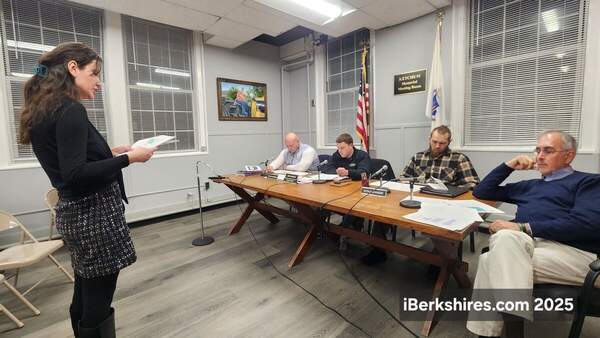
NORTH ADAMS, Mass. — A recent walkthrough of the Greylock School site turned out more interest than expected, which school officials and project managers hope will translate into multiple bids. 
 
The project includes the demolition of the 60-year-old elementary school and the construction of a new two-story school directly to its north. 
 
"We don't always expect a lot of them to show when a building is going to be demolished. There's not a lot for them to see," said Tim Alix of Collier's International, the owner's project manager, told the School Building Committee on Tuesday. "But just putting eyes on the site, seeing where the utilities are coming in so they can they've seen them all that information on the documents, but to see it in 3-D and they can start making their plans.
 
"We're hopeful that that means that we are going to be receiving a number of bids in each category. So that's encouraging."
 
The subcontracting bids are due Tuesday and the general contractors' on Jan. 14. Alix said there will be plenty of time to review the subcontractor documents before releasing that information so the general contractors can compile their bids. All bidders went through a prequalification process this past fall to be accepted by the Massachusetts School Building Authority, which is covering more than two-thirds of the cost of the project.
 
Jesse Saylor of TSKP Studio, the school's designer, said there have also been a lot of questions from potential bidders. 
 
"We have received a number of bidders' questions, which are called bid RFIs, and that's normal," he said. "I think it shows participation, you know, bidders who are working on the job, are looking at the documents, and they're finding things that they want to make sure they understand."
 
View Full Story

More North Adams Stories