Low-profile Lenox specialist scores in movies
By Joanna RochePrint Story | Email Story
John Nugent of Sandbox Pictures in Pittsfield is carving out an Oscar-winning reputation in the Hollywood Motion picture industry.
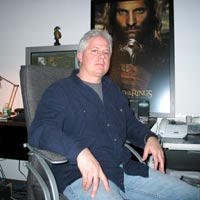
LENOX — John Nugent, owner of Sandbox Pictures in Pittsfield, has quietly built a career in Hollywood’s special effects industry that is comparable to that of any famous actor or director – only his work is behind the scenes. Nugent is a special effects compositor. He set up his Pittsfield office, very quietly, a little over a year ago to finish work on “The Return of the King.” In fact, he kept his involvement in the film a secret until it was released to theaters at the end of 2003. “When I was in New Zealand, I had the distinct feeling of being a part of a much larger process,” he said. “It was definitely history on the making, flying to locations, watching the sun rise over larger than life landscapes, experiencing the costumes, the extras, the battle scenes — you knew it was going to be big.” Nugent speaks modestly, noting that his work is extremely collaborative; a compositor works with a team of other digital effects artists, rarely alone. But over the past 10 years, five films that he has worked on won Academy Awards for visual effects: “What Dreams May Come,” “The Matrix” and the trilogy of “The Fellowship of the Ring, The Two Towers,” and “The Return of the King.” Nugent is extremely proud of his work and of the people he has worked with, particularly on the trilogy project. “Winning the Oscar is the ultimate achievement, but it’s not all about me, it’s about the work and the team,” he said during a recent interview. “The experience in New Zealand working on the trilogy was unlike any typical movie making experience, the 2D guys don’t work that closely with the rest of the crew. You had many, many people there, for three-plus years, solely focused on making these three movies.” Nugent’s film career started 10 years ago at Mass Illusion in Lenox. He began as a production assistant working in the “pre-visualization department,” learning Photoshop and the ins and outs of Silicon Graphics computers. He graduated from the University of Massachusetts with a degree in fine art and worked for General Electric in Pittsfield doing technical illustration, where he ultimately migrated to working on computers, becoming interested in graphics. The Mass Illusion job came at the perfect time, he said, allowing him to transition to the entertainment industry at a time when several special-effects firms were trying to make it in the Berkshires. When Mass Illusion dissolved and moved to California because of a change in ownership, Nugent moved, too. It was 1998, and he was in San Francisco, commuting back and forth to Lenox, working on “What Dreams May Come.” In 1999, Mass Illusion became Manex, and he worked on “The Matrix” in the same manner, commuting to Lenox to be with his family, wife Susan and their three kids. When his work earned an Oscar for both of those pictures, he said he gained a great deal of credibility in the industry. It was in early 1999 that he first learned of the New Zealand project, and he interviewed in Los Angeles for the job of 2D supervisor. The 2D supervisor was responsible for creating the digital compositing department, finding and managing the talent. He said he pitched the move to his wife with key phrases like “it’s not forever” and “what a cool place to live for three years.” His children were 3, 5, and 9 at the time and would soon be living in a beach house and attending school in majestic New Zealand. The decision to move was a defining moment in Nugent’s career, he said. Director Peter Jackson was not yet famous or notable, making the transition to New Zealand a real leap of faith. Jackson’s company, Weta Digital, was in its infancy, having started in the late 1980s and producing just six films prior to the trilogy. The first year Nugent described as an adventure vacation for the family; life was fairly normal, and he wasn’t yet in the craziness of production. Jackson’s facility was large, and the proximity to production was unusual and impactful to the team of 2D compositors, making things like a “costume reference” quick and convenient. That first year, Nugent and his team worked without an official contract, essentially proving themselves to New Line Cinema. Shooting three movies simultaneously had simply never been done before and it was complicated, he said. At the end of 2000, there was a low point when a “changing of the guard” occurred. Weta and the production company “3 foot 6” was reorganized, and Nugent lost some of the key contacts he had developed. He said he feared not getting the work done on time and not meeting expectations. He personally worked out deadlines with Peter Jackson as they approached the Cannes Film Festival in 2001, in which a segment from the first movie was scheduled to appear. This process forced them to become “a machine that produced results.” In Cannes, in May 2001, film critics loved the sequence from The Fellowship of The Ring, and it boosted the confidence of the entire team, he said. Nugent, as a manager, tried to feed his staff the imagery it wanted: “If someone wanted to work on blood and gore, we gave them blood and gore.” Any territorialism created by competing skills and egos gelled under tight deadlines, he said, adding that when “The Fellowship of the Ring” won the Oscar, there was a collective sigh of relief that they were on the right track. But in year three, working on “The Two Towers,” the work became very difficult, he said: Gollum, a central character, was completely computer generated or “CG,” a synthetic actor that had to be believable. That, combined with the giant battle scenes, created a stressful environment, Nugent said. It was at this point that his family had had enough of New Zealand living and wanted to return to Lenox, he said. They were living in Wellington on the peninsula and the weather was extreme. Nugent remembers sand being everywhere, in his car, in his house. He recalled telling his kids at the time, “Mark my words, you will regret not being more interested in what your dad is doing right now.” That included hanging out with Elijah Wood and Orlando Bloom, who were not yet famous. The family moved back to Lenox, and Nugent returned to finish “The Two Towers” alone. He was in New Zealand on Sept. 11, 2001, and said he felt the impact of the attacks through a world perspective, since the crew was so multicultural and diverse. He said he spent the next year there living alone, feeling very isolated and missing his family. Film three was the turning point; Nugent had invested so much time and energy in the project, he was in a key position, supervising the largest department. “I knew that Peter Jackson wanted everything done in his backyard,” he said. Nugent said he had a good enough relationship with both Jackson and the producers that he felt he could pitch the idea of him going back to “the work” and stepping away from his managerial role. They were open to the idea, and eventually decided to allow him to work remotely on “The Return of the King.” On his way back to Massachusetts, he stopped in Los Angeles and picked up some work on “Terminator 3.” He said his success in working on T3 in the Berkshires ultimately bought him the negotiating power he needed to seal the deal on “The Return of the King.” He traveled to back New Zealand, where he broke down the special-effects sequences, bid on them and brought the project home in a suitcase. He then took office space in Pittsfield, assembled a crew of six, including old friend Dan Klem, and worked seven days a week from July through November. Nugent FedExed the tapes to Los Angeles for “Terminator 3,” where they were transferred to film. For “Return of the King,” the work was uploaded to the Internet so others could review and critique it. The time difference worked to his advantage, Nugent said, and the six-person team legitimized his efforts. In the future, his company, Sandbox Pictures, hopes to purchase a house and create a collaborative environment for digital artists, he said. He is currently bidding on a classic Hollywood action movie — and he plans to continue keeping a low profile.
If you would like to contribute information on this article, contact us at info@iberkshires.com.

Lanesborough Fifth-Graders Win Snowplow Name Contest

LANESBOROUGH, Mass. — One of the snowplows for Highway District 1 has a new name: "The Blizzard Boss."
 
The name comes from teacher Gina Wagner's fifth-grade class at Lanesborough Elementary School. 
 
The state Department of Transportation announced the winners of the fourth annual "Name A Snowplow" contest on Monday. 
 
The department received entries from public elementary and middle school classrooms across the commonwealth to name the 12 MassDOT snowplows that will be in service during the 2025/2026 winter season. 
 
The purpose of the contest is to celebrate the snow and ice season and to recognize the hard work and dedication shown by public works employees and contractors during winter operations. 
 
"Thank you to all of the students who participated. Your creativity allows us to highlight to all, the importance of the work performed by our workforce," said  interim MassDOT Secretary Phil Eng.  
 
"Our workforce takes pride as they clear snow and ice, keeping our roads safe during adverse weather events for all that need to travel. ?To our contest winners and participants, know that you have added some fun to the serious take of operating plows. ?I'm proud of the skill and dedication from our crews and thank the public of the shared responsibility to slow down, give plows space and put safety first every time there is a winter weather event."
 
View Full Story

More Stories