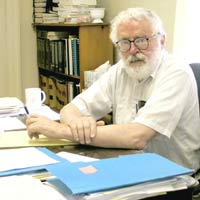
LENOX — As Hugh Curley Cowhig prepares to retire on June 30 after 32 years as Lenox town counsel, he recalled events last week that have changed the face of his home town over the decades.
Cowhig took time out from filling boxes with records and memorabilia at his office in Lee to talk about progress made and opportunities lost during his tenure.
When he was appointed in 1972, there was no town manager to oversee the town’s affairs; that job was established in 1991. The decaying Curtis Hotel, in the heart of downtown Lenox, was restored and converted to subsidized housing for the elderly that same year. The Community Center, once a men’s club, became a tax-supported town department. The town’s cultural life was enhanced by the formation of Shakespeare & Company and the rescue of Ventfort Hall from a wrecker’s ball.
While those positive developments enhanced Lenox as a place to live and as a tourist attraction, there were far-reaching negatives, according to Cowhig. He said no one thing has impacted the town more than the slow decline of General Electric Co. as the county’s largest industry and major employer. Its effects rippled through Lenox, the home of many employees, who had formed a large pool of citizens to run for town offices and volunteer for civic duty. Most of them are gone now.
Born in Lenox, Cowhig went through the public schools here. After graduating from Holy Cross College in 1956, he spent three years in the Army, mainly in Berkshire County, conducting counterintelligence background investigations of Army personnel. Then he earned a law degree from New England Law School and joined Charles Alberti’s law office in Lenox until opening his own office on the second floor of the Lenox Library. He moved later to Lee, where he has engaged mainly in real estate and probate law as a member of the firm of Hannn, Lerner, Cowhig, Scully & Bell. In addition to retiring from the firm and as town counsel, he is retiring as counsel for Monterey and New Marlboro.
“I will be 70 in September, and I’m celebrating by retiring,†Cowhig said in an interview. “I figure I should retire while I’m still able to do something.â€
His wife, Nancy, has retired after 32 years of teaching mathematics at Berkshire Country Day School. They have two sons, Shawn, who owns a bed and breakfast in New Lebanon, N.Y., and Daniel, a lawyer serving in the Army Judge General Department in Silver Spring, Md.
Hugh Cowhig used to be a familiar sight riding on his motorcycle, but he gave it up six years ago.
“My reaction time was getting too slow,†he said. “You don’t make many mistakes on a motorcycle.â€
As town counsel, Cowhig has seldom attended meetings of the Selectmen or other boards here.
“If you are at a meeting, people keep turning to you. That really isn’t your job,†he explained. “We are not supposed to give decisions. We are supposed to give legal advice to keep them out of trouble legally. That’s why you elect the officials. The elected officials make the decisions.â€
He added, “Really, the job of town counsel is to try to keep people out of big situations where they get in trouble. The real function is to try to steer them away from what can become a problem. Fortunately, in the time I have been counsel in Lenox, we never had any cases that cost large amounts of money. That’s because of the good judgment of the people who were making the decisions.
“We had some highly contested zoning issues,†he recalled. “I remember when a developer wanted to rezone the area up by Holmes Road for a shopping mall. That was a real long, drawn-out affair. They didn’t get the vote to change the zone.â€
In another case, Jonas Douydenas sought permission to build a new village on land now occupied by Shakespeare & Company. It was to have 418 detached houses and townhouses. The application was voted down at a town meeting in November 1991. Still another developer was turned down on an application to build a nursing home on the Ventfort site.
“The vote in Stockbridge for the Rockwell Museum was a long drawn-out affair,†Cowhig said. “I drew it for Stockbridge because at that time their town counsel was also counsel for the Rockwell Museum, so he couldn’t handle it.â€
He said turning the Curtis Hotel into housing for the elderly was “probably was one of the best things that could have happened.â€
“The hotel was going down. There wasn’t any way to bring it back as a hotel. The thing that saved it was conversion to housing for the elderly, with commercial space in the bottom. The Board of Selectmen, the governor's office, a lot of people, had to get on board to make it happen.â€
Cowhig said the once-active Kiwanis Club, of which he served a term as president, and the now-defunct Civic Association used to be sources of candidates for office and volunteer service to the town.
“The community has a much more diverse population now than we had,†he said. “We have a lot of second and third homes. A lot of people are only here for a few weeks at a time. They are not really involved in what is going on.
“Before, when we had GE as a big employer, a lot of GE groups lived in town, and that gave you a real pool to draw from, a lot of diverse talent, of people who were available for various boards. Now you have retired people who volunteer, but you don’t have the same mix you used to have. That is one reason there are not enough people running for office.â€
He added, “We don’t really have any one thing that draws in everybody in town. The various churches have their people. The soccer league has their people. The Little League has their people. People have different interests, and they are involved in a particular group, but there is no one central thing that kind of draws everybody together.â€
The Cowhigs plan to leave soon to drive across the country to Glacier National Park and south to the Grand Canyon before heading back home. On their return, Cowhig said, he will be available for consultation about any town matters in which he has been involved.
As for responses to people who seek his legal advice?
“I’ll just smile sweetly and tell them I have retired,†he said. “I’ll be happy to talk to them, but I can’t give them any legal advice.â€
If you would like to contribute information on this article, contact us at info@iberkshires.com.
Your Comments
iBerkshires.com welcomes critical, respectful dialogue. Name-calling, personal attacks, libel, slander or foul language is not allowed. All comments are reviewed before posting and will be deleted or edited as necessary.
No Comments
Former Adams Police Chief Facing Fraud Charges
Staff Reports
PITTSFIELD, Mass. — The former chief of police in Adams was indicted Tuesday on fraud charges by a Berkshire County grand jury. He is accused of taking nearly $20,000 in overtime funds he didn't earn.
Kevin Scott Kelley, aka K. Scott Kelley, 46, was relieved of duty in September and placed on a paid leave of absence until December. Adams town officials declined to say if he was fired or resigned at that time.
He is accused of submitting fraudulent reimbursement claims under a municipal traffic enforcement grant administered by the Office of Grants and Research in conjunction with the Massachusetts Department of Transportation, according to the Berkshire District Attorney's Office.
The alleged conduct began in or about January 2024 and continued through at least January 2025 and was reported by officers under Kelley's command.
The members of the Adams Police Department identified discrepancies in the reimbursement submissions and gathered evidence indicative of fraudulent activity. They subsequently requested assistance from the Berkshire State Police Detective Unit and the DA's Office.
Based on the materials initially collected by Adams Police, State Police conducted a formal investigation, which concluded that the defendant submitted and received $19,123.15 in overtime compensation for dates on which he either absent from work or performed duties not consistent with the requirements of the grant program.
Kelley was sworn in on January 2021 to replace the retired Chief Richard Tarsa. He came with more than 25 years experience in law enforcement, most recently as police chief for Spartanburg (S.C.) Community College.
Qwanell Bradley scored 33 points, and Adan Wicks added 29 as the Hoosac Valley boys basketball team won a Division 5 State Championship on Sunday. click for more
Adan Wicks scored 38 points, and the eighth-seeded Hoosac Valley basketball team Saturday rallied from a nine-point first-half deficit to earn a 76-67 win over top-seeded Drury in the Division 5 State Quarter-Finals. click for more
Caprese Conyers scored 22 points, and Kyana Summers had a double-double with 10 points and 13 rebounds to go with eight assists as Pittsfield got back to the state semi-finals for the second year in a row. click for more