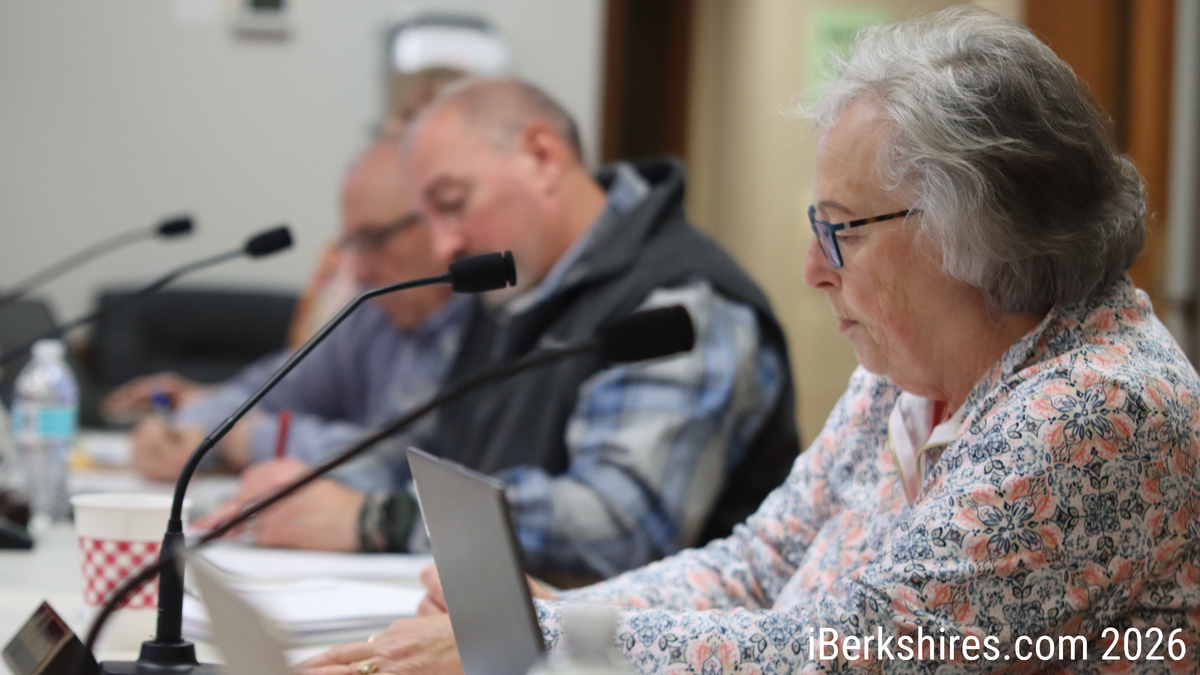
Lanesborough Officials Review Schools' Budgets
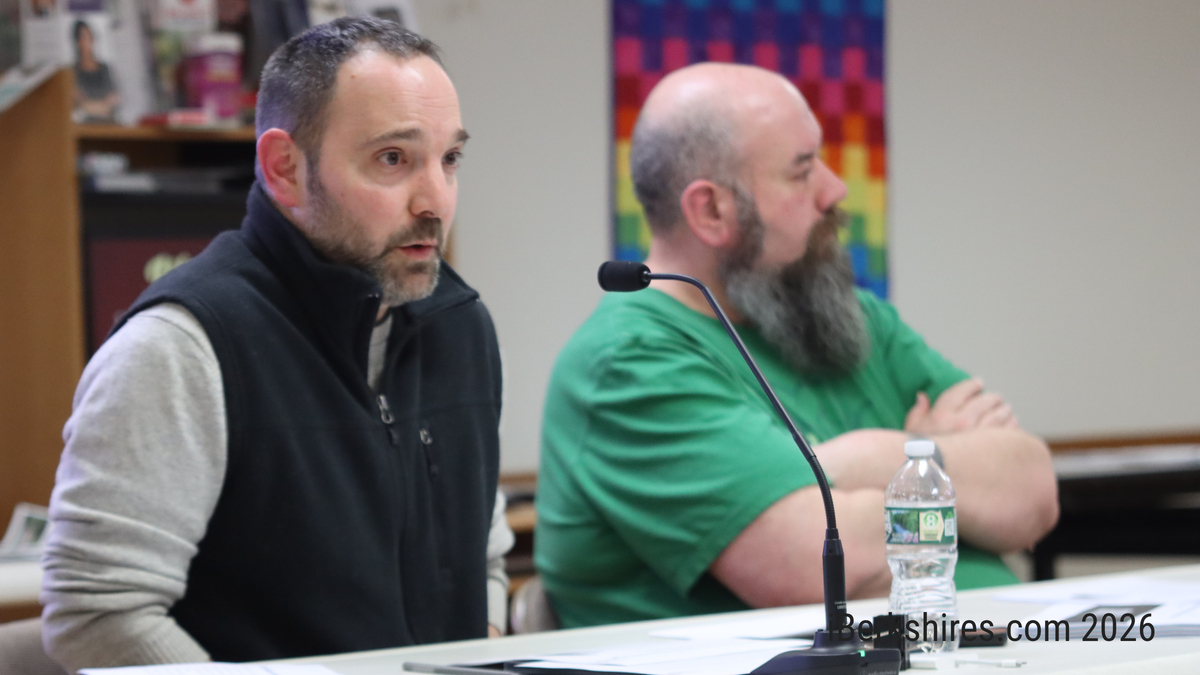
Mount Greylock Superintendent Joseph Bergeron, left, addresses the Lanesborough Select Board and Finance Committee as School Committee member Curtis Elfenbein looks at the projection of a slide in the district's budget presentation.
Superintendents from the Northern Berkshire Vocational Regional School District (McCann Technical School) and Mount Greylock Regional School District presented their respective FY27 budgets to a joint meeting of the town's Finance Committee and Select Board.
Both districts are sending significantly higher assessments for approval at Lanesborough's annual town meeting in June.
McCann Tech, which constituted a $317,109 expenditure for the town in the current fiscal year, is seeking $463,978 for the fiscal year that begins on July 1 even though the school's operating budget is up just 3.2 percent year to year.
The 46 percent increase in Lanesborough's share of McCann Tech's budget is is due to two factors: a rise in enrollment of town residents at the vocational school from 20 in 2025 to 29 in this school year and a capital assessment for the first round of payments — for interest only — for a roof and window replacement project on the North Adams campus.
The Mount Greylock assessment, a much larger component of Lanesborough's property tax bill, is up 10.99 percent from FY26 to FY27, from $6.8 million to $7.6 million.
Mount Greylock Superintendent Joseph Bergeron gave a budget presentation similar to one he has delivered twice to the district's School Committee and again last month to the Williamstown Finance Committee, explaining that while the FY27 budget maintains level services to students with a net reduction of three positions, a series of factors are driving much larger assessments to Mount Greylock's two member towns.
That list of budget pressures includes a second straight year of soaring health insurance costs, an unexpected spike in costs for out-of-district placements of students with special needs and the absence of reserves that the district purposely spent down over the last few years at the urging of officials in Lanesborough and Williamstown.
The intentional depletion of Mount Greylock's school choice and tuition "revolver" accounts and its excess and deficiency account, the equivalent of a town's free cash, was challenged by two members of the Lanesborough Select Board.
"I don't understand why you weren't thinking — instead of decreasing [Lanesborough's assessment by 0.1 percent in FY21], why didn't you keep it level so you could put more money into reserves?" Select Board Chair Deborah Maynard asked Bergeron.
Bergeron answered that officials in both member towns told the district they did not want Mount Greylock using taxpayers' money to build their reserves. In fact, officials in those towns said the opposite.
Carolyn Greene, one of four Mount Greylock School Committee members in attendance, explained that the district did build up one of the reserve accounts, E&D, to around a million dollars, near the maximum allowed by law, so that the district would be in a better fiscal position to seek a bond for the middle-high school building project that wrapped in 2018.
"There was a point where we had [built those reserves] and the towns said, 'OK, Now we want to know the true cost of education,' " Greene said. " 'We don't want you to hold onto all this money. We want you to use it to keep assessments to the towns low. ... And then come to us and say here's what it costs to educate our kids.'
"That's what we're doing now. That was a decision made by your predecessors."
Lanesborough Fin Comm member Lyndon Moors, who served as a faculty representative on the Mount Greylock Building Committee, confirmed Greene's account.
"We had elected officials here at these ‘virtual tables' in recent prior years who were very adamant that we should spend down the reserves," Moors said.
"It might have been a poor message," Select Board member Jason Breault replied.
His colleague Michael Murphy responded.
"As one of those officials, I agreed with that," Murphy said, adding later that earlier iterations of the Select Board called for Mount Greylock to use its reserves to provide property tax relief for Lanesborough residents.
"It wasn't us in a closed room making those decisions," Murphy said. "It was pressure from the community to make those decisions. We were responding to the community."
Bergeron said there was a case to be made for keeping assessment increases to Lanesborough low — 0.27 in FY20, minus-0.1 percent in FY21, 2 percent in FY22, 2.68 percent in FY23, 3 percent in FY24 and 3.38 percent in FY25 — even as the district's costs increased.
"I understand that perspective," Bergeron said of the earlier pressure from Lanesborough and Williamstown officials. "But in a year like this, when reserves would have been helpful dealing with shocks to the budget … it does not look like it was the right collective decision by the communities."
Going into FY27 and assuming no dramatic increase in state funding, the district expects the three reserves in the coming fiscal year to stand at $364,000 for E&D, $125,000 for School Choice and $50,000 for tuition — a total of $539,000.
Compare that to FY22 — the year the Mount Greylock project went out for final bonding — when the accounts stood at $959,957, $1,219,074 and $1,274,245, respectively, a combined $3.45 million.
And the reserves may not be bouncing back any time soon. In the tuition and school choice revolvers, the FY27 spending plan utilizes every dime the district expects to take in starting July 1.
Both McCann Tech Superintendent James Brosnan and Mount Greylock's Bergeron fielded questions about specific line items.
Bergeron took time to explain the differences between school choice, tuition and out-of-district placements.
The first two are revenue generators for the Mount Greylock district, which has more students coming in through the commonwealth's school choice program than it has families choosing to send children to schools outside Lanesborough and Williamstown and has a tuition agreement with the towns of Hancock and New Ashford (the former for middle and high school students only).
Although school choice reimbursement to the district is low — $5,000 per student, per state law — Mount Greylock has a relatively small choice population, 7 to 8 percent of the total student body for the three schools. And the district has a longstanding practice of adding school choice pupils at the elementary schools only when it has "empty seats" in a grade level while also planning to make sure those students don't cause a need for staffing increases at the middle-high school down the road.
Out-of-district tuition, on the other hand, is an expense for Mount Greylock. It is the cost paid for highly specialized education programs, sometimes residential programs, that district provides for youngsters it is legally — and, Bergeron always adds, morally and ethically — bound to educate.
"It's a cost that sometimes can be very significant," Bergeron said. "At other times, it can be quite low. It's purely based on population.
"This year, one of the schools we used was allowed [by the state] to double their tuition mid year. We had no choice."
There is some good news on the horizon, Bergeron noted. The commonwealth's circuit breaker program does provide relief to local districts for the high cost of specialized programs. But since that program is retroactive, the relief will hit the FY28 budget.
Bergeron also addressed some of the conversations in the Lanesborough community — including social media — suggesting that the town is overtaxed for public schools relative to neighboring districts.
The second-year superintendent pushed back against that argument two ways: First, by noting that Mount Greylock educates the third-largest population in the county while having the second-lowest per-pupil cost of that peer group. And second by noting that state funding formulas result in 17 percent of Mount Greylock's budget coming from Boston, a much lower percentage than some neighboring districts.
"That's an area where we are advocating to look at the formula," Bergeron said.
No one from the two Lanesborough elected bodies pushed for budget cuts at either McCann Tech or Mount Greylock. But in an echo of the Fin Comm hearing in Williamstown, the Lanesborough officials expressed sympathy for a resident who argued that the district should add a teaching position into the FY27 budget.
Jodi Szczepaniak-Locke, a former chair of the town's Finance Committee, spoke from the floor of Monday's meeting to urge the district to follow the recommendation of the Mount Greylock School Council and add another math position at the middle-high school.
Szczepaniak-Locke called the district's self-described "level services" budget "unacceptable" for parents of vulnerable students.
"If I'm going to spend 11 percent more in taxes to send my child to a public school, I want what she needs," Szczepaniak-Locke said.
"The School Committee agrees these positions are critical," Greene said. "We agree they're a need and not a want. But we also agree we couldn't justify putting them in this year's budget."
Maynard asked Bergeron whether the district could fund another full-time equivalent teaching position, an estimated $120,000 expenditure, through line item reductions elsewhere in the budget.
"We have already gone through all the non-staff things — meaning supplies, services, text books, software, transportation. We don't have any other places to decrease," Bergeron said. "The only thing left is staff.
"[Adding a math position] would take someone else coming forward saying, 'You just eliminated an English position for a math position,' or, 'You just eliminated the art department to get a math interventionist.' "
Tags: fiscal 2027, lanesborough_budget, MGRSD_budget, school budget,