Williamstown Backs Parents on School Amendment, Passes All But One Article
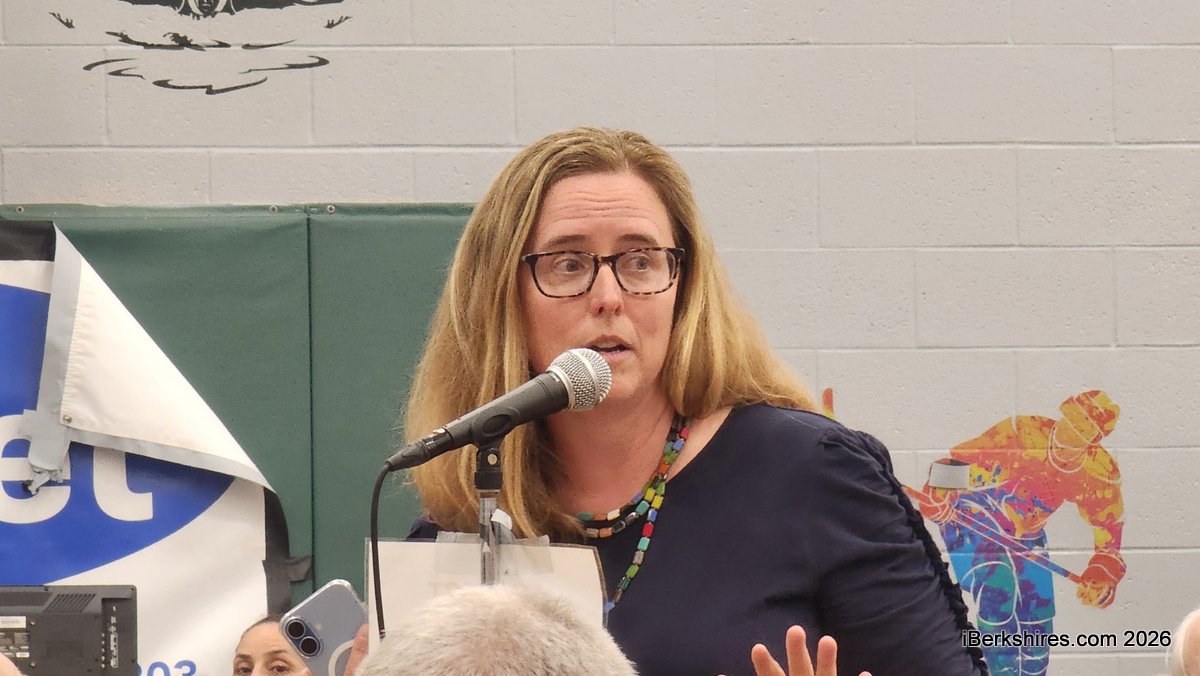
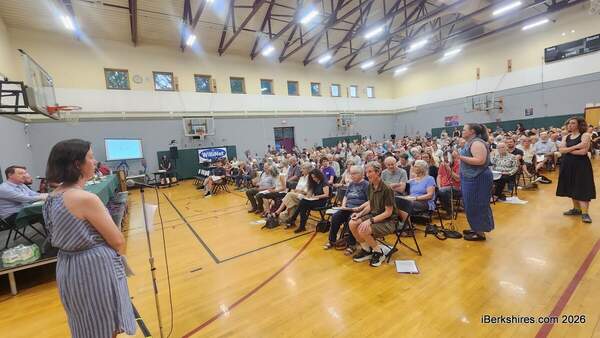
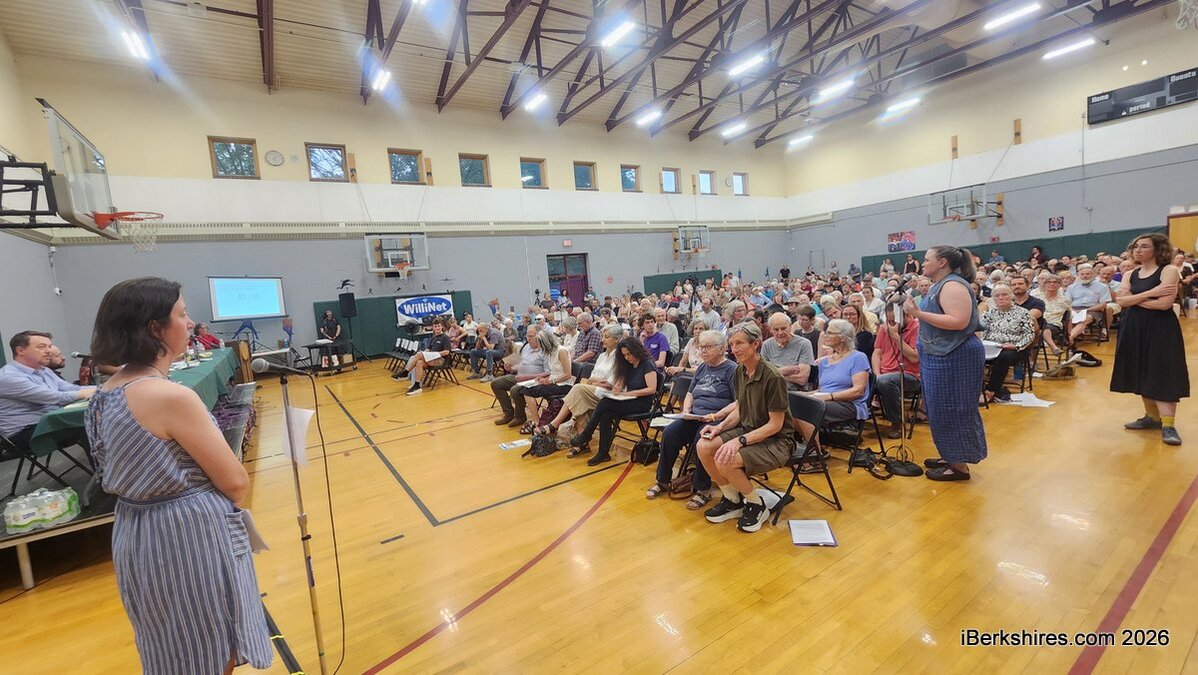
School Committee Chair Julia Bowen speaks in favor of the school budget, saying difficult decisions had to be made.
The fiscal 2027 assessment of $16,963,270 to the Mount Greylock Regional School District then passed easily by voice vote.
All town meeting questions on the 32-article warrant passed easily with the exception of a request by the Select Board to initiate special legislation to allow the town administration to determine the type of media for legal notices.
The addition of the math interventionist generated the most discussion, focusing on the educational and financial effects of the position.
A group of WES parents concerned about mathematics instruction at the school had been advocating for the additional funds, about 0.7 percent of the proposed assessment.
Jenna Hasenkampf, a member of the School Council that unanimously recommended the post, made the amendment, which was quickly seconded.
"Our MCAS state math scores at WES have declined every year since 2019," said Hasenkampf. "Our iReady assessments, which is our current math curriculum from this school year, show that 40 percent of our students are currently below grade level by at least one grade level, if not more, in math, as of December 2025."
The interventionist was identified as a priority staffing need, she said, and "it's restoring a role that was previously cut and has been requested by the School Council as far back as 2021."
Resident Anne Skinner thought the causes for this drop in math scores must be complicated, and noted this has been a trend across the country.
"I think we perhaps need more information. I understand that a new math curriculum is in the process of being introduced, and I suggest that we give that a year or so to see if that helps with the problem before we go on the proposed interventionist," she said.
School Committee Chair Julia Bowen said the $30 million level-service school budget "represents difficult decisions that we discussed and made as a School Committee."
She confirmed that 40 percent of students performing below grade level but said when numbers are that great they point to curricular issues in the classroom.
"Yes, additional support would be great. So I do not want to diminish or tell parents that their advocacy is misplaced," she said. "I want to provide context for how the School Committee came to the budget that we came to."
Steven Miller, a School Committee member, said it wasn't just $120,000 for one year, but for every year thereafter.
"This is a budget that has been carefully prepared by the committee," he said, noting he was speaking on his own and not really for or against. "At the local level we have done a tremendous job to be efficient with the resources we have to meet the needs and the challenges that we have, unless we are willing to annually add significant local burdens to the taxpayers. The only reasonable solution long term is to put pressure on state legislature to make responsible decisions."
A dozen or so parents advocated for the adding the funds, saying it was critical to support children's education in their early years.
"I agree with Jenna that this is not a undoing of the School Committee's very challenging, heart-wrenching work, making difficult decisions," said Devan Bartels. "This is the messy part of our democracy. This is not a circumventing or bypassing process. This is the process, getting that right, and I think the School Committee wants to get that right too, and we want to get it right just as much as they do."
One parent spoke of how her children had benefited years before when a math interventionist had been in the school; others pointed to the need to lead when society was slipping toward anti-math and science.
"These are the years when our children are building core skills and developing beliefs about whether they are capable math learners," said Elizabeth Upton, a math professor. "Early support, early success, early confidence — these things can make a lasting difference."
Briee Della Rocca said it was an opportunity for the community to share with the School Committee that it would support the schools' needs.
"I think this is an increase that you must fund as a message to the School Committee that they must fund our schools to the measure of need that they are seeing," Della Rocca said, adding when the requests come for other staff, "let them know we will support that we are a pro-school community."
Hugh Daley, former Select Board member, said, he had "great confidence" in the School Committee, the administration and the budget they'd put together.
School Committee member Carolyn Greene on a point of order asked why the amendment was being debated before the school budget had been presented. Moderator Elisabeth Goodman said the amendment was a simple figure and she would allow debate to continue.
"We are a very pro-school School Committee," said Green. "Please do not misunderstand our ask for a level-service budget as being anti-school.
"We are disheartened that we do not feel we are able to bring forward positions that were recommended by all three school governance councils in all three schools in our district, but it's not because we don't care about our kids, it's because we know the fiscal realities that we are facing as a town."
Another $120,000 for the school was another $120,000 closer to a Proposition 2 1/2 override, she cautioned.
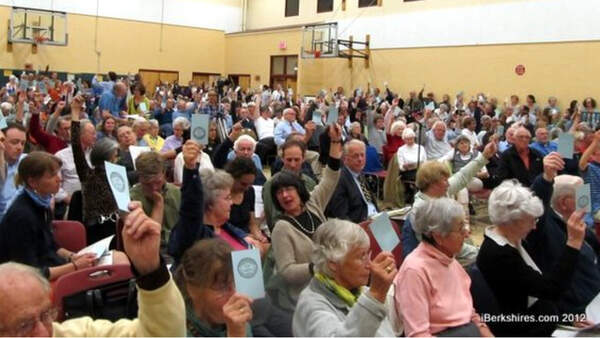
The amendment passed on a clicker vote 233-102; the school budget passed on a voice vote after a brief presentation by Superintendent Joseph Bergeron.
The amendment vote was one of a handful the 389 registered voters took by clicker during the three-hour meeting. Goodman generally took the voters' measure when deciding which way to vote and most went by voice.
She warned speaker to stick to the three-minute limit and to make sure they weren't just repeating what others had said.
"It doesn't help your case to present the same points over and over," she said. "Keeping your remarks brief shows respect to your neighbor's time and may help your cause."
• A citizen's petition to ban second-generation, anti-coagulant rodenticide to protect native predators from being sickened or killed easily passed 268-35.
Leslie Gura, who motioned the article, noted 49 towns have municipal bans and 33 petitions on bans are pending in the Legislature, which is also debating bills to ban the products.
"The average person may not be aware of what's being placed on their property," she said. "Once this is passed and it's approved by the Legislature, then the town can decide how to implement this."
• A ban on land application of sewage sludge passed 235-57. The citizens' petition was motioned by retired farmer Sharon Wyrrick.
The concerns are that the sludge, a compost created from human sewage, contains per- and polyflouroalkyl substances, so-called "forever chemicals" that will enter the food system. PFAS have been linked to cancer and other ills.
The Hoosac Quality Water District, the shared wastewater plant on Simonds Road, last year had raised the possibility of taking sludge and composting it for sale. This was quickly rejected when residents in North Adams and Williamstown opposed the move.
"Let's act now. Let's not wait for an unknown and undetermined wait," said Wyrrick. "It is about our values as a community to protect one of our absolutely most valuable resources."
Hugh Daley said it feels intrusive to be questioning people about using material that is legal to buy in the next town over, and would put more pressure on the health inspector.
"I think we should wait for the state to do this," he said. "Let's not make Williamstown a whole separate bubble within the North Berkshire communities."
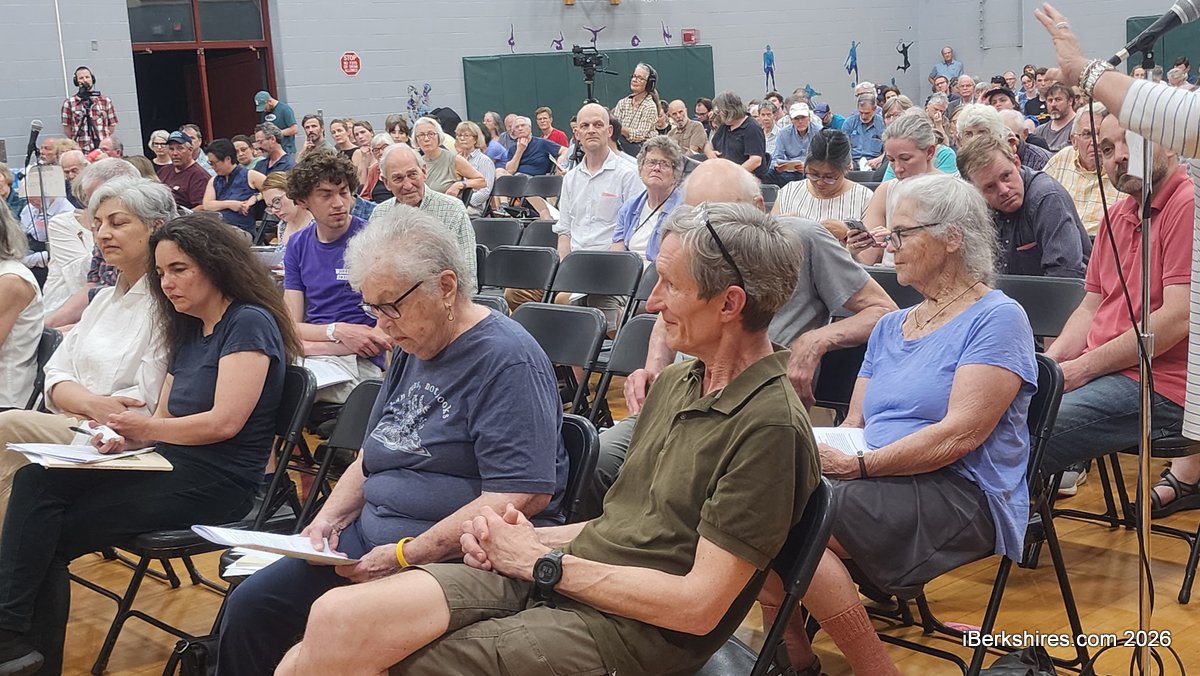
The crowd began to thin as the night wore on.
Stephanie Boyd, chair of the Select Board, stepped down to speak in favor of the article, telling Maroja this was about solids and that the PFAS is coming from industrial and other sources rather than human waste.
"We know there is PFAS contamination is in our treatment plant here, but again, this bylaw does not necessarily address what happens with the waste from our facility, but we want to protect our community from having waste coming from other towns," she said.
The article passed 235-57.
• Sue Abrams motioned the citizen's petition to tighten the town's 2015 ban on single-use bags to include "compostable" bags, thicker plastic bags and product bags. It would not affect bags used for the transfer station.
She said she has spoken to the manager of Wild Oats who told her paper bags are already being used in the bulk produce aisle.
One voter asked why the Select Board failed to recommend. Boyd said they hadn't seen the petition until late and didn't feel there was enough review it even though they agreed with the intention.
Ralph Hamman wanted to know about the "draconian" fines. Abrams said they were based on the 2015 fines and raised in line with inflation. The article passed 167-105.
• Also easily passing by voice vote were raising the income limits for tax exemptions, adopting a seasonal communities designation (putting the town in line for state grants), and amending the accessory dwelling bylaw to comply with the Affordable Homes Act.
• All the Community Preservation Act requests also passed, but not without nearly an hour of debate despite Goodman's request at 9 p.m. to "wrap it up."
The sole article that failed a request for special legislation to allow the Select Board or town administration to determine what media to use for legal notices.
State law mandates that notices be filed in print, even if they are also posted online.
Susan Puddester, who is on the Council on Aging, asked if this meant shifting notices online and out of The Berkshire Eagle, the only print paper left.
"We often hear that people don't know what's going on because they are not comfortable using the computer or their iPhone to get information, so I think that it's a bad idea for people to get their information that way only," she said.
Boyd said it was possible and Skinner responded that "if somebody's really worried about only getting their stuff through iBerkshires or something like that, they should probably oppose this."
They did: 123-126, in the closest vote of the night.
Tags: annual town meeting, fiscal 2027,