Mount Greylock School Committee Talks Elementary Math Instruction
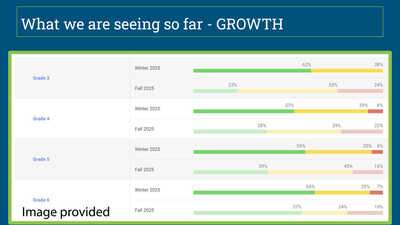 |
| A slide shown to the Mount Greylock Regional School Committee shows an increase in the number of elementary school pupils performing at grade level in math (in green) and a decrease in the number performing two or more years below grade level (in red) |
WILLIAMSTOWN, Mass. — In the shadow of a community-wide discussion about math instruction at Williamstown Elementary School, the Mount Greylock Regional School Committee Thursday heard a presentation about steps the district is taking to improve its program at both elementary schools.
Assistant Superintendent of Teaching and Learning Joelle Brookner talked with the committee about the district's move to the i-Ready math curriculum in grades K through 6 and how the first year of the curriculum's adoption already appears to be paying dividends.
Brookner first provided some background in how the district came to adopt the learning platform from publisher Curriculum Associates.
The process started when the district took a hard look at the pupils' performance in math and realized its former curriculum, Everyday Math, might need to be replaced.
Math instruction was a strong enough concern at the Williamstown school that its School Council this winter requested the addition of a full-time math interventionist to the faculty for the 2026-27 academic year.
Ultimately, that request did not make the cut when the administration produced a budget that was approved by the School Committee to send to town meetings in Williamstown and Lanesborough. But a group of concerned parents has announced its plan to make an amendment on the floor of the Williamstown annual town meeting Tuesday to add $120,000 to the town's assessment for the district in order to fund the position at WES.
At last Thursday's meeting, Brookner acknowledged the planned amendment and said that an interventionist, if added, would become "an integral part of the team" at the elementary school.
But she focused her presentation on how i-Ready already helps create the capacity for differentiated instruction in the classroom at WES.
i-Ready was selected after a year-long review by a committee including faculty from each grade level representing Lanesborough Elementary and Williamstown Elementary, Brookner said. The selection process included last year's piloting of the curriculum in one classroom at each grade level and culminated in this year's implementation across the district.
Brookner said that among i-Ready's benefits is its focus on face-to-face instruction supported by computer-assisted learning.
"All of the programs have an online component," she said. "We wanted one that very much had the online component that could either be very much in the background or a small piece of it. We are very conscious at the elementary schools about screen time."
i-Ready also incorporates diagnostic tests that pupils take three times over the course of the year, she explained. The data can help identify children who need extra help and inform strategies for teaching the whole class.
"i-Ready is built on an acceleration model, and it suggests differentiation and suggests differentiation tools and lessons for teachers that support students while also carrying on with grade-level instruction," Brookner said.
"There is an online individualized learning platform called My Path. It is completely tailored to a student's performance on the diagnostic. So based on the questions they could answer and couldn't answer, My Path picks that up. … This is the online computer piece. There are also many, many face-to-face lessons teachers can learn.
"Curriculum Associates recommends students use it for no more than 49 minutes per week, and that's not at one sitting."
Preliminary diagnostic data shows that the new curriculum already is helping to improve pupils' performance.
Brookner showed the School Committee data that indicates a growth in the number of elementary school pupils district-wide performing at grade-level from fall to winter during the current school year.
"Third grade, went from 23 percent green [at grade level] and 24 percent students in the red [two or more years behind grade level] to zero percent red and 62 percent green," Brookner said. "That's just fall to winter. We're super excited to see what comes in the spring."
Superintendent Joseph Bergeron noted that the diagnostic data produced by i-Ready provides far more information than can be presented in a setting like a School Committee meeting.
"The relatively high-level grade-level data you saw tonight in terms of fall and winter benchmark assessment data, that, of course goes many layers deep and at the individual student level," Bergeron said. "The data teams [in each elementary school] utilize that data. They utilize teacher observations. They come together and pick up each individual student ... and say, 'OK, what does this student next?' Does the student need further evaluation? Does the student potentially need support from the Special Education department? Does the classroom need X or Y next?
"These data teams are being given the time to do that in a highly reflective, data-rich environment, which is something that has not existed in our schools to the extent that we know our schools will benefit from."
School Committee member Carolyn Greene asked how the implementation of i-Ready with its focus on differentiated instruction is impacting the schools' teachers.
Brookner acknowledged that the adoption of any new curriculum is difficult, but the district is introducing the i-Ready platform in stages to make it manageable. She also noted that i-Ready provides targeted materials for pupils who may need help with specific concepts, eliminating the need for what she characterized as, "teachers … spending an inordinate amount of time outside of school hours either creating materials or looking for materials," in the past.
School Committee Chair Julia Bowen noted that she formerly taught math in a high school setting and knows how difficult it can be to help students catch up to grade level in the classroom.
"I wish I had something that could help automate the process for me to recognize: Here are the skill gaps and here are the tools that will be served up for a student," Bowen said.
"What I'm hearing [Brookner] say is this is a hard shift, but it is going to get [teachers] to a better place that hopefully will be easier."
Bowen also noted that the continued training on i-Ready is a part of the district's professional development strategy for faculty in fiscal 2027. She said some members of the community may be concerned to see the budget line item for PD declining from FY26 to FY27, but that number does not fully represent the district's commitment to investing in its faculty.
"The most important thing we can do is provide our teachers with high-quality PD, which you will still be doing," Bowen said, addressing Brookner. "They will have the time to absorb and learn and work with the tools we have without having us bring in more expensive PD."
Tags: Mount Greylock,