Federal program could boost Berkshire farms
By Claire CoxPrint Story | Email Story
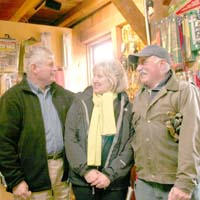
Richard Coombe, left, of the Natural Resources Conservation Service, with farmers Judy and Dennis Mareb. (Photo by Claire Cox)
GREAT BARRINGTON — A 70-acre farm that produces 30 varieties of apples was the site on Nov. 5 for the kickoff in Berkshire County of a federal program to reward farmers for taking proper care of their soil. Berkshire County is among 202 counties across the nation designated by Ann Veneman, U.S. secretary of agriculture, for farmers to receive payments from a $900 million federal appropriation designed to recognize farmers for long-term soil-and-water conservation practices within important watersheds. Berkshire and Essex County were selected for the introduction of the Conservation Security Program in Massachusetts, under which farmers will be required to file applications describing in detail the conservation measures they have taken over the years. The signup date will be announced soon, with checks for as much as $20,000 sent to top-rated farmers next year. The Berkshire watershed, which extends from North Adams in the north to Sandisfield in the south, lies within the northern and central portions of the Housatonic and Farmington Rivers and portions of the Hoosic River. Richard Coombe, regional assistant chief of the Natural Resources Conservation Service, announced the program at a gathering that included several other Department of Agriculture representatives and local farmers in the main shed at Windy Hill Farms on Route 7. The hosts were Dennis and Judy Mareb, owners of the farm, which was chosen for the occasion because of the long-term practices that have enhanced the quality of its soil and water — and its crops as well. The Marebs have transformed an abandoned dairy farm they bought in 1980 into an orchard, a garden center and raspberry and blueberry patches. The old dairy barn houses a productive cider press. Coombe said that for the first time in American history, the federal government is recognizing the conservation efforts of many farmers. “This is a quantum leap,” he said. “We are rewarding the farmers who are good and great stewards of their soil and of their land. We are choosing watersheds where the farmers themselves have demonstrated over the years, often for four, five and six generations, the fact that they have been excellent stewards of the land.” He said the designated Massachusetts watershed areas include more than 600 farms on 30,000 acres, with two-thirds of the farms being in Berkshire County. Of the total acreage in the two watersheds, about 30 percent is used for crops, 65 percent for hay and grazing and 5 percent for orchards and nursery stock. Coombe said each of the selected Massachussets watersheds has unique and important natural attributes that are valued and often utilized by farmers and the public. “Although the main stem of the Housatonic River is compromised by contamination with PCBs, the numerous wetland and other water resources within its watershed provide exceptional stopover and nesting habitat for black and wood duck and migratory waterfowl,” he said. “Deer, bear, upland game and non-game wildlife abound throughout the watershed. Fishing, hunting, camping, canoeing and hiking are therefore popular associated recreational activities enjoyed by the general public.” Cecil B. Currin, Agriculture Department conservationist for Massachusetts, said farmers would be enrolled in one of three tiers in the program, depending on the extent of the conservation treatments in place on their farms. Payments will be based in part on existing conservation treatments, as well as on landowners’ willingness to undertake additional environmental enhancements. Bruce Philbrick, the Agriculture Department’s conservationist for Berkshire County, said the program would be “a great deal for the farmers in our area by allowing them to maintain what they have been doing.” He said all farmers in the watershed would be encouraged to participate. Dennis Mareb, who serves as a supervisor in the Berkshire Conservation District, was horticulturalist on the Great Barrington estate of Beatrice Berle for 10 years before he and his wife, a former elementary school teacher, bought Windy Hall Farm. “I have tried to practice careful conservation procedures to keep the soil healthy and water clean,” he said. “I worked with the soil, establishing contour planting on the hillside with a layout of trees that minimizes erosion and maximizes water retention. I provided cover cropping with vegetative strips between rows of trees. I changed from a tillage system, where we were losing a lot of soil, to wider spacing with grass stabilization strips between trees. We have gone to drip irrigation instead of overhead irrigation. That allows us to use water more efficiently. It helps replenish the soil and minimizes erosion. “In 24 years, we have done a number of what we felt were major improvements. They have made a huge difference in the success of this farm.” And soon, with the new program, federal officials hope, similar practices could make a huge difference at other farms.
If you would like to contribute information on this article, contact us at info@iberkshires.com.

Friends of Great Barrington Libraries Holiday Book Sale

GREAT BARRINGTON, Mass. — The Friends of Great Barrington Libraries invite the community to shop their annual Holiday Good-as-New Book Sale, happening now through the end of the year at the Mason Library, 231 Main Street. 
 
With hundreds of curated gently used books to choose from—fiction, nonfiction, children's favorites, gift-quality selections, cookbooks, and more—it's the perfect local stop for holiday gifting.
 
This year's sale is an addition to the Southern Berkshire Chamber of Commerce's Holiday Stroll on this Saturday, Dec. 13, 3–8 PM. Visitors can swing by the Mason Library for early parking, browse the sale until 3:00 PM, then meet Pete the Cat on the front lawn before heading downtown for the Stroll's shopping, music, and festive eats.
 
Can't make the Holiday Stroll? The book sale is open during regular Mason Library hours throughout December.
 
Proceeds support free library programming and events for all ages.
View Full Story

More Stories