Review: Divergent Artists Usher a North Adams 'Bloom'
 |
In our newly eco-conscious culture, these seem timely, topical guidelines for one to curate a show.
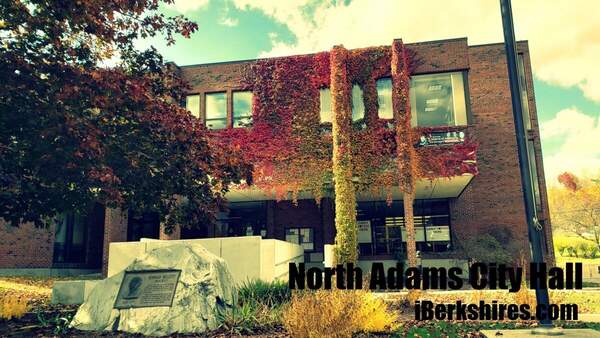
But there's a nod to location that's equally relevant, if understated. North Adams itself, that mill-town-turned-arts-mecca, enjoys its own bloom — from Massachusetts Museum of Contemporary Arts to the Eclipse Mills Studios, the city's clearly on the upswing and one fostered by the unlikeliest of injections, the fine arts.
Here's where the hip kids move (cheap rent!), where the downtown's returning (Gallery 51 means 51 Main St.), and local events outpace most neighboring towns.
No wonder then that this "Bloom" is homegrown, curated by Sean Riley (whose "nothing but a man is a man" can be seen in the gallery's window) and his 15 museum studies students at Massachusetts College of Liberal Arts. Williamstown may have the Clark and its college, but "Bloom" makes the case that the young blood flows east.
<L2>And young it is. From all accounts the "Bloom" artists are at the start of their careers, not long from MFAs in Providence or Portland, and exhibiting in a wide range of media and material: digital prints, paint, plywood, water pearls, wheat grass, video and sculpture.
And with some exceptions, the work's accomplished.
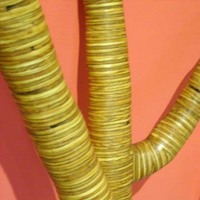
Top of the list has to be Christopher Robbins, who, unlike his A.A. Milne namesake, mixes playtime with destruction. Don't miss his "There was a man who made a tree just so he could chop it down" and the accompanying video documenting its production. The sculpture/performance confronts our notion of natural resources, their manipulation and co-modification.
It's storybook synopsis would run something like this: once there was a tree, turned to plywood, which we then chainsawed, glued and made into a tree. Then we planted it. For an encore, we took these steps backwards and returned the plywood to Home Depot with receipt.
Sculptors Austin Heitzman and Jeffrey Mann also manipulate trash and scrap, the latter building "Autopuddle," a sort of art-deco tribute to the Motor City, from sprockets and bars. Mann explains: "I use car parts because I believe the car is ... the subliminal informer and the Frankenstein monster that will eventually cause our destruction."
Heitzman trashpicks more democratically, fastening an "accumulation of scavenged remains" into a "Triton." This violent assemblage looks like a cocoon wrapped around a Barbie's last car crash. Or a praying mantis risen from rubbish. Or a junkman's dying thought.
On the two-dimensional side, Jaime Kennedy and Bennet Morris make the strongest impressions with their digital prints. Bennet's trio of pictures imagines a post-apocalyptic sea floor or landscape, industrial ruin backlit by colors vibrant as interstellar clouds.
Kennedy remains harder to pinpoint, his massive black and white photos looming like a latter-day Audubon on the museum's west wall. They're monumental and illustrative, standing in stark contrast to the show's weaker prints. Patrick Perry's "Gorge" and "Envelop" seem obvious sops to the eco-mantra that the earth conquers all. In one a tree trunk grows over a fence post. In another, brambles crawl across the Virgin Mary's stone face.
These attempts at profundity seem harmless, however, when compared to Noah Kalina's "Everyday," a video project cycling through a three-year catalog of expressionless self-portraits. Kalina offers "the subtleties of the aging process" as a motivator, but a twenty-something with a desktop camera speaks less to mortality than the MySpace mindset: I am my own art, unfiltered. His portentous soundtrack only makes such self-indulgence harder to watch. <R3>
But this is a small matter, when the rest of the work's so thought-provoking, if not simply strong. Spend some puzzling over Barbara Miner's "Reassignment of Resources," a book arts sculpture that's been shotgunned with water pearls, pinched with calipers, and set atop beeswax and glass. Or listen to Jennie Thwing's "Kirby," a video interview that splices an elderly man's reflections on life and love.
In fact it's Kirby who provides the best subtitle for the entire exhibit: "It was hard for me to restore paradise to the earth." And yet we try daily, with renewed efforts and pains.
The exhibit runs through April 20, and can be viewed seven days a week, 10 to 6. For more information: 413-664-8718.