MCLA Physics Professor Receives Science Award
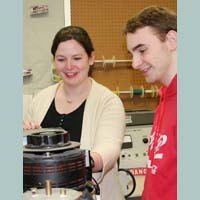 |
| Emily Maher, Photo Courtesy of MCLA |
The funding – a two-year award in the amount of $33,286 – will allow Maher to to participate in the MINERvA (Main INjector ExpeRiment for v-A) experiment at the Fermi National Accelerator Laboratory (Fermilab), in Illinois. At Fermilab, Maher and MCLA students will join more than 100 physicists from more than 20 different colleges and universities from around the world – including the U.S., Greece, Brazil, Germany, Mexico, Russia and Peru in studying low energy neutrino-nucleon cross sections.
“The Cottrell College Science Award encourages the culture of research at MCLA, as well as directly involving students in cutting-edge physics research,” Maher said. “Specifically, the funding will allow students to contribute to the MINERvA experiment at MCLA and accompany me to Fermilab. At Fermilab the students will have the opportunity to help construct the MINERvA detector, observe how a collaboration works together to conduct a multi-million dollar experiment, and meet physicists from all over the world.”
According to Research Corporation President James M. Gentile, “Predominantly undergraduate colleges and universities play a leading role in the development of future scientists. Research Corporation awards foster the professional growth of faculty to ensure that many students will have the opportunity to participate in high quality research, enriching their undergraduate years. Participation in research funded by Research Corporation has encouraged and inspired many students to follow careers in science.”
Little is known about the neutrino, one of 12 fundamental particles which make up all matter. “Neutrinos are neutral and almost mass-less, so they rarely interact with other particles. We can only study them through their interactions,” Maher said. “The more we understand about neutrinos, the more we’ll understand about our universe.”
In the planning stages for the past six years, participants are building a detector that will record what happens when the same beam of neutrinos interacts with the nuclei of four different materials – lead, iron, carbon and helium.MINERvA is in its final design and prototyping stages. The first detector module was completed in early 2007 and project participants expect to begin taking data in 2009. Maher’s work on the project will involve writing software analysis coding, interface data analysis and participation in the installation of the detector.
Research Corporation is a nonprofit research organization that provides grants for work in the sciences.
Fermilab is located in Batavia, Illinois, about 45 miles west of Chicago. Originally named the National Accelerator Laboratory, Fermilab was commissioned by the U.S. Atomic Energy Commission under a bill signed by President Lyndon B. Johnson in 1967. It was renamed in 1974 in honor of 1938 Nobel Prize winner Enrico Fermi.
For more information, go to http://www.mcla.edu/physics or http://minerva.fnal.gov.