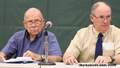
Academics Suggest U.S. Policy Partly to Blame for Terrorism
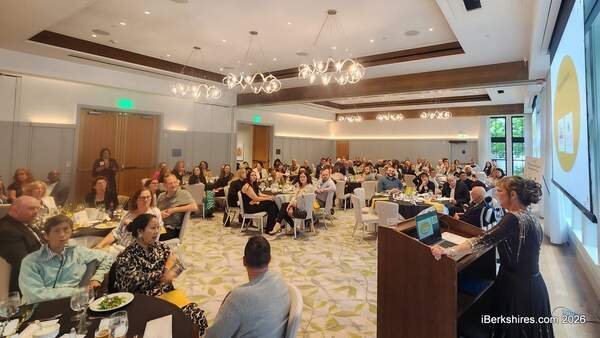
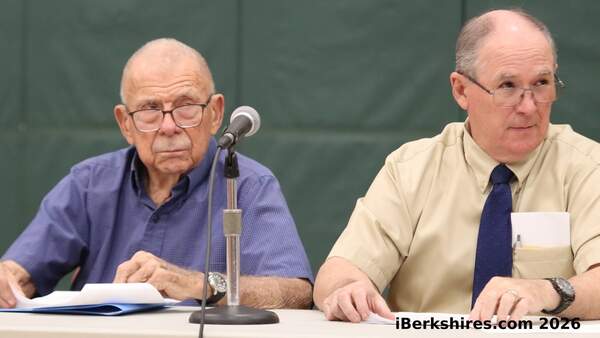
WILLIAMSTOWN, Mass. — Visiting professors at a roundtable discussion at Williams College last week said that while most Middle Eastern Muslims would recoil from violence against the innocent, they nevertheless oppose much U.S. policy in the region.
In particular, they said the United States — the one remaining superpower after the collapse of the Cold War — props up repressive regimes. And U.S. policy in the region often translates to Middle Easterners as hostile. Some speakers at the discussion held Thursday, Oct. 4, in Griffin Hall stressed that an effort to understand the historical context of anti-U.S. sentiment is by no means to rationalize the Sept. 11 attacks on the World Trade Center and the Pentagon that left an estimated 7,000 dead.
Michael Klare, professor of security studies at Hampshire College, said the repressive rule of the Saudi royal family — who are supported by the United States — drives any dissidents underground.
"Opposition to the regime has to be secretive," said Klare. "There is no legal, non-violent way to oppose the government, so opponents are drawn to 'terrorism' and violence, to the most extreme elements.
"If open discussion was allowed, these people would be marginalized."
The fundamentalist mindset, he said, views the Saudi regime as corrupt, squandering its wealth on palaces and limousines. And worst of all, from that point of view, is the U.S. military presence — infidels — in the land of the Prophet Muhammed.
"They want to purify the Muslim holy land, but they [believe they] first have to get rid of the U.S.," said Klare. "The epicenter is Saudi Arabia."
And U.S. interest in that region dates to World War II, when its crucial position as an oil producer made its importance evident. Mary Wilson, professor of Middle Eastern history at the University of Massachusetts at Amherst, told listeners that her Beirut-born mother-in-law, who was a delegate to the founding conference of the United Nations, was awakened in her northwest Washington, D.C., home after the attacks by the sound of eggs hitting her windows.
Americans are asking, "Why do they hate us?" said Wilson, "but to Middle Easterners, the question is, 'Why does the United States hate us?'"
This assumption of hatred, she said, rests on U.S. support for Israel, which, she said, allows Israeli settlements to continue, and sanctions on Iraq lasting more than 10 years and estimated by UNICEF as having resulted in the deaths of half a million children under the age of 5.
Wilson noted that hijackers in the Sept. 11 attacks "come from Middle Eastern states allied with the United States — Egypt, the United Arab Emirates and Saudi Arabia."
"If they'd come from Syria, we'd already have bombed Damascus by now," she said.
Wilson recalled Israeli Prime Minister Ariel Sharon's role, while he was defense minister, in the massacres by the Lebanese phalangist forces of refugee camps of Sabra and Shatila that cost of the lives of an estimated 3,500 people.
"If the United States is truly embarked in a war against terrorism, let's apply the yardstick equally," she said.
Jamal Elias, professor of religion at Amherst College, noted that photographs of the hijackers show, for the most part, clean-shaven faces, and no turban-wearers, in contrast to the appearance of members of the Taliban regime in Afghanistan.
"Their motives were very strongly political, but there's no denying the religious dimensions," said Elias.
He called terrorist mastermind Osama bin Laden "the Che Guevara of his generation — a revolutionary hero to many Muslims."
"I know a lot of Muslims, and I do not know one Muslim who supports killing innocent people. And I know a lot of mean Muslims. To be radical doesn't mean you commit horrible acts," he said.
The trend toward the politicization of Islam dates from the first quarter of the 1940s, he said. "People started seeing their contemporary societies in collapse — colonized or humiliated in a state of capitulation," and this caused a wish to return to a utopian age 1,400 years ago, when the Prophet Muhammed was alive and immediately after his death.
The Taliban's wearing of straggly beards and pants that don't cover their ankles are symbolic gestures indicating a disregard of appearance that is, he said, "historically inaccurate."
"They cultivate the unkempt look, but they're not anti-modern," he said. "They use satellite phones."
Islamic fundamentalist groups, he said, flourish in states such as Egypt, Pakistan and Sudan, "states that have completely failed to deliver services."
"These groups come in and deliver services [schools and hospitals] efficiently and honestly." Their ideas are fostered in Islamic fundamentalist religious schools in Pakistan that are independent of the state Ministry of Education, where they are "taught who knows what."
And Elias warned against the United States pinning its hopes on the Northern Alliance.
"God help the Afghan people if the Northern Alliance takes power," he said. It was the chaos of civil war at the end of the Soviet occupation, he said, that led to the Taliban's rise to power, because that group promised to restore order.
Ali Mirsepassi, professor of sociology at Hampshire College, noted that the 19 hijackers all had knowledge of at least one Western language and had lived in the West quite a long time. They were middle-class and educated, said Mirsepassi. "These people have been exposed to quite a lot."
He pointed to the recent nature of Islamic movements as following a long period of secular politics. "These movements are very seductive to intellectuals and immigrants," he said. "There is a war going on in the Muslim world for the hearts and minds of Muslims.
"The people of the Middle East have been humiliated and oppressed."
Mirsepassi urged Western nations to support liberal, democratic movements.
"We have supported some pretty monstrous governments in the Middle East," he said. "When you're a guy sitting in Asia, the U.S., Britain and Russia look pretty much alike," he said. Mirsepassi said the United States was loved in the region, was considered "young, revolutionary and anti-colonial," until the 1950s when its CIA-led coup overthrew the popular, democratic and liberal Iranian government of Premier Mossadegh. And, concerning regional opposition to the state of Israel, he said, "When a group of Europeans go to Palestine, the people who used to live there don't like it."
And, in an assessment highlighted by the weekend's start of U.S. retaliatory bombing in Afghanistan, Mirsepassi said, "If the United States wants to, it can get rid of the Taliban in less than a week." "The Taliban can be taken out very, very easily," he said. The question is, what might replace it.
Tags: 9/11,