Oncology Practice Introduces High-Tech Cancer Test
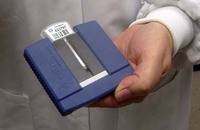 |
| Tumor cells are captured by this device so they can be read by a technician. |
Berkshire Hematology Oncology is the first private clinic in the area to offer the diagnostic blood test that can snatch a single cancer cell from a pool of billions of cells.
The test will offer "vital real-time" benchmarks of how well a course of treatment is working, said Dr. Paul Rosenthal in announcing the practice's offering of the test. "Adding this technology, based on how many cancer cells are in circulation, will give us a true advantage in the fight against cancer here in Berkshire County."
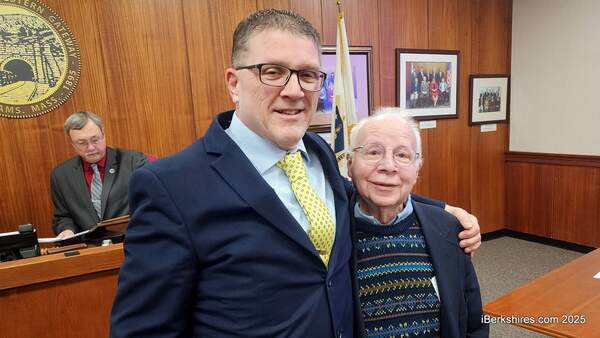
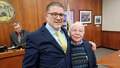
Mayor John Barrett III joined the oncologists at the Ambulatory Care Center on the North Adams Regional Hospital campus on Thursday morning to discuss the possibilities of the CellSearch technology, named the "Top Medical Innovation of 2009" by the Cleveland Clinic.
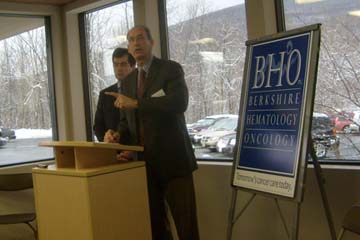 Dr. Paul Rosenthal makes a point at a press conference announcing BHO's new cell test; Dr. Spyros Triantos stands next to him |
Two decades ago, Eileen Barrett received devastating news during what should be have been her happiest time — her honeymoon.
It was breast cancer, first in one breast and, six months later, the other. After both surgeries, she was given a clean bill of health. But less than two years later, she was battling cancer again when it was found in her chest cavity.
"She probably had it all along," said the mayor. "If this technology had been available, she might be alive today."
Dr. Spyros Triantos said oncologists have depended on physical examinations, standard blood tests and more advanced tools such as PET and CT scans to determine if treatments, such as chemotherapy, are working. But there's a time lag in using these tests of weeks, or months; in the meantime, patients may be pursuing ineffective, and painful, therapy.
"One would not expect any meaningful change in a patient's scans until aftertwo to three months of treatment," he said. "Furthermore, scans are costly and expose patients to radiation and dyes that could cause side effects or serious allergic reactions."
The CellSearch circulating tumor cell, or CTC, test can be done in a matter of hours and can tell whether the number of tumor cells circulating through a patient's blood stream are decreasing — or not.
That is more cost-effective (the test is about $200 and covered by insurance) and more efficient. More importantly, it's far more accurate, faster and can allow doctors to customize treatments for patients.
The U.S. Food and Drug Administration has cleared the test for use for metastized breast, colorectoral and prostate cancer. There are hopes that, one day, it may be used for other cancers and preventive screenings. But, said Triantos, "it's not ready for primetime yet."
While in development for more than a decade, the test and equipment to make it have only been in use for a few years. Berkshire Hematology Oncology is the only private pratice in the region, including much of New England, which will offer the test. The closest places to get it are at a handful large academic instutitions, such as Memorial Sloan-Kettering Cancer Center, said Triantos. The practice is leasing the testing equipment, by Veridex, which runs just over $200,000.
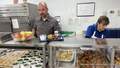
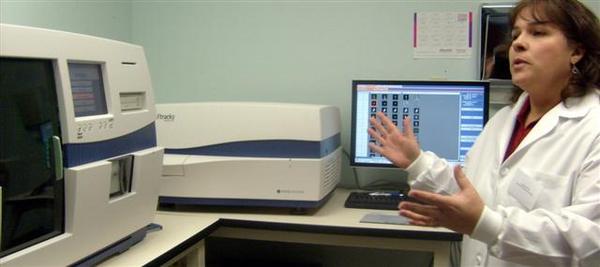
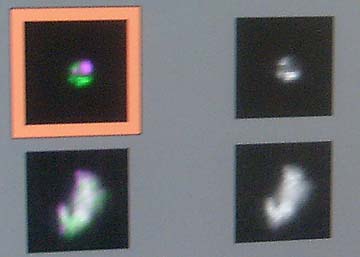 The separated cells are pictured on a monitor. The selected cell is a tumor cell. |
While the majority of the process is automated, a technician still has to read the results because fragments and stray cells can get picked up. Wick, who holds a bachelor's degree in medical technology, attended training on the machine in New Jersey. Her results are being independently checked by a California lab during the practice's trial phase of 20 patients.
"We're really pumped about this," said Fred Harrison, the practice's administrator. "The doctors are really excited."
Some 1,000 new cancer diagnoses are made each year locally, said Rosenthal, and one in four people will be affected by cancer in their lifetime. This latest addition to the practice's stable of diagnostic tools is one more step to defeating the disease, he said.
Triantos agreed: "It's almost miraculous, this technology."