Greylock Glen Ski Trails Must Pass MEPA Muster
 Cathy Garnett of Department of Conservation and Recreation ponders a question at Thursday's Greylock Glen Advisory Committee. Top, Steven Derdiarian of Vanasse Hangen Brustlin Inc. goes over changes to the design. |
If the agents of the Massachusetts Environmental Policy Act decide that the trails can categorized as a "disturbance" of the land, it could mean limiting skiing to 2 or 3 miles within the central development area and curtailing the already designed network of trails around its perimeter.
The red flag was raised at a meeting with Department of Environmental Protection on Wednesday to prepare for the MEPA submissions, said Cathy Garnett, project design director for the Department of Recreation and Conservation.
"We may have to make a major decision on cross country skiing versus no cross country skiing," she told the Greylock Glen Advisory Committee on Thursday. "Basically, a hiking system versus an expanded trail for cross country skiing ... How they calculate disturbance will have a dramatic affect on the trail system."
If MEPA determines the trail system constitutes a disturbance it will put the development over 50 acres, triggering the need for an environmental impact report. Or, said Garnett, they could issue a waiver or decide trails aren't a disturbance. "We really don't know," she said. "We have to get a direct statement from MEPA."
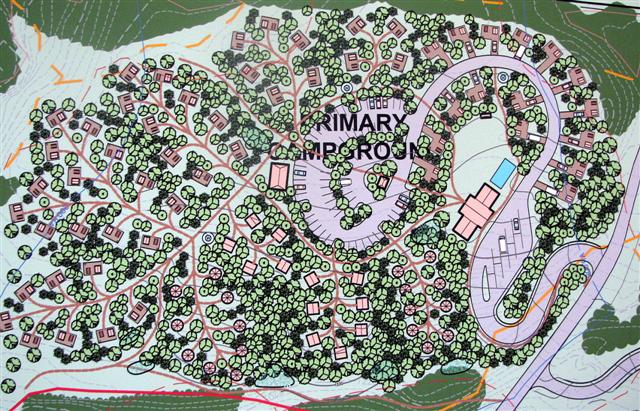
A cross country ski center is one of the focal points in the planned development of the glen, which will also include a fully accessible, 130-unit rustic campground and ampitheater, environmental education center and lodge.
But there apparently no one had thought about how the trail system and the 30-acre core development would be seen together by MEPA. Effort had gone into reducing the size and impact of the core even as Hodson & Associates Inc. revised and reduced a series of trails of various sizes on 31 acres that connect to the Mount Greylock State Reservation.
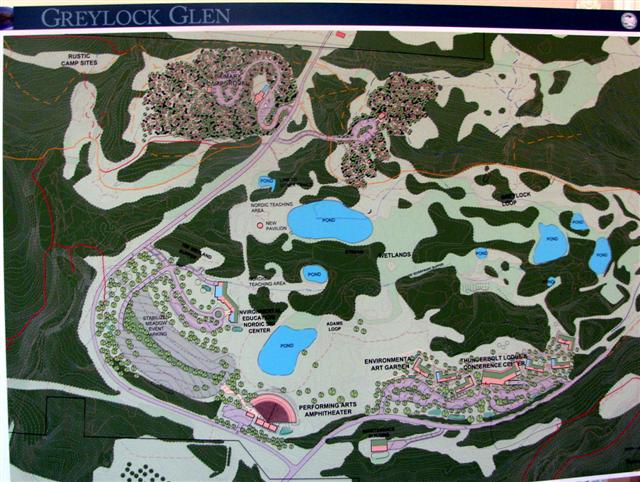 Above, a rendering of the core development; below a closeup of the rustic camping area. To minimize impact, vehicles will be limited to a parking area and campers will walk ito the clustered sites |
 |
"I don't think anyone wants to get rid of the trails," said Community Development Director Donna Cesan, but added "No one in the Northeast is making any capital investments in ski or snow making facilities."
Steven Derdiarian of Vanasse Hangen Brustlin Inc., the core development's designer, said other aspects of the plans seemed well-received by DEP, such as green roofs, rain gardens, water and silt management, erosion control and procedures to minimize the impact of construction on the land. Some tweaking of access roads and a parking area, and uses near waterways have been done to further limit disturbance.
The affect on the town's waste-water treatment plant should be a "drop in the bucket," he said.
Fire protection, however, is problem because the pumping station at the bottom of Gould Road is in "seriously degraded condition" based on a 2004 report. Derdiarian said options were a stand-up pipe, an overhaul of the pumping station and lines or, the preferred option, a 30x30x15 underground reservoir that was more cost-efficient and would not have a major impact on the land.
Garnett also reported that the botanical survey had gone well. There were some concerns over two areas that would be reviewed again in the spring. If OK'd, the project would not need a conservation management program.
Community Development Director Donna Cesan suggested a public hearing in the evening for more public input on the trails. It was decided to hold off until MEPA gave some indication of its thinking on the trail system.
Garnett said she may begin Friday on setting a preliminary meeting with MEPA. She and Derdiarian said they were meeting with other stakeholders in the process before submitting documents to MEPA in the next month or so.
"We're trying to touch all the bases so by the time we meet with MEPA, we will have a very strong comfort level," said Garnett.