image description

SBA Tour Brings Hope of State Aid to Mount Greylock
By Tammy DanielsiBerkshires Staff
Print Story | Email Story


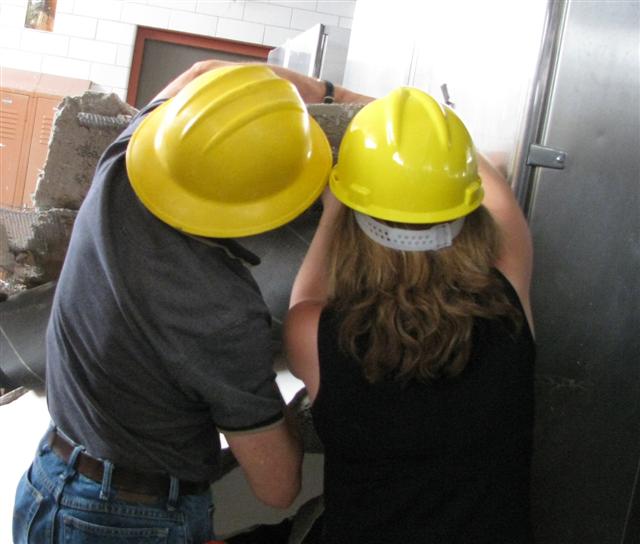
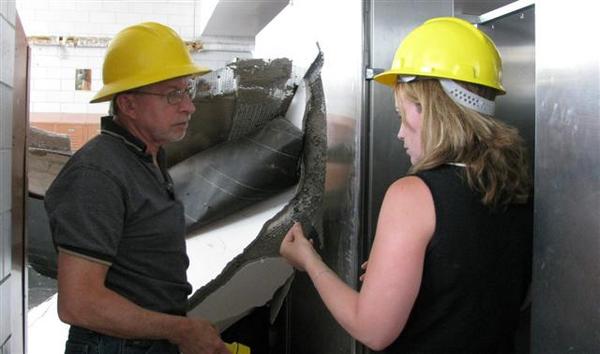
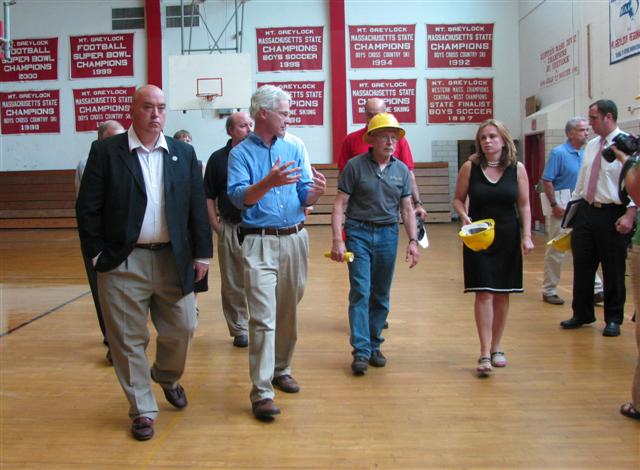
Rep. Denis Guyer, left, Andrew Hogeland, Robert Ericson and SBA's Katherine Craven and Brian Mclaughlin tour Mount Greylock. Top: Craven checks the collapsed ceiling; right: Ericson and Craven put their heads together.
WILLIAMSTOWN, Mass. — The state could pick up half the estimated $1.5 million cost of replacing boilers and drooping ceilings in the lockerrooms at Mount Greylock Regional High School.

"The problem in the locker rooms sort of elevates your status, and rockets it to our attention," said Katherine Craven, executive director of the state School Building Authority, after a hard-hat tour of the closed-off areas. Craven also was shown the 183,000-square-foot building's three antiquated heating boilers and pumping system.

Mount Greylock should know by Sept. 30 whether the SBA will provide 54 percent of the funding for both projects. Craven seemed optimistic but cautioned that the final decision was up to her board.

Longstanding problems in the aging building came to a head in May, when a large section of ceiling fell down in the girls' locker room because of faulty construction. A survey of other ceilings found the same too-short nails in a boys' locker room (and a drooping ceiling) and ceiling hot-water tanks were removed from the same area because of structural support concerns.

Replacement of the heating boilers, first installed in 1960 and 1968, has been discussed for several years. The old furnaces have entailed nearly $20,000 in repairs over the past few years and one is no longer functioning. The building itself has little insulation, School Committee member Robert Ericsson told Craven, and on more than one occasion, students have worn coats and sweaters during classes to stay warm.
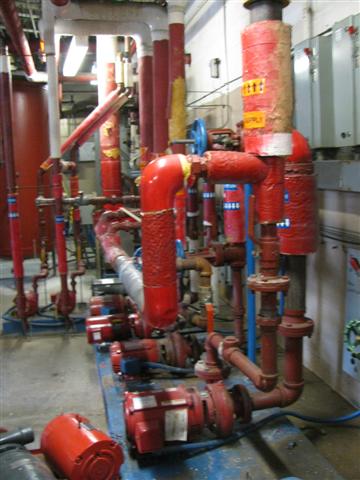

The pumping system is in
as a bad a shape as the heating boilers.
The school district is estimating spending up to $1.5 million; the figure could change based on boiler options. In a brief School Committee meeting prior to the tour, a quorum authorized the formal notification process to the school district's towns of its intent to bond the work (setting the high number at $2 million in case.)

School officials are hoping to reduce the amount by pursuing grants and other governmental funding but were unsure if the SBA would help pay for the work. The district's statement of interest in possible new construction two years ago had not made the authority's priority list and it's second, pared-down statement last fall had elicited no firm response.

The school district asked for emergency funding after the ceiling collapse.


Craven said the school didn't have "the perfect storm of overcrowding and a bad building" at the time of its first request. Since then, the most desparate schools had been taken care of, leaving the SBA ready to look at districts with just bad buildings.

Also in the district's favor is the fact that a lot of preparation work has been done in terms of engineering studies. The SBA, however, will also require a budget and copies of the request for proposals before its seven-member board meets Sept. 30.

Andrew Hogeland, chairman of the Building Committee, told her the request for proposals for the ceiling work was ready. "We want to make sure we're following the process so we don't jeopardize any state funds," he said.
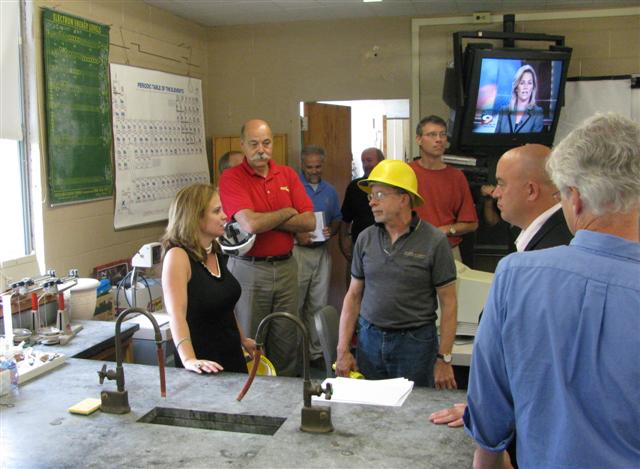

Craven scopes out the school's outdated science labs. Superintendent William Travis is in red.
Craven spent about 45 minutes surveying several areas of the school, with Ericson as guide, along with Hogeland, state Rep. Denis E. Guyer, who represents Lanesborough, Superintendent William Travis, Town Managers Peter Fohlin of Williamstown and Paul Boudreau of Lanesborough and other committee members and staff.

A meeting with with board members afterward was taped for broadcast on Willinet. She also spent time checking the science labs that were on the school's request list last year.

Repair work like Mount Greylock's "flies through our process," said Craven, but renovation to the science labs and several other sections should probably be worked through as a collaborative process, along with other areas that need upgrades.

She's also taking a little bit of Mount Greylock back to the SBA board: a chunk of crumbly ceiling plaster.

"This makes it real. A picture is worth a thousand words but there's nothing like feeling it yourself."

If you would like to contribute information on this article, contact us at info@iberkshires.com.

Students Show Effects of Climate Change in Art Show

By Breanna SteeleiBerkshires Staff

Students from 10 area high schools are showing works that reflect on climate change at the Clark Art this week. The exhibit will move to Pittsfield and Sheffield later. 

WILLIAMSTOWN, Mass. — Students got to showcase their art at the Clark Art Institute depicting their relationship with the Earth in the time of climate change.

"How Shall We Live," a juried art exhibit, was on display Saturday in the Clark's Hunter Studio at Stone Hill. Students from 10 high schools participated.

Climate educational organization Cooler Communities has hosted this show for the past couple of years at different venues across the Berkshires. This year, it was approached by the Clark to host the show and is co-organizing with Living the Change Berkshires.

This was the first year Cooler Communities, a program of the Harold Grinspoon Charitable Foundation, changed its prompt to make it more personal for the students in hopes to start a conversation in the classrooms on climate change.

"In our work with Cooler Communities, we want to really make conversations about climate change normal, so it doesn't just happen in high school science or in activist circles, but for everyone to feel like they have a role to play, and for everyone to explore what it means for them," said Executive Director Uli Nagel.

"And so that's why the work of classrooms rather than after-school programs, but actually have it in the classroom and then bring it to the community and connect it to solutions. That's why the community is here, and so we always try to actually make it real, but also give kids the opportunity to explore their own emotions and interior experiences through art."

The Clark wanted to expand on its Sensing Nature Program and give students a higher impact experience instead of just the program tour that could help fit the criteria for the students’ portrait of a graduate.

The show had 74 displays as well as an iPad that showed other students’ art that was not showcased in the show, which was around 180 submissions.

Students were asked to respond to one or more elements in the following prompt:

  • What does nature provide?
  • What are the Earth's needs?
  • What matters most?
  • What is resilience?
  • Where do you find guidance and inspiration?

Pittsfield High student Stella Carnevale, 16, made her artwork out of newspaper, Mod Podge, chalk, and watercolors. She drew three sardines showing the effect polluted water had on them and wrote in her artist's note that she wants people to pause and feel empathy while also recognizing their role in protecting the natural world.

"Fish are vital to our world. They balance ecosystems, feed communities, and remind us how deeply connected life on Earth is. When our waters are polluted, fish are often the first to suffer, and their disappearance signals a greater loss that affects us all," she wrote. "Pollution doesn't just damage rivers and oceans; it threatens food sources, cultures, and the health of the planet itself. I make art to bring attention to what is quietly being taken away."

She said it was really cool to see her art hanging in the Clark and never thought it would happen.

Wahconah Regional High student, Alexandra Rougeau, 18, painted a jellyfish in acrylics.

"I started off making a different painting that was very depressing, obviously, because it's climate change, and I got really annoyed because everything was so negative," she said. "And although climate change is a really negative part of the world right now, I want to try to show that there is some hope in it. And that we do have some hope in saving our environment. So the jellyfish is meant to depict fire, global warming, but it's in the ocean and it's rising up, and there is some hope, hopefully at the top, in the surface."

Rougeau said it is an honor to be chosen to have her art here and to see all the other depictions from other students.

Monument Mountain High sophomore Siddy Culbreth painted a landscape in oil pastels and said he was inspired by his grandfather who is a landscaper and wanted to depict "what we should save."

"I was picturing this as a quintessential, it's kind of like epitome of what a nice landscape should be like," he said. "And so in terms of climate change, like how that is kind of shifting, or what our idea of like the world is shifting. And I feel like it's really important to preserve what, like, almost not a perfect world, but, what the world should be like."

Some students from Pittsfield High in Colleen Quinn's ceramics class created a microscopic look of what they thought PCBs looked like and wanted to depict how the polychlorinated biphenyls might have affected them at Allendale Elementary, near disposal site Hill 37. 

Quinn said she is very proud of all her students. 

The show is at the Clark until April 26 and is free and open to the public. It will be moved to Pittsfield City Hall to run from May 1 through June 8, and then to Sheffield's Dewey Hall from June 12 through 21.

It is made possible with support from the Feigenbaum Foundation, Lee Bank, and Greylock Federal Credit Union.
View Full Story

More Williamstown Stories