Nonprofits Pump $1.9 Billion Into Berkshire Economy
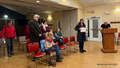
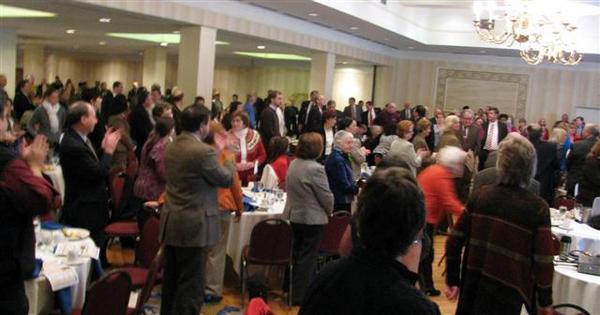
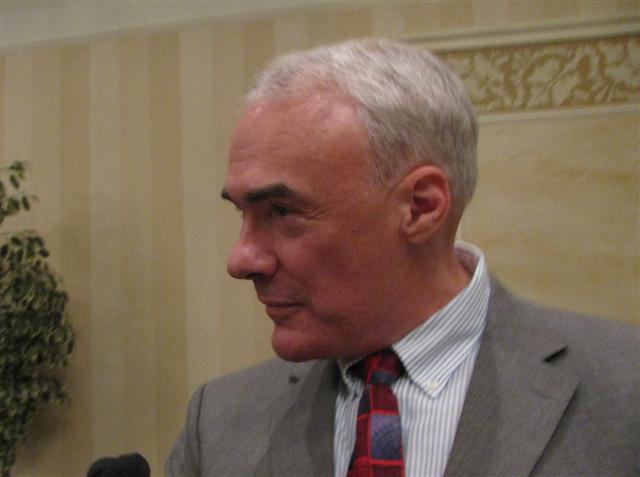 Economist Stephen Sheppard explains a point in a report on nonprofits' economic impact Wednesday. Top, chamber members involved on boards and other aspects of nonprofits stand up, showing the entities' local reach. |
"The nonprofit sector is a large, robust and growing part of the Berkshire economy," Stephen Sheppard, a Williams College economy professor and director of the Center for Community Development, told a capacity crowd at the Crowne Plaza on Wednesday.
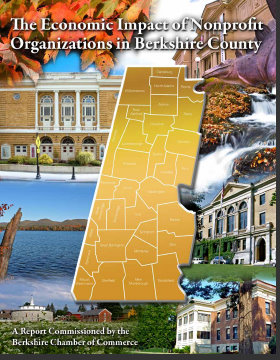
The monthly breakfast meeting of the Berkshire Chamber of Commerce was the setting for the unveiling of the nearly 18-month study commissioned by the chamber that looked at the impact of nonprofits with income greater than $25,000 over a 10-year period. The study was done by C3D, a collaboration of Williams and Massachusetts Museum of Contemporary Art that looks at the effects of arts-related development.
The results were eye-opening for the more than 400 chamber members attending the breakfast.
The county has more than 1,000 nonprofit organizations. Of those, more than 700 are 501(c)3 organizations employing a total of more than 25,000 people, primarily in the health and education fields. They also account for more than a third of the local economy, pegged at between $5 billion and $5.25 billion a year.
"Nonprofits are spending over $1 billion here in the economy, and that is generating both within the sector and within the other parts of the economy that they patronize and support a total of $1.9 billion of local income," said Sheppard. "That's enormous in the context of a $5 billion-a-year economy. That's huge."
 Nonprofits earning more than $25,000 are required to file with the IRS. Sheppard said other elements of the nonprofit sector, such as churches and public schools systems, were not included in the survey because of its focus or the difficulty in acquiring financial information. Their contributions should not be discounted but maybe more difficult to analyze, he said.
A large number of those studied are reliant on donations and grants; in total, they hold more than $4.1 billion in assets. That number "shows the ability of this sector to present itself to the community, to attract resources from the community and generate expenditures," said Sheppard.
The county definitely supports nonprofits: There are more nonprofits per person in Berkshire County than in the state as a whole, and Massachusetts has more per person than the national average.
Since the study is focused before last year's financial meltdown, he said there will likely be decrease in those assets. Williams College, for instance, holds a significant portion of those assets but took a hit this year to its endowment.
"Berkshire County led the nation in entering the recession first," he said. "On the good side, there is at least some preliminary hint that we may get out of the recession more rapidly."
The nonprofit sector is unlikely to decrease in size. Over a 10-year period, arts and culture nearly doubled, for example, and employs 10 percent to 15 percent of the nonprofit work force. On top of that, it generates an estimated $37 million more in ancillary spending atop the $145 million it generates yearly and 2,500 people it employs..
The health-care sector is the biggest, employing more than 10,000 workers and generating upwards of $970,000 a year; the education and human services aren't far behind, with nearly as many employes combined and more than $720,000 million.
"I was very surprised," said chamber President Michael Supranowicz of the study's results. What it does is give ammunition to the chamber's presentation to prospective companies on the important amenities available here.
"One of the most important factors is the health-care sector because employers want to know their employees and their employees families will be able to have the goods and services they need to lead good, healthy productive lives," he said. "So this is huge for us to be able ... to draw a company. We do have those quality-of-life factors."
James Canavan, outgoing director of Northern Berkshire United Way, said there was another benefit as well because many of the nonprofits were seeking grants and other funding sources from outside the county.
"These groups are bringing in outside money and spending it here," he said.
The next step will be to build on the study's findings and seek ways to better collaborate. The chamber will host workshop along those lines on Jan. 20.
For the full report, click here.
The emcee for the morning was Kristine Hazzard of Berkshire United Way and the sponsor was TD Banknorth.