Community Cooperative Farm Sets Sights on Sustainability
SHEFFIELD, Mass. — Farming in New England has never been easy. But Justin Torrico, with the help of his friends and family, is determined to give it a try.
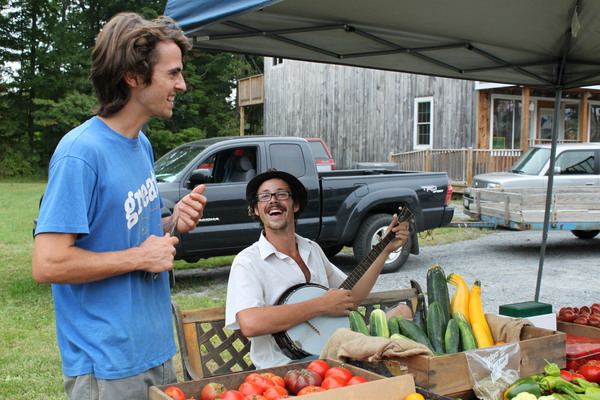
He, along with Tashiana Colston and Mael Raoult, have been working the fickle soil of Mount Washington and Sheffield in order to support Community Cooperative Farm, the most recent addition to a growing number of CSAs (community supported agriculture) in the area.
"We're trying to create a model of truly sustainable agriculture that largely doesn't exist," he said. "The problem right now is that there is such a heavy reliance on fossil fuels to run farms, even small ones. Everybody uses a tractor; we don't."
Instead of tractors and machinery, Torrico and his band of merry farmers have taken an old-fashioned approach to farming, their hands.
"Their approach seems like they're trying to cut out the extra stuff," said Sarah Johnston, a local gardener and Mount Washington resident who has been watching Torrico and his crew build their farm from the ground up. "They don’t use fuel or tractors. They even try to limit their trips up and down Route 7. I've watched them move huge fields of topsoil using a wheelbarrow."
Clearly, Community Cooperative Farm isn't in it for the money. In fact, according to Torrico, the end goal is sustainability, not profit.
.jpg) Tashiana Colston digs up weeds the old-fashioned way at the Sheffield plot of Community Cooperative Farm. |
"Social profit is the driving force," he said. "We've made a little profit for our business. We all work largely for free, we have no debt. Realistically things can support quite a few people."
With ten CSA members, Torrico is hoping to double that number by next year. And that is just the beginning. In addition to recruiting new members and farmers, CCF has applied for nonprofit status and is anticipating a land grant from the state Department of Conservation and Recreation.
"People have been generally supportive," he said. "We just need an audience to teach that farms should be used in an ecological, responsible manner. We’re looking to grow more farmers."
Currently, Community Cooperative Farm is one of 18 CSAs stretching from Pownal, Vt., to Sheffield. according to Berkshire Grown. What makes it unique, said Johnston, is education.
"They're all highly educated people," she said. "Their background is definitely something that local schools would be interested in. The idea is great; they just need to find their niche here."
Torrico agrees that education is an inevitable component to CCF's mission, especially given what he calls the "one size fits all" model of standard "organic" farm productivity.
"It doesn't leave room for the natural world," he said. "We're producing sustainable veggies using biodynamic and biointensive techniques. We use open-pollinated seeds on order to save our seeds for the next season. This way we can grow the best plants for our soil and they adapt well to changes in the environment."
Keeping the farm contained and sustainable is easier said than done. But Johnston is confident that CCF will thrive on its current practices.
"There are a lot of small, grass roots farms coming up now," she said. "But Justin is really trying to be more organic than organic," she said. "Everything they do is local, right down to the feed that they give their chickens. I'm excited to see them get this off the ground."
Torrico feels that sustainability is no longer a choice and plans to move forward with his vision.
"I felt that this was the most important thing I could do in my life," he said. "It doesn’t have to be profit versus sustenance. It hasn't always been that way. We can make a new model."
For more information on Community Cooperative Farm call 413-530-9919. Or stop in at the farmstand on 63 West St. in Mount Washington. There is also a farmstand on Route 7, just before the center of Sheffield, that's open Tuesday, Thursday and Friday.