Planning Session Envisions Viable, Healthy Berkshires
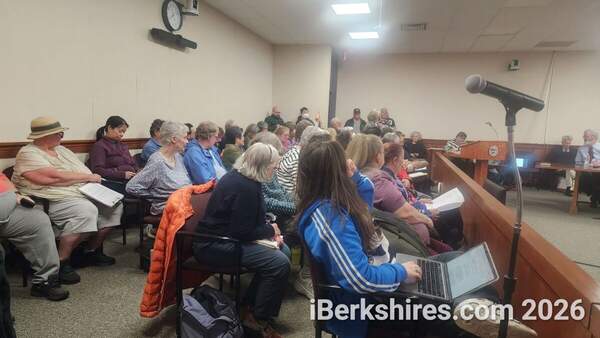
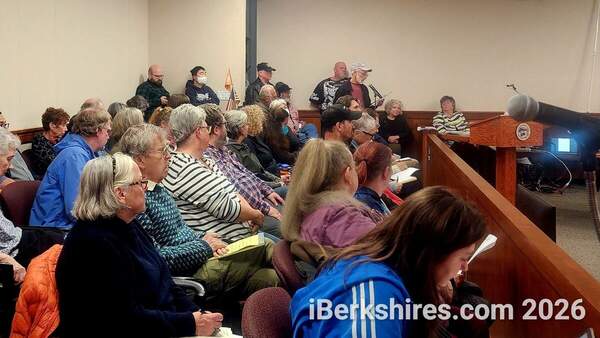
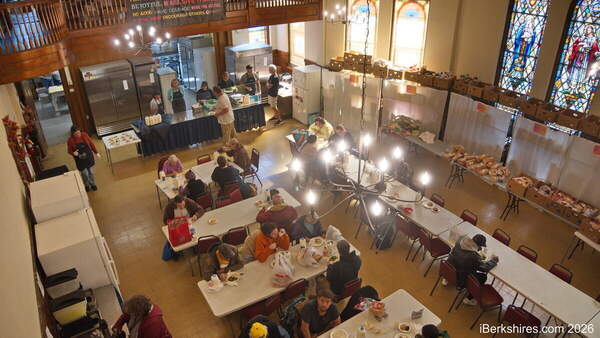
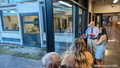
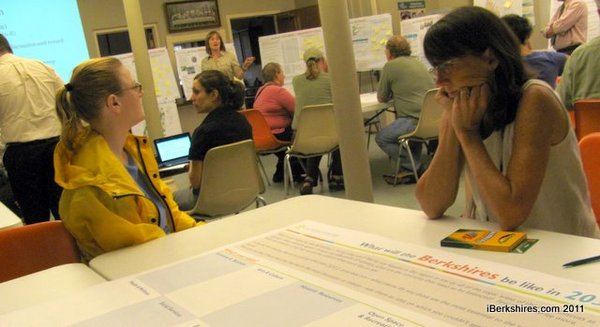
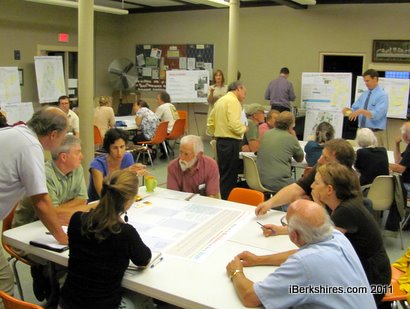
.jpg) Participants in Wednesday night's visioning session select goals and priorities in eight categories. Their work will be compiled as part of the Sustainable Berkshires planning process. Bill Densmore has a complete list of issues from each table here. |
NORTH ADAMS, Mass. — More than 30 area residents came together on Wednesday evening to envision what the Berkshires would look like in the year 2030.
There were the long-held desires — a network of bike paths, a thriving agricultural sector, green technology industry, clean waters, open space, and broadband and rail service — along with the more abstract, such as a business economy instilled with dignity, viability and soul. And the tremendously difficult: the elimination of poverty.
It was "pie in the sky" planning, said Amy Kacala, senior planner with the Berkshire Regional Planning Commission, but integral to setting priorities for a new comprehensive, countywide plan.
"Great communities just don't just happen," she said. "You need to think about long-range directions so you can start taking incremental steps to achieve your goals for the region. So this is our time to step back and create that kind of road map or guide book for 'here we are today, here's where we want to be in 30 years, what do we need to do?"
The visioning session at All Saints Church was the first of six being held across the county over the next three years to gain community input into Sustainable Berkshires, an update and significant expansion of the regional plan.
|
The plan will reach beyond the usual suspects of economy, transportation and development to look at culture, social equity, health and wellness, energy and climate change, among others. It will also take into account the region's aging population, cultural and historic venues, high number of second home-owners, land use, local agriculture, education and income.
"We want to really look at all the topics we're talking about and how they impact each other," said Kacala.
As the participants broke into groups to set priorities for their perfect Berkshires, Nathanial Karns, executive director of BRPC, said the new document will build on the regional plan developed 10 years ago and on newer strategies, including the Berkshire Blueprint (which launched Berkshire Creative) and the newly approved Berkshires Comprehensive Economic Development Strategy.
"We're all still grappling with what is the creative economy," he said, but while the new plan will reflect some changes much of the basics will remain the same. "Manufacturing, despite some people's perceptions, is still the largest income producer in the county ... It's only 10 percent of the work force; in 1970 it was 40 percent, but manufacturing is still the largest income producer."
The plan is being developed through a $590,700 U.S. Department of Housing and Urban Development grant. Only 45 of the highly competitive grants for sustainable planning were awarded in this round, four of them going to Massachusetts. Boston and the Springfield region, with more developed plans, received implementation grants; Franklin County is, like the Berkshires, beginning the process.
 The visioning sessions are just the first step (not counting the months of administrative work up to this point). A 25-member steering committee representing a variety of fields has been set up; the BRPC will host roundtables and connect with groups in business, government and other areas and meet with local boards and councils; a website and Facebook page will offer information and a chance to comment for the general public; and five artists will be invited to create a single vision for the county. The public will get to vote on which creation best represents Sustainable Berkshires.
What will the plan do? In addition to prioritizing goals for the county, it will offer a guide for updating or developing municipal plans and offer support for towns and cities seeking grants that align with the plan's goals.
"They can say 'our regional plan supports this, that this is a key initiative for the county,'" said Karns.
At the end of the two hours, each of the six groups stood up and explained their reasoning and their priorities, most of which were similar and all of which were interconnected.
Stan Brown of the town of Florida said he plans to follow the process and see what develops.
"I'll maybe have more to say then," he said. "It's a continuation of what people have been trying to do anyway to keep the Berkshires viable to attract people from out of the area ... But we want to be careful."
Michael Bedford, who has settled in North Adams and gave the most spirited presentation, said the plan will go nowhere without support.
"The political will is the most important part; it's the community speaking up to say, 'guys ...wake up,' or you can have a report coming out that sits on a shelf," he said.
The visioning session will continue on Tuesday, July 12, at 6:30 p.m. at the Berkshire Athenaeum and on Wednesday, July 13, at 7 p.m. at the Great Barrington Fire Station. The next workshop will be scheduled in six months, again with three sessions spread across the county.
Tags: Berkshire Regional Planning Commission, sustainable, vision2030,