'Ten Cents a Dance' Snoozy Stroll Down Memory Lane
 |
In what the publicists describe as the "American Premiere," the director, John Doyle, first staged this song-cycle featuring nearly 30 Rodgers and Hart tunes and a wisp of a narrative in 2002 at the Watermill Playhouse in West Berkshire, England.
 Both that production and this could be accurately described as a series of the very nice songs of Rodgers and Hart performed very nicely.
Doyle has gained quite a reputation for engaging performers who not only can do vocals, but also can double as the orchestra. They alternate their vocals with intermittent turns on the sax, trumpet, drums and strings. Doyle did this to superb effect in the past with both "Sweeney Todd" and "Company."
The artistic conceit was born, Doyle admits, of economic necessity. "Ten Cents a Dance" has an abstract, dreamlike quality, as the actors circle around the stage in choreographed movements with their instruments, shifting from, say, viola to vibraphone to trumpet.
"It's a little like watching a piece of modern dance. You don't need it to be explained to you. You accept that it is nonlinear, you seep into it, and you yourself interpret the images," Doyle is quoted as saying.
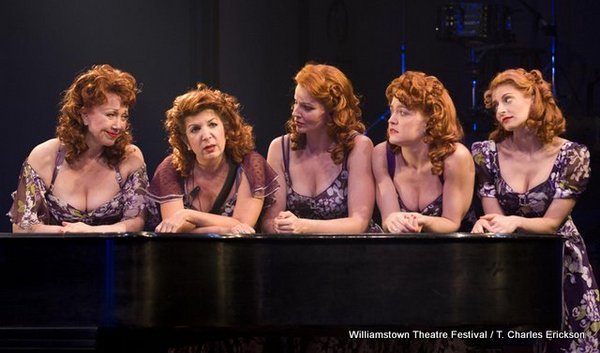
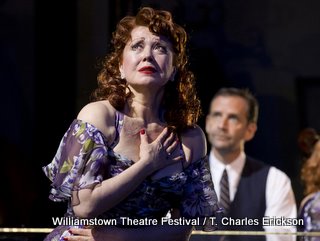
In the Williamstown revision, five actors played Miss Jones 1, 2, 3, 4 and 5 who shared the classic songs culled from the 500 or so Rodgers and Hart wrote. They are, in order, Lauren Molina, Jane Pfitsch, Jessica Tyler Wright, Diana DiMarzio and Donna McKechnie. Rounding out the ensemble is Malcolm Gets as Johnny, who is also an accomplished piano player.
Scott Pask created a haunted, dreamlike set for the sextet to sleepwalk through, for the energy level seemed to be set fairly low. Without a real book or plot, "Ten Cents a Dance" is a series of cleverly arranged medleys of song based on the flimsiest of similarities.
In the original production, the singers buzzed around the stage on rolling chairs, but in the WTF production, only the bass was on rollers, and the piano rotated all too frequently as the various Miss Jones' preened and posed in their 1930s floral print dresses and overdone hair.
What a waste of perfectly good talent.
None got to sing a whole song straight through either, and to earn their own individual applause. In fact, the mooshing of one song into the next stifled audience applause, and the overly moody staging acted to shut down any connection between performers and listeners.
This production worked for those who simply wanted to hear the music of Rodgers and Hart in a new way, and, forgive me for saying this, but it was a lot like elevator music. Safe and bloodless. Perhaps others enjoyed hearing the words, or the music in a nonthreatening way.
|
Broken into five "episodes" the segments were titled "The Blue Room," "Isn't It Romantic," "Manhattan," "Ten Cents a Dance" and "Quiet Night." There was also an encore consisting of reprises. There were 32 different songs all told.
It's really a toss up when it comes to recommending it or not, since those who enjoyed the show did so because they love Rodgers and Hart. And those who thought it terrible said they disliked it because they love Rodgers and Hart.
The set and lighting was very evocative of a warehouse of memories. And there was a giant spiral staircase (which show has that appeared in before?) which served for slow, deliberate entrance and exits.
Except when the walls turned blue ("Blue Moon," "Little Girl Blue," "A Blue Room") the overall effect of the surroundings was more of a chiaroscuro film than a musical. There was a moodiness and muddiness to the musings of Mr. Jones, which seemed to darken so many of the songs. One can only speculate as to what the subtext to all this was; he seemed pretty unhappy, even as he shed his tux down to a wife-beater tee. Don't ask me what that meant.
The five Miss Joneses seemed to represent his great love at various stages of his relationship. Still it was hard to tell, mostly they just continually circled around the piano like some seniors on a mall walk. Some of the music was sung in unison, missing acres of harmonic possibilities.
If you like the music of Rodgers and Hart, and theater that lulls you and conjures up old love affairs, hazy memories, and days gone by, this is the perfect show to enjoy.
But if you like singers to really sell their songs, to belt them out, to put real heart and soul into the lyrics, well, perhaps you might wait until a real musical comes along.
Larry Murray is a contributor to iBerkshires.com and offers reviews and arts news from around the region at Berkshire On Stage.
Tags: WTF,