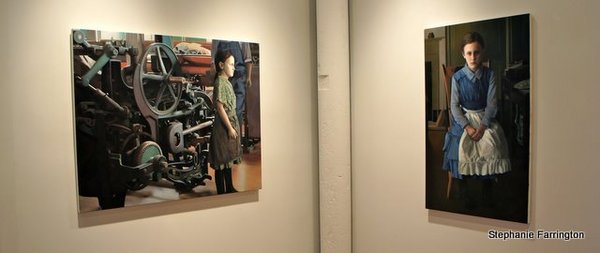
Child Labor, History Exposed in Brill Gallery's 'Mill Children'
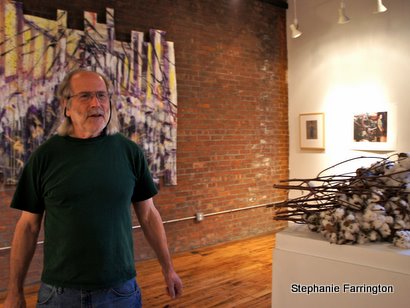 Ralph Brill invited a small group of artists, writers, educators, a filmmaker and composer to connect and create over the subject of child labor in the city's old mills. |
"It started for me a couple of years ago," he said. "People would be coming in here from all over and they'd say, 'what a gorgeous renovation. What is this place?'"
The place he's referring to is the Eclipse Mill, a converted textile mill that is now an artists' live/work space on Union Street. But it was growing local interest in the mill workers who were there long before the artists and the former Sprague Electric moved in that sparked Brill's interest in bringing their stories back into the space.
Over a year in the making, the Brill Gallery's "Mill Children" brings together two painters, a composer, a writer/historian, an educator and a filmmaker to illuminate the history of the mill and of the children who worked there.
The task of curating a show is an artist's work, though most people don't see it that way. A curator chooses the subject of the show, the artists who exhibit their work in it and often the works themselves. They also choose how best to display the work. In a way, curating is an art form that uses other artists to communicate an idea.
That is certainly the case with "Mill Children."
"For me, it's a question of looking at this building and taking it out to life as my art project," said Brill.
To do that, he needed to find the artists to make the art. Brill sought out those with a personal interest in North Adams and the mill and asked them to work on the project as a team. Frequent meetings and discussions between the artists involved meant that they were not, as is usually the case, working in isolation. The dialogue between the works shown existed before the first stroke of paint hit the canvas.
William Oberst's haunting girl workers sit quietly on one wall of the gallery, while Dawn Nelson's more dynamic, less precise works float within the space, suspended from the ceiling. But there are other elements also present.
At the opening, the work of composer Matt Hopkins and filmmaker Steven Borns will be added to the space; both the film and the music will inform and color the presentation of the work, adding a depth of understanding and a sense of continuity not usually present in a group show.
Joe Manning's writing on the subject and Ann French's educational materials will add an even deeper element of exploration into the subject of child labor 100 years ago, when photographer Lewis Hine visited Eclipse Mill to take images to support a campaign against child workers in mills across the country.
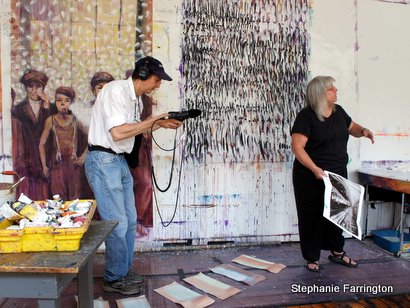 Steve Borns is making a documentary; Dawn Nelson is both a painter and a teacher. |
She was moved by the subject matter, her day job gives her a uniquely intimate relationship to these children as people.
"Kids are drawn to allure of adulthood and independence way before they are equipped. This is at the heart of why the work of Lewis Hine was so important; why it was so important for child-labor laws to be created," she said. "Lewis Hine was from the Midwest and he was a teacher, just like me. He came to teach in New York City, and was so upset by what he saw happening in having children work so early that he was compelled to act. He crossed the country photographing child labor practices, leaving a legacy of thousands of photographs documenting these practices. The effort had a huge affect of the development of the child-labor laws here in the U.S. You can see many of these photos on the Library of Congress site. I think being a teacher drives you to take action when you see something happening that is so clearly wrong for kids, even when the kids may not see it that way."
The show is made to travel and Brill hopes to see it installed at the Lowell Mill Museum someday. And it is a two-way communication. French, service learning coordinator in the North Adams Public Schools, will teach the material this fall, which will lead to two performances of children's choirs, singing French songs at the Eclipse Mill Gallery.
The French element is another important factor in the show: Many of the mill workers were immigrant families from Quebec. They stayed in America and brought their culture here with them, changing the nature of New England into a more egalitarian melting pot in the process.
Like most of the participating artists, Manning's part in the show represents only a fragment of the work he's done on the subject. Manning has spent the last several years gathering information on the descendants of the mill children (sparked by his search for Addie, a Pownal, Vt., girl photographed by Hine) and has hosted several highly successful "reunions" of the families involved.
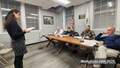
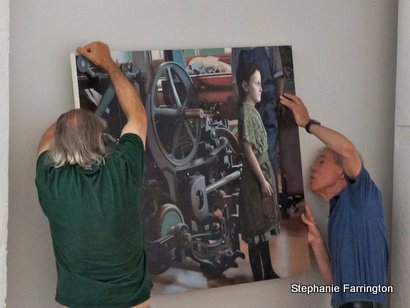 Brill and artist William Oberst hang one of Oberst's paintings for 'Mill Children.' |
As Borns points out, the subject matter of the show is still relevant today. Brill recounts a story about his interaction with an employee of the Department of Labor who found him and told him about current standards of child labor in America. Apparently, while Hine's work changed labor standards for many children, for some it did not. Standards for child labor have not changed for agricultural workers since before Hine's time in the early part of the last century.
Apart from anything else, the show is visually beautiful and it tells a fascinating story of the history of Eclipse Mill, the city of North Adams and Massachusetts a century ago, and worth seeing from any perspective.
The exhibit opens Friday, Aug. 26, at 5 p.m. with a reception on the first level of the Eclipse Mill. The exhibit is on display through Sept. 25.
Stephanie Farrington is currently camped out at the Eclipse Mill where she has volunteered to serve as administrator for the Stacks and Steeples Facebook page.
Tags: Eclipse Mill, mills,