Famed Pittsfield Agriculturalist Returns for 200th Fair Anniversary
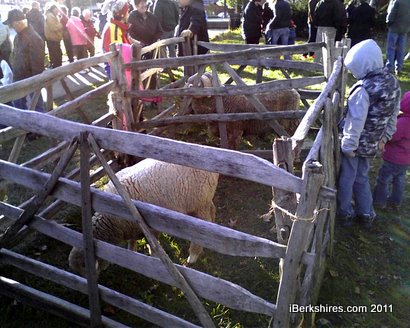  Merino sheep on display at Park Square on Friday in a recreation of the first known county fair in the nation. Right, Elkanah Watson, agriculturist and canal enthusiast, organized the Berkshire Agricultural Association to promote better farming practices. Merino sheep on display at Park Square on Friday in a recreation of the first known county fair in the nation. Right, Elkanah Watson, agriculturist and canal enthusiast, organized the Berkshire Agricultural Association to promote better farming practices. |
Though history tells us Elkanah Watson died in 1842, he was able to make a special appearance on the anniversary of his launch of the first agricultural fair in the country.
Watson was brought to life by re-enactor Dennis Picard, museum director at Storrowtown Village on the grounds of the Eastern States Exposition in West Springfield. The Big E is the largest fair in the Northeast and a long way from Watson's small exhibition of stock 200 years ago.
In a recreation of his speech from the 1811 fair, Watson told of how he had first come to display his Merino sheep, the first in the region, under the old Liberty Elm in 1807. He spoke vividly of the the immense importance of ongoing progress in democratic agriculture in the future of the nation, and of the area.
"The future wealth and sustainability of Berkshire County will be built on that foundation ..."
Watson's speech proved prophetic in a town that by the middle of that century would be producing about half the wool in the United States.
At times, passers-by unaware of what was taking place stopped suddenly to see this 19th-century gentleman make his impassioned speech as cars zipped around the heart of the downtown.
Antique tractors advertised were not seen at the event, and a truck bearing oxen from Worthington broke down en route, but modern tractors from Pittsfield Lawn & Tractor were on display, and horses provided by Bill Roberts. A natural highlight were two Merino sheep, brought by Donna Chandler of Pittsfield. The Chandler family lives in the old William Brattle House on Williams Street, the oldest remaining house in Pittsfield, a fact that provided a nice historical continuity to the bicentennial event.
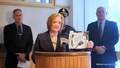
The event began with presentations by elected officials. Mayor James Ruberto was unable to attend, so Council Vice President Peter Marchetti presented a citation from the mayor's office, as well as reading a letter of congratulations from Gov. Deval Patrick.
State Sen. Benjamin Downing presented a citation from the Senate, while Rep. William "Smitty" Pignatelli, accompanied by Rep. Paul Mark and Representative-elect Tricia Farley-Bouvier, presented one on behalf of the county's House delegation.
After the speech, iBerkshires conducted an exclusive interview with Elkanah Watson about his knowledge of an unrelated Pittsfield controversy in which he was well versed: the unexplained Hebrew scrolls uncovered in Pittsfield in 1815.
 Elkanah Watson, aka Dennis Picard, repeats his speech from 1811. |
Watson, without missing a beat, quickly launched into a discussion of why the phylacteries should perhaps have been treated with more skepticism than was initially the case. Firstly, he said, it should be remembered that the artifacts were found among loads being cleared from the farm, and it was unclear whether they had come from the older soil or the more recent debris.
When asked how he thought the scrolls might first have found their way onto the farm, Watson spoke of the possible "Hessian" theory then offered by William Allen. Merrick, it was known, had employed such German prisoners of war as labor on his farm, and it was thought that one of them could have dropped it. When pressed, however, he conceded that there was a great prevalence of anti-Semitism in the ranks of such Hessian forces.
"I will say I should very much like to see those scrolls again," Watson told iBerkshires. The phylacteries, records show, were brought to the American Antiquarian Society from which it is unclear if and when they ever emerged. Inquiries to the AAS in later years failed to turn them up, though one former librarian there said he believed he had seen them ... as recently as 1917.
iBerkshires gives Dennis Picard an A-plus for his wide-ranging knowledge and improvisational skills as Watson.
Tags: agriculture, fair,