Berkshire Dirty Jobs: You Dump, He Pumps
Our semi-regular series on 'dirty jobs' in the Berkshires looks at what happens after, well, you go. We're digging into occupations that can be messy, mucky and, sometimes, a bit rank. Do you have a dirty job or know someone who does? Drop us a line at info@iberkshires.com and we might highlight your dirty work.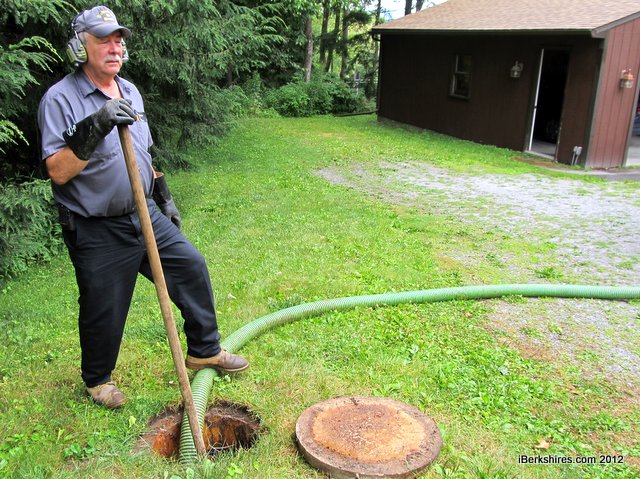 Fran Gwozdz pumping a septic tank in Cheshire. He was been pumping septic systems for 30 years. |
The veteran septic cleaner for Delmolino and Sons spends the majority of his days dealing with other people's crap. The job is not one that many envy and yields little rewards other than the paycheck.
"It's not a job everyone would want to do," Gwozdz said after completing two assignments on a recent Thursday morning. "I take s--- from everybody and I can't give it back."
The weekdays start bright and early for him at 5 when he wakes up, packs his lunch — because there isn't much time to relax at a local restaurant — and walks promptly at 7 from his house only two doors down from Delmolino's building.
"I have to do a check of the truck for inspections. I check all the fluids, I check the tires and make sure the pressure is up on them, all of your lights and the oils, oil pump and then I have to get my work order," Gwozdz said of the morning's first tasks.
That Thursday, he had the extra task of emptying sewage from the truck's tank into a storage facility until the dump later in the afternoon. From there, with iBerkshires tagging along, Gwozdz drove to Savoy where a resident was having trouble with a clogged septic system.
"The filter is supposed to be cleaned on a yearly basis and they couldn't get to it," Gwozdz said.
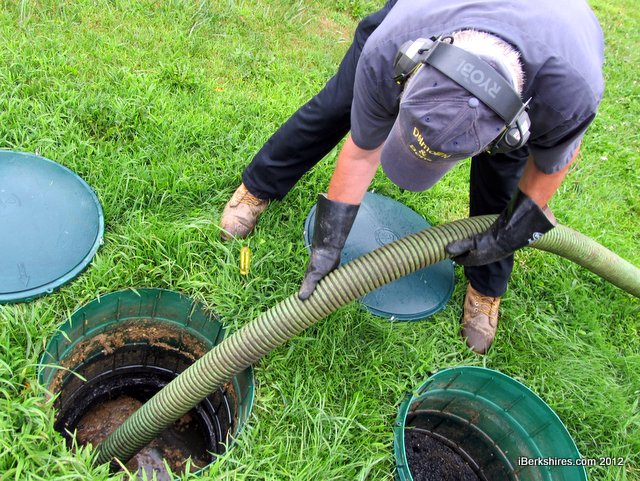
He pumped about 100 gallons of sewage from the basins leading to the septic tank itself to get to the filter. While in there, he opened the lid to the tank and noticed the level was too high. With a long pitchfork, he pulled on the "floats" that monitor the tank's level. The pump began to work, the level dropped and "gray water" began to move into the leach field.
The float was sticking, he told the customer, who was an old friend, and it would likely have to be replaced. Between chatting about old acquaintances, Gwozdz called and got prices for parts and labor.
 |
|
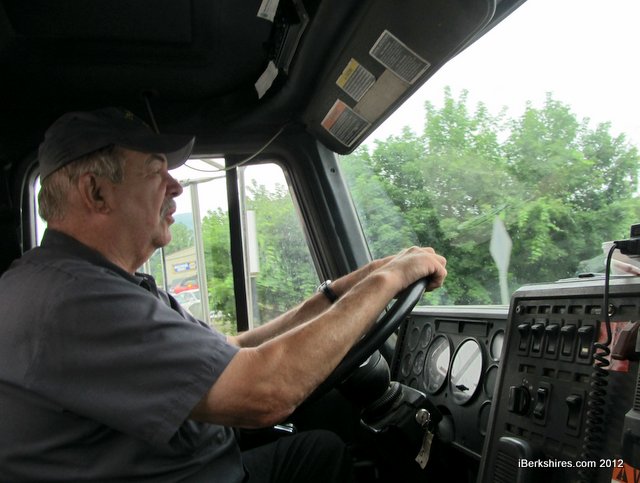
| The job takes Gwozdz all over the county and into Vermont. At the end of the day, he delivers some 3,500 gallons of sewage to the waste-water treatment plant. | 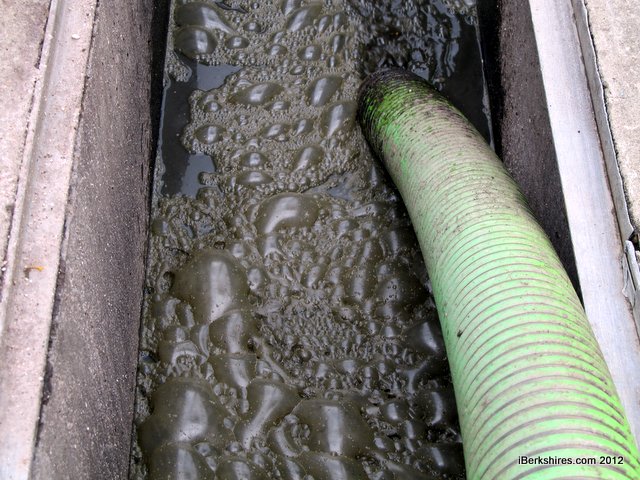 |
 |
|
For many, those sentences won't make much sense but for Gwozdz, it is almost like a second language. After 30 years on the job, he is a septic expert.
In developed areas, waste flows into a complex sewer system to a waste-water treatment plant. But rural areas, all the septic processing is right under the yard.
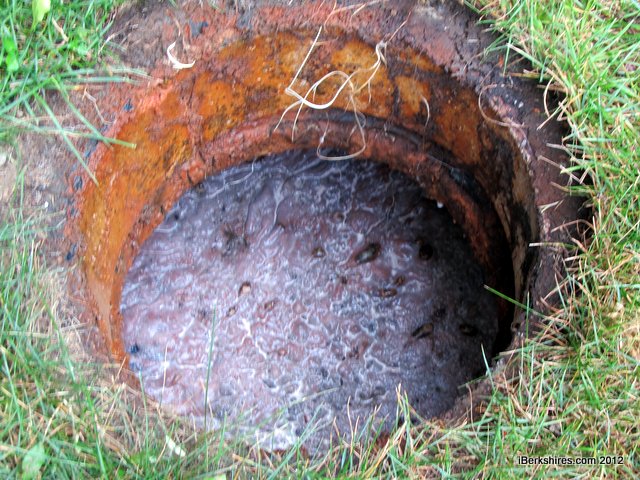
Human waste flows into a usually concrete septic tank (or cesspool) where baffles keep the solids inside. Floats keep the level of the tank steady and the water is released from the bottom into aleach field, Gwozdz explained. The solids stay behind to be pumped.
The best time to have a septic pumped is during the summer, when the sun can dry up the leach field, he said.
"There shouldn't be more than six inches of solids in a normal usage," Gwozdz said. "Gray water is the only thing that should be discharged out into the leach field. The solids should stay in your tank. If you don't [pump] it faithfully and you have an overabundance of use with your tank, what happens a lot of times is that your solids start dropping. They get saturated with water and go down to the bottom of your tank. That isn't good because you are reversing the process."
The many aspects of the job from knowing how the systems work to knowing how to operate the pumps of the truck to knowing the state regulations, Gwozdz learned from experience. He started working with the Delmolino's 30 years ago as a "jack of all trades, master of none."
He started working part time for extra money while emplyed by the former General Electric so his wife could stay home and raise their two children. When GE closed up shop, septic pumping became his full-time job.
Those two jobs, as tiring as they were, paid off for his children. His son is now a leading salesman for Anderson Windows and his daughter is a psychiatrist. That day, Gwozdz was rushing to finish his work so he could drive to Worcester to see his 12-year-old grandson play for the Little League state title.
"I was young and looking for a part-time job and [the current owners] grandfather hired me. When I retired, I went full time," Gwozdz said. "The kids went to college and things of that sort. It's not because I want to work or put it in the bank. It is for tuition and that sort."
He grew up in Pittsfield and his family moved to Cheshire in 1960. He bought his own house in Cheshire in 1966 and after a few years of working construction, he went to GE. He knew John Delmolino and started working for him to pick up money on the side. While doing septic was not his first line of work, neither was it for the company.
"My grandfather started it 51 years ago and it started off as just, he was picking up ash for people from their stoves and fireplaces and he ended up starting the rubbish part," said Kyle Delmolino, who along with his two brothers and uncle now own the company. "He brought in construction and we do everything now. When we started the construction side, we installed septic systems. So by doing the pumps, you bring in work for the septic side."
Gwozdz learned everything he knows about septic systems from working with both John Delmolino, who died last year, and Kyle's father, the late David Delmolino. While he has done everything from construction to plowing to septic, he is now the primary septic driver. At each stop, customers had high praise for Gwozdz describing him as "the best."
At the age of 70 and still on the Fire Department, Gwozdz said he'll retire for good when he "gets too old to work."
For his second task Thursday, Gwozdz drove back to Cheshire to pump a septic tank. The job requires a lot of driving, from the New York border into Vermont, sometimes down narrow and difficult roads.
 |
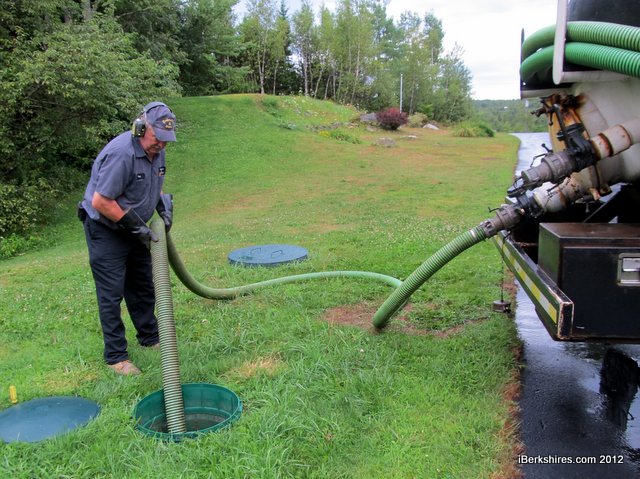 Gwozdz knows how septic systems work and he has plenty of horror stories from times when things were not working. Gwozdz knows how septic systems work and he has plenty of horror stories from times when things were not working. |
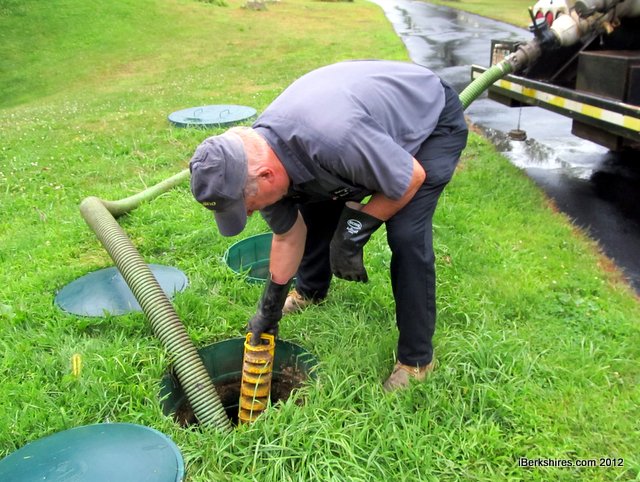 |
The pump in Cheshire was straightforward. Unravel the hose (Gwozdz considers that the most difficult aspect when the terrain is difficult to maneuver) and let the truck do the pumping.
"You don't want to super clean it, meaning getting in there with detergent and scrub brush... You want to take down as much as you can because you want the bacteria to be active in there all the time. I take it down to the bottom, I clean it out," Gwozdz said. "A lot of times you'll open the cover and you'll see little bugs there. They're called mites and they work for you for free. They activate the bacteria."
Gwozdz has some horror stories of hoses breaking and finding things — such as used condoms — clogging up the system.
On one occasion, a hose broke and the sewage "came up like a mushroom" and covered an assistant he had with him. On those rare occasions, all he can do is clean up the mess, soak his clothing and take a long, long shower.
Gwozdz has even found himself inside of the tanks to make repairs.
"You wouldn't want to go into the tank without a respirator," he said, adding that the methane gas could be fatal.
As for the smells, Gwozdz said he's gotten used to them.
"They've got a variation of smells. Some of them are worse than others because they haven't been done in a long time," Gwozdz said.
After filling up, and stopping back to the office to top off the 3,500-gallon truck from the storage tank, he went off to the Hoosac Quality Water District treatment plant in Williamstown. There he take a small pail, fills it with sewage and brings it to the laboratory to make sure the pH balance is right.
"The reason we check it is because if it is real low and becomes septic, it can be more difficult to treat," said the treatment plant's Dick Zona. "I will also do a visual inspection to see if it is contaminated with gasoline or something."
While the waste getting dumped at the treatment plant, where it is cleaned and flushed back into the river, there is the paperwork. Each address that was pumped is documented to be filed with each town's board of health.
That was the end of the day for Gwozdz. But one thing for sure, his customers will keep him coming back for more.
Tags: dirty jobs, septic, sewer,