Williamstown Agrees to Accept FEMA Grant
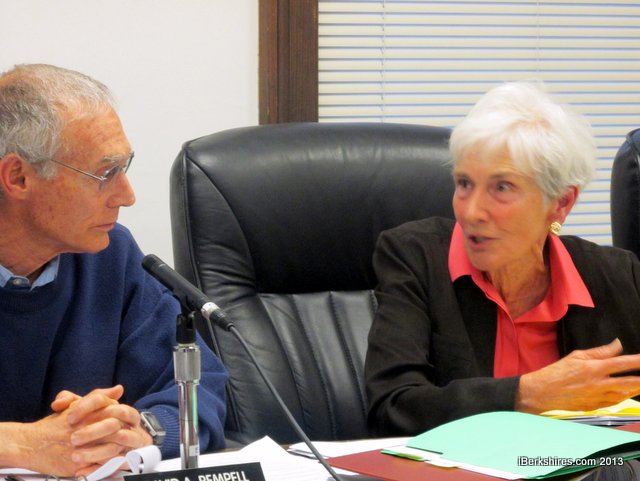 Selectwoman Jane Allen has organized a committee comprised of the heads of most of the town's boards to research the possibility of developing subsidized housing on the Lowry property. Selectwoman Jane Allen has organized a committee comprised of the heads of most of the town's boards to research the possibility of developing subsidized housing on the Lowry property. |
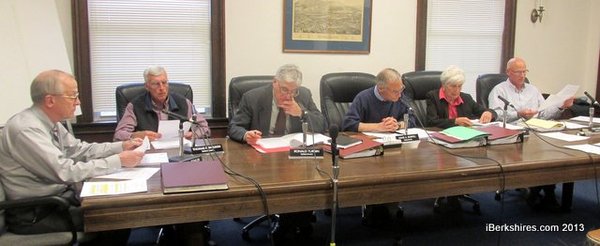
WILLIAMSTOWN, Mass. — The Board of Selectmen on Monday authorized the town manager to sign a $6.1 million Hazard Mitigation Grant Contract that will result in the town's acquisition and eventual closure of the Spruces Mobile Home Park.
Town Manager Peter Fohlin explained that although an agreement has not been signed with the park's current owner, he is confident that such an agreement will be reached. But he advised that the town not spend a dollar of the grant money until Morgan signs on the dotted line.
Responding to a question from resident Suzanne Kemple during Monday's Selectmen's meeting, Fohlin said the attorney general's office asked him a similar question about the possibility of Morgan reneging on an agreement to accept $600,000 from the Federal Emergency Management Agency grant in return for the park.
"The attorney general asked us, 'How do we know you and Morgan will make a deal?' " Fohlin said. "I said: because we have each other by the throats.
"Morgan cannot get $600,000 unless I sign that document, and I won't do that until they sign (the agreement with the town)."
Fohlin said it was important for the town to officially accept the grant in a reasonably timely manner — lest the Massachusetts Emergency Management Agency and FEMA withdraw the offer.
"There are other communities on a definitive waiting list, which you've seen, below us who would dearly love us to not sign this document," Fohlin said. "There are a lot of communities who would like to share in our wealth.
"We're in a little bit of a waiting dance with MEMA. At some point, they're going to ask us, 'Where is it? We sent you a document worth $6 million, and you haven't returned it.' "
After the 5-0 vote to authorize Fohlin to accept the grant, he fielded a question from the floor about whether the terms of the grant could be changed.
Resident Paul Harsch, who has advocated that the town look at ways to save the park (including in a Dec. 11 letter to iBerkshires.com), asked whether the FEMA grant money could be used to do just that.
After explaining that the money in question is being granted for one purpose and one purpose only — to remove housing from the flood plain — Fohlin said the town had tried in the past to seek grants to alleviate the flooding at the park.
"FEMA is 100 percent confident that the trailer park is located in a National Flood Insurance Program-designated flood plain," Fohlin said. "This is not 1950. Trailer parks don't get built down by the river in a flood plain anymore. This is not 1950. Flood chutes don't get built at the Spruces like they were in North Adams 60 years ago.
"If the town of Williamstown wishes to pursue a different outcome, it needs to turn this grant back, and it needs to secure the funding for some other solution."
The town tried to pursue money for another solution nearly 10 years ago, Fohlin said.
"In 2004 or '05, we applied through this very same program for flood mitigation at the Spruces, and the grant was rejected as being uneconomical," he said. "The application was rejected as being not sufficient to eliminate the hazard, and we got nothing."
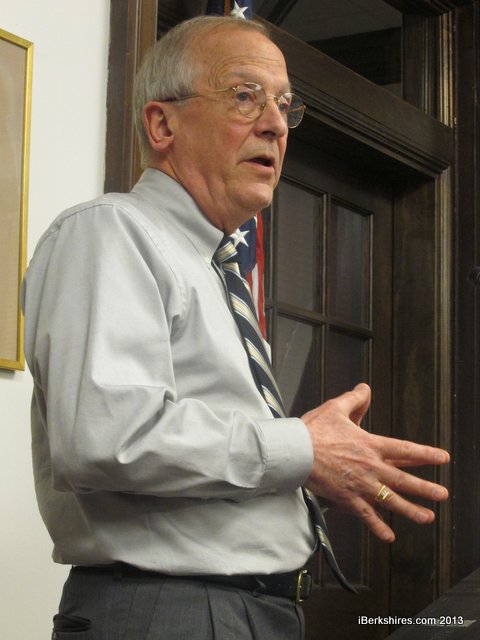 Town Manager Peter Fohlin said the town's attempts to gain federal and state money to fix the Spruces' flood issues was rejected years ago. Town Manager Peter Fohlin said the town's attempts to gain federal and state money to fix the Spruces' flood issues was rejected years ago. |
Harsch appeared to be convinced.
"People need to know definitively there's no point in going down that track any further," he said. "This is what we needed to know.
"This has been very helpful. Thank you very much."
Later, Harsch returned to the microphone to thank Fohlin for his service to the town in negotiating the agreement with Morgan and developing the grant application.
The Selectmen moved forward on a couple of other fronts on the issues of affordable housing (including potential replacement housing for the residents of the Spruces) and what to do with the park.
The panel appointed two committees, a Long-term Coordinating Committee, pulling together the chairmen of various town boards, and a Spruces Land Use Committee.
The former committee grew from last month's decision at a special town meeting to take a "time out" on the question of whether the town will develop a town-owned parcel known as the Lowry property for the purpose of building subsidized housing.
"The suggestion to [take a time out] was based on the need of the town to do its due dilligence so a comprehensive plan can be brought to the [voters]," Chairman David Rempell said.
To accomplish that end, the Selectmen established a panel pulling in the chairs of the Affordable Housing Committee, Affordable Housing Trust, Agricultural Commission, Conservation Commission, Council on Aging, Housing Authority and Planning Board along with Selectwoman Jane Allen.
One of the appointees, Planning Board Chairwoman Ann McCallum, suggested that the Selectmen add Andrew Hogeland, who espoused the "time out" strategy in the days leading up to last month's special town meeting. McCallum noted that Hogeland's experience as a lawyer and his financial acumen give him a skill set the Long-term Coordinating Committee would need.
Committee organizer Allen agreed that it should draw on Hogeland as a resource, but she said the committee on which he sits, the Finance Committee, is not part of the design for the committee.
"I organized it based on ... committees that had a vested interest in moving the issue forward," Allen said. "I thought long and hard bout this, and the Finace Committee just didn't. ... I've attended a lot of Fin Comm meetings. They don't act on warrant articles that don't have a financial impact. You'll see on the warrant (for the annual town meeting), they don't have an opinion on any of the articles that deal with housing.
"This doesn't mean this [Coordinating] Committee can't invite people to meetings. At times, we'll need more than the skill sets of the people involved."
The Selectmen announced seven members of the committee to look at the future use of the Spruces property. Thomas Hyde, Jack Madden and Libby Bartels are being invited back from an ad-hoc group that developed a highly preliminary conceptual look at the possible uses earlier this year. Spruces resident Charlene Blood, Richard Schlesinger from the Con Comm, Leslie Reed-Evans from the Ag Commission and Rempell will join that trio in developing a more concrete plan to bring to the Selectmen and the Conservation Committee.
And the Selectmen agreed at Monday's meeting to create yet another committee. The members of the newly formed Public Safety Building Study Committee will be finalized after next week's annual town meeting, but the selectmen agreed to invite a member of the Prudential Committee, which oversees the Fire District, to join a member of the Selectmen, a member of the Planning Board and two members of the Fin Comm who have been outspoken on the issue: Hogeland and Dan Gendron.
In other business on Monday, the Selectmen granted a request for a change in license to serve alcohol at the Williamstown Theatre Festival from the festival itself to local restaurant Hops and Vines, and it moved forward with a plan to create a community electric aggregation along with several Berkshire County communities, including the city of North Adams.
Tags: affordable housing, federal grants, FEMA, lowry property, Spruces,