Williamstown & Journalism Topic of Museum Talk
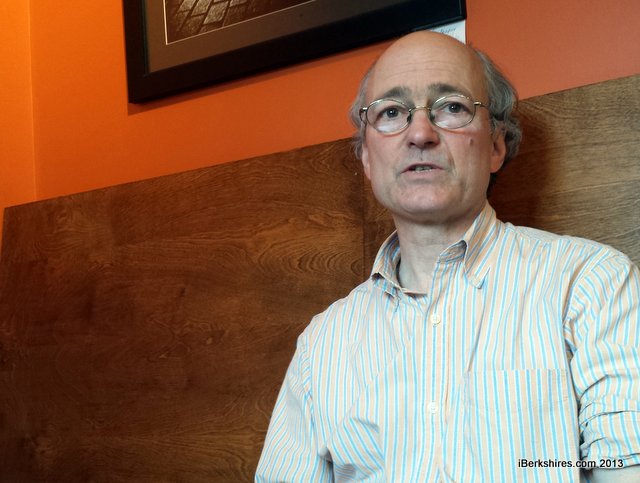 Bill Densmore will be the main speaker with Lauren Stevens on Sunday for a talk at the Williams Inn. The former publishers of The Advocate Weekly will look at community reporting, particularly in Williamstown, and the future of journalism. Bill Densmore will be the main speaker with Lauren Stevens on Sunday for a talk at the Williams Inn. The former publishers of The Advocate Weekly will look at community reporting, particularly in Williamstown, and the future of journalism. |
WILLIAMSTOWN, Mass. — What would people do if traditional ink-on-paper publications were no longer available? Will Facebook or online "newspapers" effectively replace such publications?*
Two local newsmen best known locally for their involvement with The Advocate Weekly paper will give their perspectives at a free lecture hosted by the Williamstown Historical Museum at 2 p.m. on Sunday, June 9, in the Heritage Room of the Williams Inn.
William "Bill" Densmore, a consultant to the Reynolds Journalism Institute on the future of journalism who's also involved in an online subscription service and the Media Giraffe Project, will explore the past and possible future of newsgathering and reporting in communities like Williamstown. Densmore was co-owner, with his wife, Betsy Johnson, and publisher of The Advocate from 1983 to 1992.
Lauren Stevens, who founded what was at first the Williamstown Advocate, will look the history of the town's newspapers.
The two sat down last week at Tunnel City Coffee to talk about their experiences, and give something of a preview of Sunday's lecture.
The history of Williamstown newspapers begins with the American Advocate, which was published from 1827 to 1841, said Stevens.
"Ridley Bannister, a printer, started the newspaper. .. . It was widely opinionated — politicized," he said. "We have come full circle: now bloggers have reached new heights in politicizing."
More than 100 years later, the Williamstown News was published by Fred and Eugenia Smith from 1959 to 1973.
"After Fred Smith died in 1972, Eugenia tried to run it, but wasn't able," Stevens said.
In 1980, Stevens, then an English professor at Williams College, wrote an "Editorial Prospectus: The Williamstown Reader," in which he proposed a weekly, environmentally oriented newspaper.
"Citizens more directly run a small New England town more directly than do most localities. They need to be informed," an excerpt from the Prospectus reads.
About a year later, he filled the void created by the lack of community newspaper and also satisfied his desire for change. The first Advocate came off the presses in spring 1981.
"After 11 years as dean of freshmen, I was ready for an adventure of a new and different kind," said Stevens, an environmentalist and author and frequent contributor to The Berkshire Eagle.
In the Advocate's infancy, the paper was mailed third class to 2,800 households "with the idea that by the end of the summer, it would become a paid circulation." That idea was revisited and The Advocate remained a free paper to keep advertisers and attract new ones.
But because of time pressures, Stevens suffered some embarrassing mistakes.
"Typographical errors proved too mild a term," he said sheepishly these many years later. But the community was loyal.
"People would go out of their way to tell us how much they enjoyed the paper," he said. "We featured writing about the area by local people. Although we didn't support any candidates for office, we did take sides on local issues."
The Williamstown Advocate was still losing money in August 1983, and Stevens stopped taking a salary and went on a modest hourly wage. His wife took a part-time job as office manager at Williams College. Two months later, the Densmore and Johnson bought the controlling interest.
A former Associated Press reporter with more than a decade of experience in the news business in Boston and Chicago, Densmore was eager to regain what he had "missed for years — a sense of feedback and spirit you get from serving a smaller group of readers."
Their normal schedule became "an eight-day week," but hey soldiered on, pitching in wherever needed, from typesetting to delivering papers. Circulation and advertising revenue more than tripled in four years.
Densmore's passion for journalism can be traced back to an incident in his years as a student at the University of Massachusetts at Amherst.
"My car was towed from where I had parked on campus. It really annoyed me," Densmore recalled. "I did music reviews for the school newspaper, and when I told the editor what had happened, he said 'Bill, why don't you find out what the regulations are and how the university comes to have a towing contract ?'
"I did and learned that the person in charge of contracts was the wife of the owner of the towing company. I thought 'There has to be a better way.' I was smitten and have been uncovering and reporting on such things as abuse of power and injustice ever since — without much success."
The Advocate came under new ownership in 1992 when it was sold to Ellen Bernstein. Densmore was quoted in a local newspaper as saying, "You can get stale after a while. The Advocate needs new blood."
The weekly was moved to North Adams and sold in 2001 to Osmin Alvarez, president of Boxcar Media and publisher of iBerkshires.com. The website became the Advocate's online presence for a time — and the only print product iBerkshires has had — until the paper was sold in 2005 to MediaNews Group's New England Newspapers Inc., which includes The Eagle and the North Adams Transcript.
The Advocate would have failed, Densmore believes, if conditions when it was founded were the same as today.
"Let's say Lauren and I wanted to start The Advocate now," Densmore suggested. "It would be impossible to sustain it. There are so few independent stores, because of box stores, and big companies advertise less and less and even stop advertising in newspapers."
When a question was raised about the possible impact of the decline in the newspaper business, Densmore pointed out that newspapers and journalism are not synonymous.
That question probably stirred a memory for Densmore.
"I was visiting a journalism school, and I noticed a young girl with her mother and father. The parents looked concerned. I said to them, 'I bet you are worried about the current state of the newspaper business,' " Densmore recalled.
He assured the parents that a journalism degree would serve their daughter well, whether or not she worked for a newspaper. "[As a student of journalism] you learn how to learn, to write well, to call people and ask questions, you learn how government and business work," he told the aspiring journalist's parents.
As for the Internet as a tool of communication, Densmore took us back to the days he was an Associated Press reporter.
"They had a teletype machine that ran at 66 words a minute," he said. "A bulletin would be no more than a sentence. A reputable reporter would convey the news ...
"Now [140 characters] is something like bulletins, and it is possible that Twitter will become an effective means of conveying news. Protocol has to be established," he said. "Bloggers are not trained to be journalists and face the challenge of how to create a method to convey trustworthy, reliable news on the Internet."
*Editor's note: We believe that question has already been answered by numerous hyperlocal sites. iBerkshires has been providing timely coverage of news and events in the Berkshires for years, including on Williamstown.com.
Tags: hyperlocals, lecture, news media,