Warren Says Dollar Coin a No-Go During Crane Visit
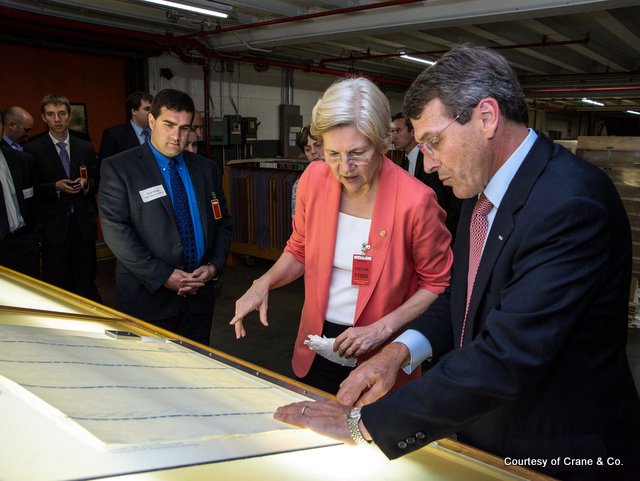 Crane & Co. Vice President Douglas Crane show U.S. Sen. Elizabeth Warren the security features in the company's currency paper to prevent counterfeiting. Crane & Co. Vice President Douglas Crane show U.S. Sen. Elizabeth Warren the security features in the company's currency paper to prevent counterfeiting. |
DALTON, Mass. — Congress is once again considering a plan to eliminate the dollar bill and replace it with a coin.
U.S. Sen. Elizabeth Warren had a one-word answer for that one-dollar question Sunday: "No."
Folding money is close to the heart of the Berkshires, where Crane & Co. has been making currency paper for the United States for more than a hundred years. The new high-tech $100 bill, printed on paper made in Dalton, finally makes its debut this October.
It's also about jobs: the currency division alone employs 400 people.
"People don't want the one-dollar coin ... we tried that," said Warren during a tour of Crane on Monday. "We tried it back in the '70s and there's a vault of one-dollar coins nobody wants."
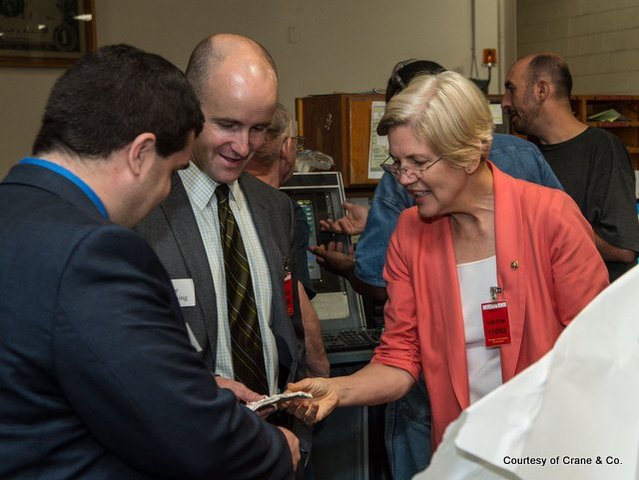
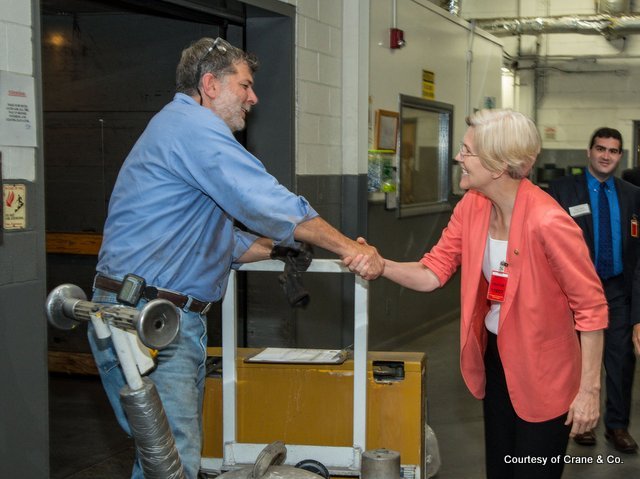
The Cambridge Democrat was given a presentation on the new $100 bill and a quick tour of the facility with CEO Stephen DeFalco and Douglas Crane, vice president of business development and government relations. The senator quizzed Crane on the papermaking process as she made her way by the often-noisy machinery, stopping to shake hands with workers.
She was accompanied by state Sen. Benjamin B. Downing, D-Pittsfield, and Rep. Paul Mark, D-Peru. Downing said she had clearly done her homework and was impressed by how "attentive she was to the needs of some of the bigger employers here in the region." (Warren had also toured General Dynamics in the morning before appearing at a tourism hearing.)
"We saw it on the campaign, and we're already seeing what kind of partner she's going to be on the state level," said Mark, noting the frequency of her visits during her short tenure.
Warren said she had done her homework on Crane.
"I know the history of this place. This has been a business since before the Revolutionary War, I also know it's a family business," she said, standing in the shipping room of the Wahconah Plant, where thousands upon thousands of reams of currency paper was packed and awaiting shipment to the U.S. Treasury in Washington and to mints around the world.
She told the couple dozen workers who followed the group out to the shipping department that she understood something of "what you do to produce something no one else produces, and nobody else can produce, which is part of the point here."
The bipartisan Currency Optimization, Innovation, and National Savings Act, aka COINS Act, was introduced by Sens. John McCain, Tom Harkin, Mark Udall and Tom Coburn. Striking coins rather than printing dollars would save the nation billions because coins last longer, say supporters.
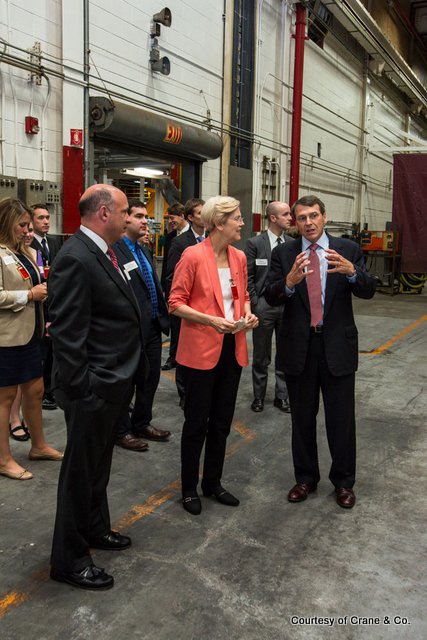 Warren with CEO Stephen DeFalco, left, and Douglas Crane. Warren with CEO Stephen DeFalco, left, and Douglas Crane. |
DeFalco said the most important aspect for Crane is to ensure "the debate has all the facts."
"The coin is much more expensive, you need a lot more of them, the public doesn't want them, and there's no payback," he said. "I think you stick with what the public wants if there's no savings."
According to the Government Accounting Office, the coin costs more to make (18 cents vs. 5 cents for a bill) but lasts 30 years to a bill's 4.7. But over a four-year transition period that would see paper money removed, more coins would have to made because "coins circulate with less frequency than notes."
Of course, the government already has plenty of coins on hand: more than a billion in fact. The dollar coin of Berkshires native Susan B. Anthony was struck for only a few years for lack of want, and production of the Sacajawea coin was cut back by 90 percent because it, too, was stockpiling. The government and banks are still storing some of those coins.
Warren's predecessor Sen. Scott Brown and former Sen. John Kerry brought the production of special presidential dollar coins to a stop in 2011 because the government was being forced to warehouse them at a cost of $37 million a year because no one wanted them.
Perhaps, said one worker, "the coins that are in the vault we could use to pay down the debt."
"That's a thought," responded Warren.
"I'm kind of an evidence-based person ... I think when you've got good evidence that it's not going to work you don't put anymore money into it. ... Paper really works for us and that's what we see here."
Editor's note: No photography was allowed inside the plant because of security regulations. The photos accompanying this article were kindly provided by Crane & Co.
Tags: coins, Crane & Co., currency, papermaking, senator, state officials, Warren,