Residents Untrusting Of Latest Wind Siting Investigation
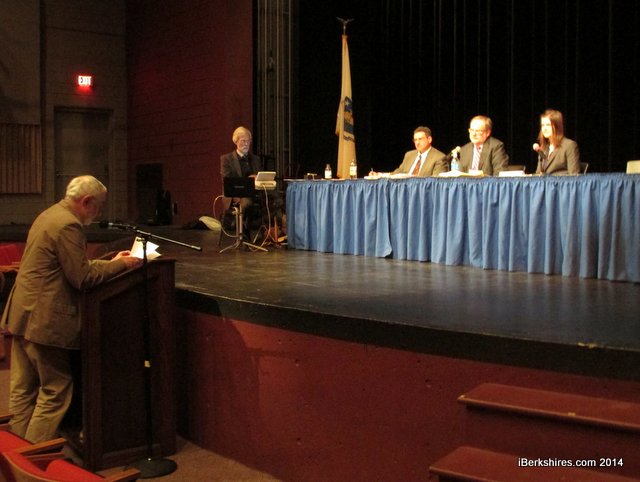 BCC professor Wayne Klug outlines studies showing that the majority of residents are concerned with wind turbines and questions why the state pushes for them. BCC professor Wayne Klug outlines studies showing that the majority of residents are concerned with wind turbines and questions why the state pushes for them. |
PITTSFIELD, Mass. — After five years of questioning attempts to pass a Wind Energy Siting Reform Act, there is little wonder anti-wind activists don't trust the newest state investigation into the issue.
The Department of Public Utilities held a hearing on Monday on the latest try at developing a wind siting policies. This study is an interagency look at developing guidelines and suggestions for how to permit land-based wind power facilities.
"I want to emphasize that the task at hand for the DPU is to develop a voluntary guidance document on the siting of wind energy facilities. The department is not developing enforceable standards, requirements or regulations," said James Buckley, the hearing officer presiding on Monday. "The guidance document when issued will not alter existing state or local permitting authority or responsibilities."
The document is being crafted by the Executive Office of Environmental Affairs, the Green Energy Center, the state Department of Environmental Protection, state Department of Energy Resource and the DPU. The goal, Buckley said, is to craft a document that could be of assistance to local and state permitting authorities.
The goal is to find the best practices of wind energy, which includes research into socioeconomics, health, environment, safety, decommissioning, construction impacts and design. Those best practices are expected to be shared with communities to help guide them.
However, the move comes on the heels of five consecutive attempts by the Patrick administration to pass the Wind Siting Reform Act, which could have eliminated local control of the permitting process and instead appointed a granting authority for all projects statewide.
In the Berkshires, the act was fiercely opposed because of the perceived lack of local control and the predominance of identified sites. With higher elevations and open space, residents fears industrial wind turbines would be placed in their back yards without their input.
On Monday, they tore into Department of Public Works officials, claiming this latest investigation is just another attempt to push wind-siting laws. But, this time, by going through the DPU it would bypass the Legislature.
"WESRA, or pseudonyms for it and in this case is DPU Order 13-165, is Gov. Patrick's zombie legislation. It's been killed over and over and over again and it should stay dead. But it keeps stalking our communities with renewed malcontent in spite of strong opposition from the public," Lenox resident Cynthia Wick said.
Wick, who led off the hearing, believes this investigation is just another attempt to remove local control. She feels the push for industrial wind energy isn't about reducing carbon emissions or combating global warming, but instead trying to help big businesses reap profits off of the Berkshire ridge line.
"It is an outrage and citizens of Massachusetts looking for smart energy policy [are] going to step up to fight it every time it rises from the dead," Wick said.
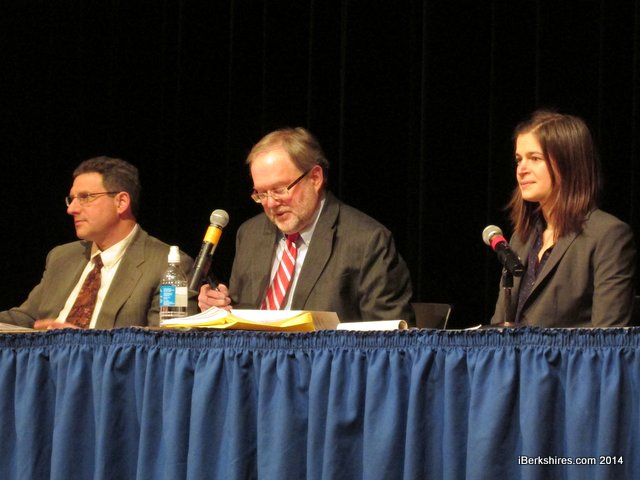 Andrew Green, director of DPU's siting division, James Buckley, hearing officer, and Meg Howard, analyst, were at BCC on Monday to take testimony. Andrew Green, director of DPU's siting division, James Buckley, hearing officer, and Meg Howard, analyst, were at BCC on Monday to take testimony. |
And she isn't alone. John DiTomaso of Peru said while this investigation may not create laws and processes to remove local control, it will be the basis for the next attempt.
"It will resurrect the Wind Energy Reform Act," he said, adding that with uncertainties of the impacts on communities, "now is the time to strengthen local control."
Outspoken wind-power critic Eleanor Tillinghast questioned why residents should trust the DPU's investigation under the request of Patrick because of past efforts.
The administration has spent five years "trying to push turbines into our communities" so why would this be different, she asked.
"The guidance will be nothing more than a boon for the winding industry," she said. "The Patrick administration has earned our distrust."
Janet Sinclair, of Buckland, pointed to the DPU's previous rulings including one where the regulatory authority provided an exception from local zoning bylaws for a biomass company. There have been wind turbine proposals in her area and they were stopped only because of local laws.
But now that DPU is involved in wind siting, she is worried that they would make a similar ruling allowing it to go forward.
Notably, none of the Berkshire's elected officials testified at the hearing.
Reached on Monday night, state Sen. Benjamin Downing, who sits on the Joint Committee on Telecommunications, Utilities and Energy, said the DPU does not have the authority to regulate or permit such wind projects and can only create voluntary guidelines.
Nonetheless, residents are on their toes watching for any indication that the state will somehow override their input on these projects.
Buckley said residents can continue to submit written comments to the DPU and another round of hearings will be held when the draft is issued. Monday's hearing was the third the department held.
"We're here to listen," Buckley said.
Tags: DPU, public hearing, wind siting, wind turbines,