DHCD Official: Williamstown Housing Project 'Worthy' of Fast Track
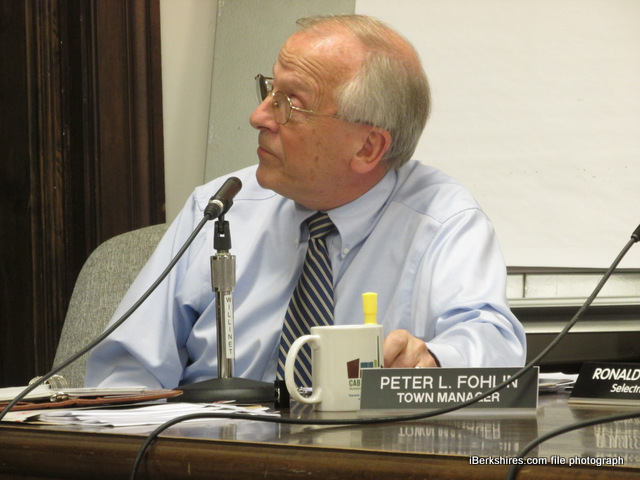 The developer of Williamstown's Highland Woods senior housing project credits Town Manager Peter Fohlin with making the project possible. The developer of Williamstown's Highland Woods senior housing project credits Town Manager Peter Fohlin with making the project possible. |
On Monday, it was announced that Highland Woods, in its first year of application, is one of 24 affordable housing projects around the commonwealth to be funded this year through a combination of state money and federal funds administered at the state level.
The undersecretary for the state Department of Housing and Community Development said it is atypical that a project like Highland Woods would leapfrog other proposals already in the queue.
"Certainly there are many projects we're not able to fund each year," Aaron Gornstein said. Many of those will come back in and be eligible for funding next year.
"We usually end up getting to most of the projects that apply for funding. It may take several years, though."
Gornstein pointed to another Williamstown project, the renovation of the Cable Mills property on Water Street, as an example of a proposal that had to wait its turn.
Cable Mills developer Mitchell Properties plans mostly market-rate apartments in the former mill building. Thirteen units are going to be available to income-eligible residents.
Highland Woods, by contrast, is entirely "affordable" or subsidized housing, with eight of the 14 units set aside for households earning less than 30 percent of the area median income.
"This project scored very high in our scoring criteria," Gornstein said. "We considered it a high-priority need. In and of itself, it was a worthy project."
The president of Berkshire Housing Development Corp., the lead developer on the Highland Woods project, said the state funding announced on Monday means the project has cleared a major hurdle in planners' push to have it ready in time for the March 2016 closure of the Spruces Mobile Home Park.
The park's closure — and specifically the Federal Emergency Management Agency grant that triggered it — is one of the keys elements of Highland Woods' fast-track funding.
"We look at whether there's a local match, and the stronger the local match, the more competitive that project is going to be in our funding rounds," Gornstein said. "In this case, Williamstown is stepping up to the plate and providing important resources. And of course, the partnership with college is also important."
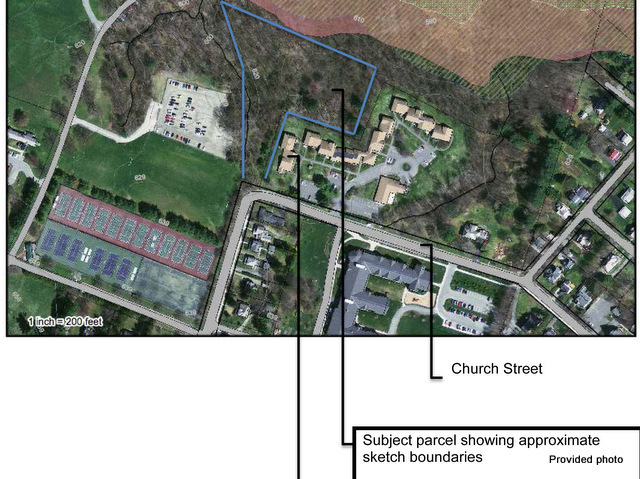
Williams College is donating the land at the end of Southworth Street to build Highland Woods, a joint project of BHDC, Higher Ground, Williamstown Elderly Housing and Boston's Women's Institute for Housing and Economic Development.
The town is contributing $2.8 million — $2.6 million of which comes from the $6.1 million FEMA grant (after park residents and owner Morgan Management are compensated and the town pays to return the flood-prone land to its natural state).
The unique public-private partnership between the town and Morgan Management and a grant structure created out of whole cloth made that $6.1 million possible.
And everyone involved says there is one man to thank.
"It's not an exaggeration to say it wouldn't have happened without Peter [Fohlin]'s advocacy for it," BHDC's Elton Ogden said after Monday's announcement. "He wouldn't want me to say that. But he's done a great job of representing the town's interests."
Fohlin negotiated the grant agreement with Morgan, FEMA, the Massachusetts Emergency Management Agency and the Massachusetts attorney general's office, which looks out for the interests of residents of manufactured housing parks.
The veteran town manager consistently has been praised by Williamstown's elected and appointed officials for finding a creative solution to the longtime problem: a park that had standing-water issues that came into sharp relief during 2011's Tropical Storm Irene.
On Monday, Ogden was clear that he joined the town officials in crediting Fohlin.
"My view is he went and found a way to get that FEMA money," Ogden said. "And that funding right there is one of the reasons we're standing here today.
"Without that amount of money from a local source, this wouldn't have risen as quickly to the top and gotten everyone's attention. And then they were able to look at the housing need that was behind it. Peter's been great."
Tags: affordable housing, FEMA, Fohlin, Spruces,