Pittsfield Police Lieutenant Ending 36-year Career
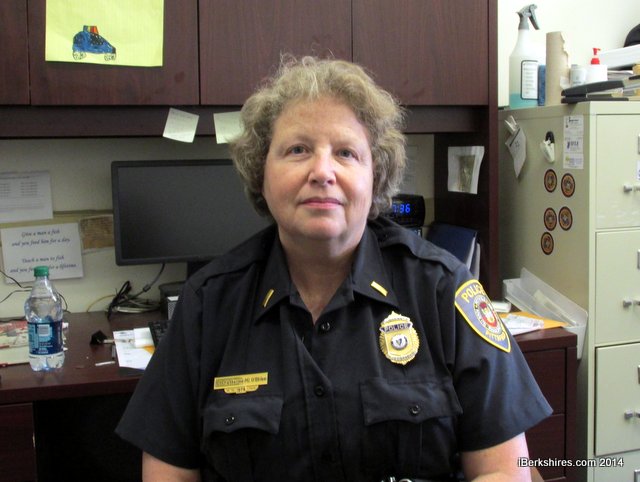 Lt. Katherine O'Brien will end a 36-year career on Saturday with the Pittsfield Police Department. Lt. Katherine O'Brien will end a 36-year career on Saturday with the Pittsfield Police Department. |
She met a woman who was a detective in the Rochester, N.Y., Police Department and knew then what she wanted to be when she grew up.
"I just thought it would be fascinating. I always loved Nancy Drew books, mysteries and stuff like that. That was when I was in seventh or eighth grade, and that's when I decided I wanted to be a police officer," O'Brien said on Wednesday, just three days before she was to retire from a 36-year law enforcement career in the Pittsfield Police Department.
She first became involved with the department in her high school days at Pittsfield High School when she entered the Explorers program.
From there, she went to Westfield State College for criminal justice to return to the city in 1978 with a part-time job in the department as detention attendant, watching over prisoners.
In February 1983, the department hired and sent O'Brien along with Detective Kimberly Bertelli and Julie Baker to the academy. The hiring came just a few years after the city's first-ever woman officer was dismissed and it started O'Brien's 31-year career as a police officer. O'Brien later became the first woman in the department to hold a supervisory position.
"In September, I joined the special investigations unit, which was the drug unit at the time. I stayed in that for 2 1/2 years until it was disbanded in 1986," O'Brien said.
In the SIU, O'Brien headed drug investigations at a time before crack cocaine had taken hold and became the epidemic of the times. Now, heroin has become the latest drug to hit the city.
"We were seeing a lot of powdered cocaine, marijuana and heroin. It was a different kind of heroin user," O'Brien said. "It wasn't as prevalent as it is now."
During her time, O'Brien says the biggest change in the job is the technology.
O'Brien came to the department when reports were written on typewriters and evidence documented with Polaroid cameras. She remembers when an officer reported to work with an electric typewriter that had spell check on it and how that helped in reporting.
"Technology has assisted in investigations but it hasn't sped up investigations. There is still a human factor. We are still reliant on the drug labs or checking DNA," O'Brien said. "DNA is a wonderful thing but the lab is so overwhelmed at this point you don't submit DNA on a housebreak unless it is a big housebreak. And then you have to wait."
With the disbanding of the special investigations unit, she returned to patrol and was put on the overnight shifts, where she spend most of her career. At the time, the officers would "bid for shifts" and there wasn't any extra incentives to do the overnight so her lack of seniority led her to that squad.
"It's evolved and more people want it. A couple years ago on the midnight shift, we had probably six or seven people with over 20 years experience," O'Brien said.
In 1991, she was promoted to patrol sergeant and seven years later to lieutenant. As lieutenant, she spent just short of a year on the evening patrol shift, then the detective bureau for about a year and half and then worked a few years on the day shift - overseeing day patrol, being the court officer and overseeing dispatch.
And then she eventually found her way back to the overnight shift, overseeing that patrol squad.
"I like how it is generally autonomous. We have to work together as a team. Very often on the other shifts, if something big erupts, they have detectives to call in who are working already. It is easier for them to get the troops in whereas on our shift, we don't have detectives working with us. We call them in on overtime," O'Brien said. "We learn to work together better, I think."
An example of that teamwork was in 2005 when there was a rash of break-ins. The overnight officers pooled information, brought in the detective bureau, identified a suspect and then crafted a plan to catch the crook.
"We were just getting killed with breaks and it was driving us crazy. The shift developed a plan and we got a call of a break in progress. You have to have the fortitude to not just swoop down on it but to maintain a perimeter," O'Brien said. "We did that and we finally caught the guy ... The whole shift worked together on that."
The overnight shift tends to be the "least busiest" shift but also sees many of the more dramatic events such as bar brawls, shootings and stabbings.
Through out her time, she's seen the city change a lot — particularly in economics and drug use.
"The economics have changed a great deal. At the time I came on, there wasn't the broad numbers of unemployed or underemployed. GE was still here. They were closing down at the time but there were still a lot of people employed by GE, Crane, Sprague. There were a lot more people staying in Pittsfield. The exodus was just beginning," O'Brien said.
"I think a great deal of the time crime is related to the economy. The hopelessness that some people have."
She has also seen how laws have changed. She remembers responding to domestic abuse calls and because the law at that point didn't allowed police to make an assault battery arrest unless they see it happen, she had to let the perpetrators go.
"You knew that he beat his wife up and there was nothing you could you. You'd urge him to leave for the night and he wouldn't want to leave. It was scary because you didn't know what was going to happen after," O'Brien said. "And then the laws were changed and we are able to make arrests when we believe an assault and battery did occur in a domestic... That's where we make an awful lot of our arrests."
The department continues to handle a lot of domestic calls and O'Brien says there is still a lot more happening in the city that isn't reported.
"We get calls from the usual places all of the time. But I know there is domestic violence happening across the city. We don't get calls from some of the more well-to-do places. I know there is domestic violence occurring there. It is still something that is not talked about too often," O'Brien said.
One of the most memorable cases for O'Brien was when she once fielded a call from a woman claiming she had been sexually assaulted. The caller gave O'Brien the license plate number of the suspect but officers failed to locate the man.
Months later, another woman reported that a man had broken into her house and raped her. Police were unable to identify a suspect in that case but it, too, sat dormant.
Then one night, police got a call for a break-in in progress and were able to arrest the man. But for O'Brien the details weren't making sense. It didn't seem like a normal break-in. She started putting the pieces together and eventually linked that man to both sexual assaults, more than a year after she fielded the first call.
"The whole thing didn't make sense. We got his palm prints and ended up linking the guy to that. He was charged with that. It was a nice case," O'Brien said.
But when Saturday morning comes, O'Brien will no longer be responding to those late-night calls for service or chasing down the bad guys. And she won't miss what sometimes seems like the "feeling of futility of going to the same calls, at the same places and seeing the same results."
But she will miss her co-workers. She will miss working with the public. She will miss having the job she's always wanted.
"I've had a great career. I was blessed to be able to do something I've always wanted to do," O'Brien said.
Tags: people in the news, Pittsfield Police, retirement,