Gift Sculpture Installed in Williams' Restored Reading Room
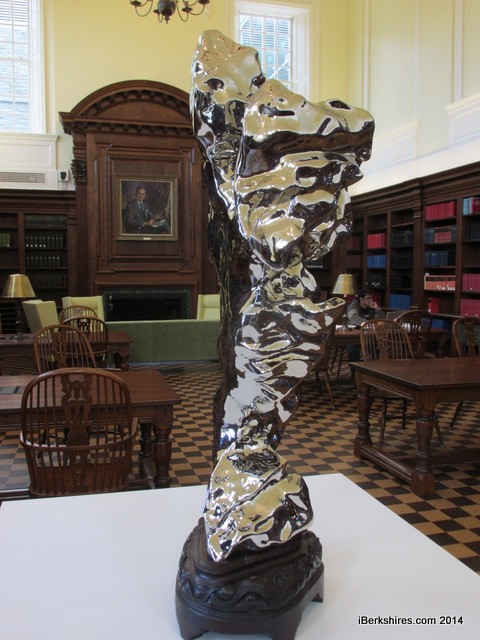
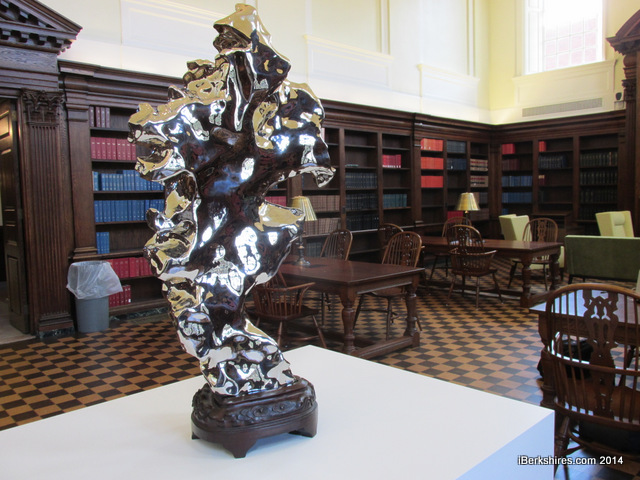 Artist Zhan Wang's 'Artificial Rock No. 77' situated in the restored reading room in the new Stetson-Sawyer Library is designed to encourage 'deep thinking.' Artist Zhan Wang's 'Artificial Rock No. 77' situated in the restored reading room in the new Stetson-Sawyer Library is designed to encourage 'deep thinking.' |
WILLIAMSTOWN, Mass. — The sculpture gracing the renovated reading room in the new Stetson-Sawyer Library was created by one of China's leading contemporary artists today: Zhan Wang.
"Artificial Rock No. 77," a modern-day take on the traditional Chinese "scholar's rock," was installed in its permanent home on Sept. 17, approximately two years after Susan Adler donated it in honor of the Williams College Faculty of Art and in memory of her late husband, Herbert S. Adler.
Herbert Adler was a chairman of the Williams College Museum of Art's visiting committee and the Williams Parents Committee, and a director of the Williamstown Art Conservation Center.
The sculpture was in the care of WCMA during construction of the $86 million library project.
"I once put it in an exhibition at the museum for a short time," Kathryn Price, curator of collections, said, adding that the sculpture was always meant to be moved upon completion of the library.
High expectations were met, if not exceeded, on the day of installation. Even workers gathered round to admire the piece.
David Pilachowski, director of libraries, said on the occasion that, " 'Artificial Rock No. 77' is an outstanding piece that evokes contemplation and deep thinking, and it seems more appropriate to be located in our restored reading room."
Price and her WCMA colleagues were also present for the installation of the nearly 4-foot high stainless steel sculpture with mahogany wood base.
"We are very excited to see the Zhan Wang go to its new home, where students will quite literally be able to study next to and be inspired by this work for years to come. In China, scholars' rocks have served as inspiration for intellectuals for centuries," she said.
In his work, Wang draws upon a long cultural tradition of rock appreciation in China, where for hundreds of years, Chinese literati have collected rocks as objects of art and tools of meditation.
Wang creates so called "Artificial Rocks" by making hollow molds of naturally occurring stones over which sheets of metal are placed and hammered to reproduce their rugged surfaces, and polished to a high sheen.
His stainless steel artificial rocks are presented in such prestigious installations as the Los Angeles Museum of Contemporary Art; the Metropolitan Museum of Art in New York City has acquired "Artificial Rock No. 10," making him one of the first contemporary artists to have his work in the museum's permanent collection.
At Williams College, a couple of freshmen and a senior were among the first students to set eyes on No. 77 in the renovated reading room. They described the mirrored, irregularly shaped sculpture as "inspiring," "surprisingly soothing," "new in its abstractness" and "impressive." The freshman from India also joked: "I'd like to have one of those!"
None of the students were aware that scholars' rocks are credited with inducing deep thought but, when enlightened, they found it encouraging.
Susan Adler, speaking via telephone from her home in Scarsdale, N.Y., explained how she came to give Williams College a gift of a Zhan Wang work of art.
 "It was an impulse inspired by my daughter Maggie's enthusiasm for the work of Zhan Wang," Adler began.
"Maggie was an art history major and classical major at Williams, she graduated in 1999. When she was at Williams, we fell in love with the college."
"We had contact with the museum years before. Our collection of works of early American art on paper had been displayed at the museum."
Margaret Adler, a Williams graduate, had became director of development of the Addison Gallery of American Art at Phillips Academy in Andover.
"But Maggie decided to be more hands-on in art so she went back to Williams in the graduate program for art. She also volunteered and worked at WCMA," said Susan Adler. "A class celebrating its 50th reunion wanted to donate a piece of art to Williams. They did not choose Zhan Wang and Maggie was very disappointed."
Adler assured her daughter, now assistant curator at the Amon Carter Museum in Fort Worth, Texas, that she would do her best to bring a Zhan Wang work of art to Williams
"We requested from Zhan Wang and his dealer possible candidates for the new library and they sent photos. It was primarily handled by the art folk at WMCA," said Adler, who made the final decision on which piece was selected.
"I was thrilled that the piece would be in the library. The library is the heart of scholarship at the college."
Tags: gift, school library, WCMA, Williams College,