Documents Detail Complaint Against Mayor Bianchi
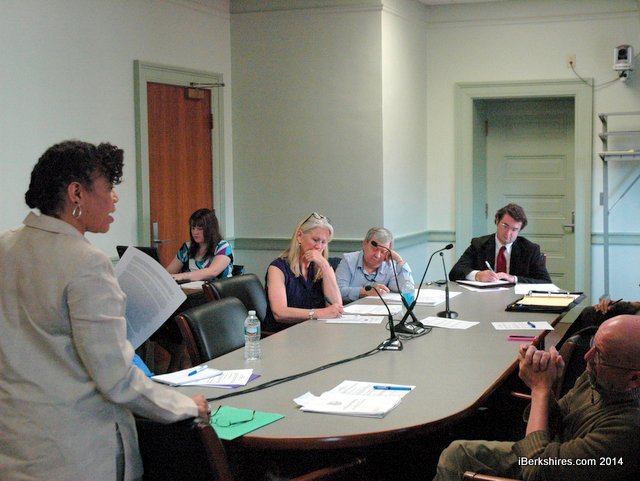 Complainant Doreen Wade speaks to the Human Rights Commission earlier in 2014. Complainant Doreen Wade speaks to the Human Rights Commission earlier in 2014. |
Since April 2014, the city's Human Rights Commission has been examining accusations made against Bianchi by Wade that include assault, hostile racist behavior toward her efforts to relocate her online business to the city, and refusing to hire her for a position in his cabinet.
Records provided to the HRC in its deliberation of this matter, released on Dec. 29, 2014, include a substantial volume of emails and memorandum between Wade and local officials, meeting minutes, applications by Wade for several city administrative positions, as well as news articles and other supporting references to the ongoing dispute.
Based on some of the released documents, the origins of this conflict appears to date back to more than a year before the start of the investigation, following initial attempts by Wade to contact local economic development officials regarding the prospect of relocating her business, the New England Informer, to Pittsfield. (The website does not appear to be operating at this point.)
On March 7, 2013, Wade sent a blanket email to then Berkshire Chamber of Commerce President Michael Supranowicz, Pittsfield Economic Development Authority Director Corydon Thurston, and Community Development Specialist Ann Dobrowolski indicating her interest in relocating her business.
In it, Wade first expressed her disappointment that the city had "no form of minority communication," in terms of media specific to the local African-American community, and inquired about what business funds and business opportunities were available.
"In evaluating the lack of a communication resource or even a connection with other minority communication resources I decided to purchase a permanent home and may move my global communication business on a web and print basis to the area," wrote Wade.
When more than two weeks passed without a response, Wade contacted Bianchi, prompting a response from Dobrowolski on March 25. An initial conversation between Wade and Bianchi appears to have been cordial.
"After talking to the Mayor I really think things will go a little better," Wade wrote in response to the March 25 email from Dobrowolski. "He seems to be a good man and I believe he wouldn't have people working with him that were not good also."
According to memorandum in the documents provided, Wade met with Dobrowolski on April 2 to discuss available resources for businesses through the city, again inquiring if there were any programs particular to minority business owners, to which she was told there were none.
"She said the business had not been making money. It was originally a print publication that was now strictly Web-based, but that she planned to restart a print publication while continuing a Web presence," Dobrowolski stated in a May 15, 2014, memorandum to the Human Rights Commission. "She said that she might need funding, but did not have a business plan."
Dobrowolski says she reviewed two available loan and assistance programs available to the city, and also referred her to Berkshire Community College and Berkshire Enterprises for more information.
The following day, according to testimony given to the HRC, Wade met with Bianchi in his office. While there appear to be no notes of this meeting among the documents released by the city, handwritten notes by Mary McGinnis (hired shortly after as the mayor's director of administrative services) enclosed from subsequent meetings indicate differing perceptions from Wade and Bianchi as to how that sit-down went.
While Wade has indicated in HRC testimony that she found remarks made by the mayor to be combative and racist in nature, Bianchi described Wade's initial contact with him as "very aggressive" from the start.
"This was the most strange conversation with anyone in a little over a year that I've met," Bianchi said at a May 22, 2013, meeting of the NAACP, according to McGinnis' notes. "I felt like I was being lured into a debate."
Following the April 3 meeting, Wade contacted the Berkshire chapter of the NAACP, as well as reaching out to local media. When McGinnis began work for Bianchi on April 23, the "Wade situation" (as described in her notes from that day) had already begun to boil.
A few days later, on April 29, Wade again met with Bianchi in his office, this time accompanied by Will Singleton from the NAACP. Several pages of notes by McGinnis offer a more extensive transcript of what she heard at this meeting, portraying an increasingly heated exchange between the two, and quotes that follow are drawn from these minutes.
Based on her notes, the meeting began contentiously from the start, with Wade indicating that she had found the mayor's tone to be "racist" and "unwelcoming," and stating that at their previous meeting Bianchi had said "there are no black role models in this city."
"I did not set this meeting to have words put in my mouth I never spoke," Bianchi responded, according to these meeting minutes.
When asked by Singleton what she wanted from the mayor, Wade said she was "looking for a city that helps and likes black people."
Bianchi stated that his point to her in her pursuit of city resources for her proposed business had been that a print publication devoted to Pittsfield's African-American population "would be difficult."
"We may not have the demographics to support a print product," Bianchi said.
The two sparred verbally over the topic of support for minority businesses, with Wade stating that the mayor had told her she was ineligible for the city's PERC small-business loans and that there "were no programs here to help a black woman."
"I think you heard what you wanted to hear," said Bianchi, "You said the city does not support black businesses."
"Ok, I'm a liar," Wade shot back.
"I never said that you said I said," Bianchi responded, adding. "I called the mayor of Medford, he's never heard of you."
At this point, Wade attempted to call Medford Mayor Michael McGlynn. Singleton attempted to defuse the escalating situation, asking, "Can we get past that? What is the next step?"
(Minutes from later meetings indicate that a commissioner and the mayor later spoke with McGlynn again and that he had said he did know Wade.)
According to the minutes, during their heated exchange, Wade twice said to Mayor Bianchi, "Stop pointing at me."
In later testimony before the Human Rights Commission, Wade called this action by Bianchi "cowering," saying that he physically loomed over her and shook his finger while "yelling and screaming," and act she considered "committed an assault against me, as well as performing an act of criminal threatening." Singleton later stated before the commission that the mayor was "obviously angry," and shook his finger while leaning forward in his chair.
Based on the meeting's minutes, discussion continued with heated back and forth, with Bianchi saying she was misinterpreting what he was saying, and Wade saying he had "verbally rejected" her proposal to relocate her business.
" 'If you're going to bring an all-black business to Pittsfield, I would not give you funding based on that,' " Wade quoted Bianchi as saying.
"I couldn't say and suggested I didn't know," answered Bianchi.
After some continued arguing, the meeting began to draw to a close, with Bianchi suggesting the city's Community Development department would try to assist her if possible.
"We will help you in any way we can," said Bianchi, who also made reference to tax incentives, after which McGinnis suggested she could introduce Wade to members of the Chamber and Downtown Pittsfield Inc.
"Why are you wanting to help me now?" asked Wade, to which Bianchi asked, "Are you baiting me?"
The meeting wound down after some brief discussion of a lack of minority hiring by the city, with Bianchi stating that City Hall was not discriminatory, and referencing local police Chief Michael Wynn.
Based on the minutes, Wade left the meeting clearly dissatisfied, saying Bianchi "did not do anything."
While this marked their last in-person discussion, the emerging conflict between the Medford businesswoman and Pittsfield's mayor was just beginning.
This is the first part of a two-part article looking at the document related to the Wade case. The story will be continued in Part 2 on Tuesday morning. More documents will be released after review.
HRC_Initialcomplaint by iBerkshires.com
Tags: human rights, municipal complaint, public records,