
North County Banks Issued Ornate 19th-Century Notes
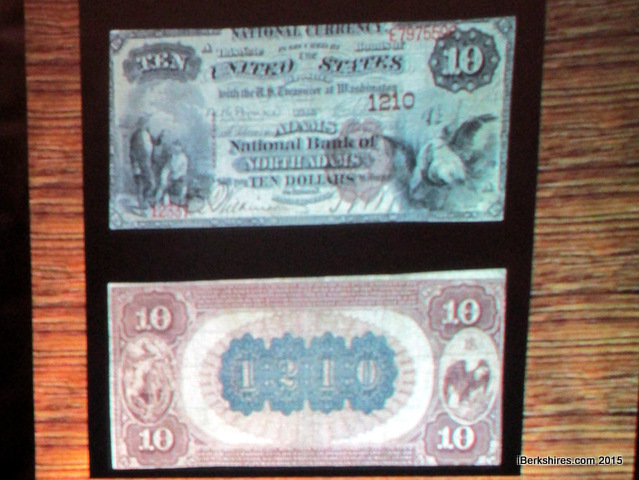
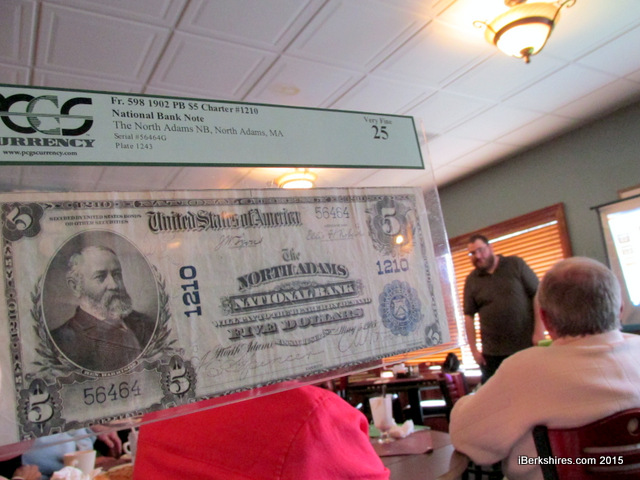 President Benjamin Harrison is featured on a $5 national banknote issued by North Adams National Bank. The 1210 indicates the bank was the 1,210th to join the national banking system after the Civil War. President Benjamin Harrison is featured on a $5 national banknote issued by North Adams National Bank. The 1210 indicates the bank was the 1,210th to join the national banking system after the Civil War. |
NORTH ADAMS, Mass. — There was a time in the Berkshires when you didn't have to go to a museum to see a piece of art — you could just open your wallet.
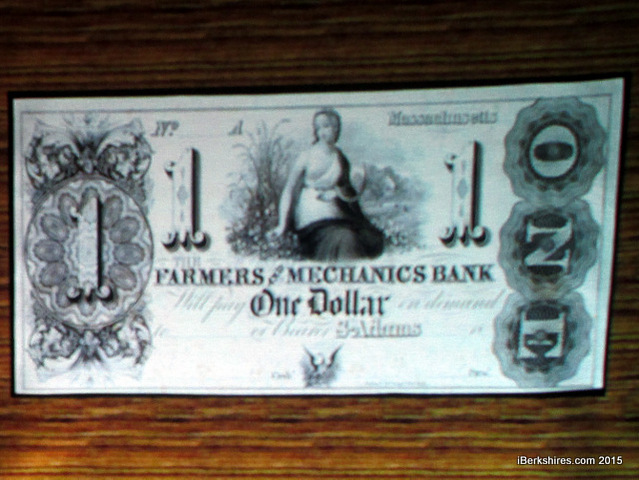
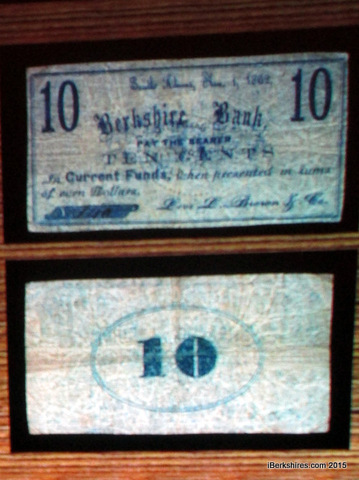
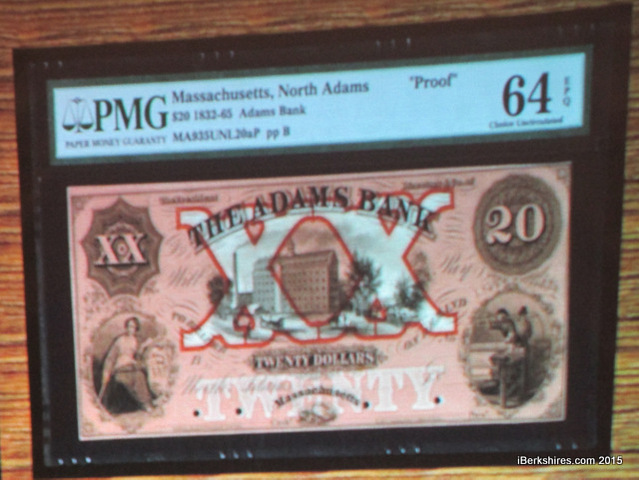
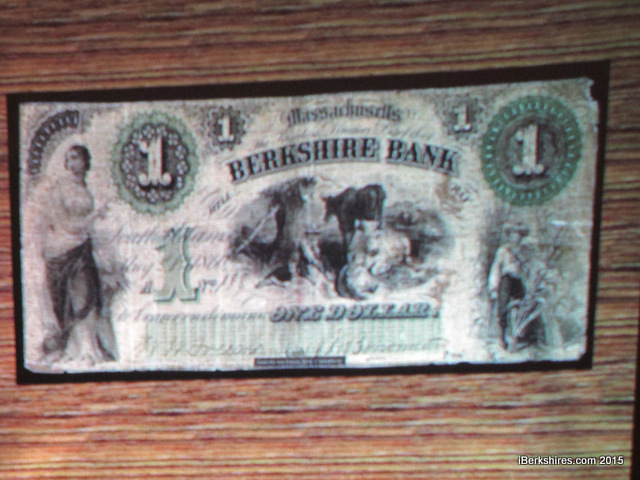
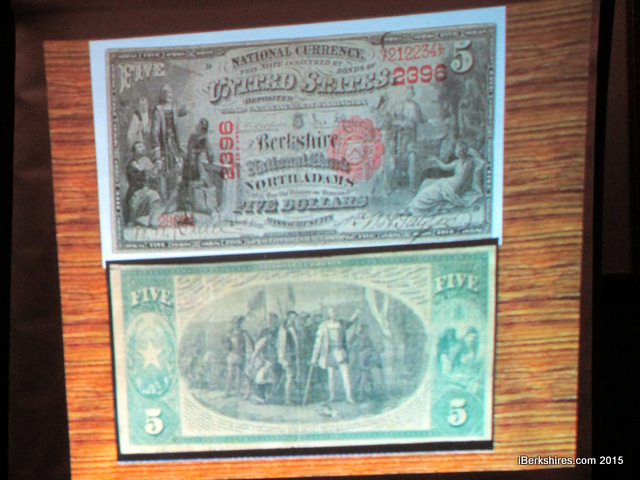
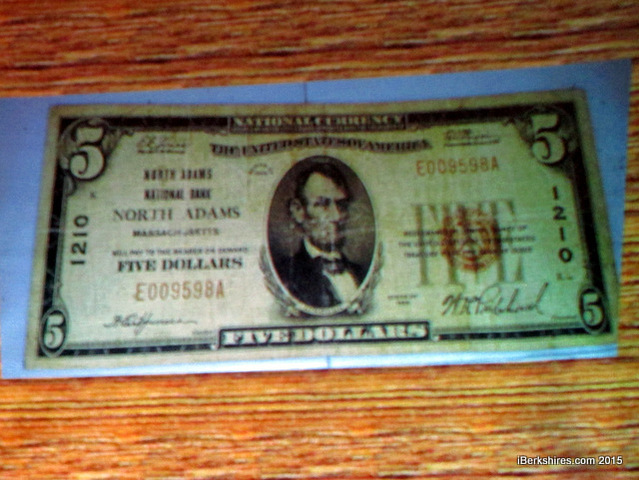
Paper banknotes of the 19th century were often engraved with lovely maidens, historical figures, natives, farming and local industry, all catering the tastes of the community or, more precisely, the officers of the local bank.
"Now we have the Clark Art and Mass MoCA, and places like that in the area that have beautiful art, but a 150 years ago there was still beautiful art, too," said Josh Colon of the North Adams Historical Society about the now obsolete currency. "You can see they made them very ornate, with different designs. They had them with a lot of women, with animals and other things."
Colon's illustrated talk at the North Adams Historical Society's annual meeting on Sunday at Boston Sea Foods included some carefully preserved banknotes dating from the early 19th century through the 20th century's national banking period.
Bank-issued notes were used extensively between the American Revolution and up through the Civil War period. Thousands of banks circulated their own paper scrip in a variety of denominations and sizes and designs.
"It would be like you writing a check and that check would eventually go back to the bank that it came from," Colon explained. "What they were allowed to do is make their own money and design on it. They could make it any amount that they wanted."
Not unlike today, banks would usually only accept back their own banknotes in exchange for U.S. coin currency, or charge the bearer for the inconvenience of drawing on another bank. For example, a banknote for $5 from Adams' Farmers & Mechanics Bank might bring $2.50 at a Pittsfield bank, the balance being the cost to bring the note back to Adams for redemption.
Colon's been collecting coins for years but it was 2009 when he stumbled on a North County banknote being sold by a dealer in New Jersey that piqued his interest in the obsolete currency.
"I happened to bid on one of them," he said. "I didn't even know there was a North Adams National Bank."
He has notes from North Adams National Bank (which became First Agricultural in 1962), Farmers & Mechanics Bank of South Adams, Berkshire (National) Bank of North Adams, the Adams (National) Bank, and Arnold Print Works, among other Berkshire County banks. Other North County banks during this time include Greylock National Bank of Adams and Williamstown National Bank.
Businesses, too, often printed notes to pay employees that could be be drawn on specific bank, he said. Local notes were printed on mostly paper from the American Banknote Co. and Crane & Co.
Most of the paper notes are thin and almost see-through; some are engraved on both sides, some on just one. Colon said the prices for these bits of history can range from a few hundred to thousands of dollars, depending on the rarity and the market. Millions of dollars worth of banknotes were printed during that banking era.
"The fun thing about these $5 notes is I have many of them that are considered to be contemporary counterfeits," he said. "I have not found one that's actually an original one."
That's not surprising. Banks would hire an artist, usually local, to create the note and then send the artwork to an engraver and a printer. It wouldn't be difficult to run off a few (or many) extra notes on the side.
In one case, he said, a bank's president had ordered extra notes for show — they were never supposed to leave the vault — but somehow they got into circulation and the bank collapsed when it couldn't cover the volume.
By 1863, Congress had enacted the National Banking Acts and established the U.S. Bureau of Engraving and Printing to bring some standardization, confidence and commercial convenience to the reams of paper notes circulating. While issued through the U.S. Treasury with seals and serial numbers, the notes were still ornate, unique and boasted the bank's name and the signatures of its cashier and president. The difference was any bank in the national system would accept the notes.
As the 19th century century closed out, the notes became more standardized and, by the time the national banking system came to an end in 1934, paper currency was very similar to today's.
"They kind of dumbed them down a bit and by the end, they got rid of all the artistic value altogether," Colon said. "I think we got generic and boring."
Tags: banking, historical society, historical talk,