Sagas of the Shire: The Morewood Lake Disaster
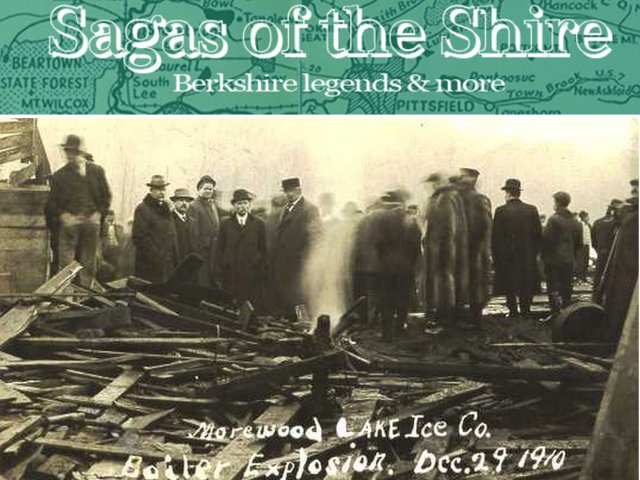 The Morewood Lake disaster killed 17 and injured 20. The Morewood Lake disaster killed 17 and injured 20. |
PITTSFIELD, Mass. — It was set to be an exceptional year in the ice business.
Early the year before, George Shand and Everett Lesure had purchased the Morewood Lake Ice Co., and were anxious to increase profitability in their second season. The company, which in the peak of winter employed up to 150 men, had been seeing steady yields of 20,000 tons of ice harvested annually from the Morewood Lake site, but Shand and Lasure announced this year they expected to raise the output to 25,000 tons.
Advertisements for laborers had been put out, and everything was in place to begin when workers arrived on the morning of Thursday, Dec. 29, 1910, for the first day of the season. Minor equipment issues had been worked out in advance so that work could begin promptly. In particular, a valve on the boiler used to run the conveyor carrying the ice up to the ice houses had been acting up the day prior, but had been replaced, and appeared to be in good working order at 9 that morning.
At 9:20, about 40 of the men headed down from the boiler house toward the lake while many of the rest remained clustered around it.
At 9:30, the boiler house erupted into the sky in a short, horrifying whirlwind, hurling debris and bodies hundreds of yards in every direction.
The explosion could be heard throughout the city; the blast shook windows downtown on South Street, a mile away.
Men working around Morewood, even up to 400 yards from the house found themselves dodging a rain of pipes and steel pieces. One 200 pound piece of boiler was flung north of the ice house, over 500 feet away; another 300-pound hunk flew almost twice that distance, cutting off the tops of five trees on the south of the house at a height of 30 feet.
Twelve men were killed instantly, and many more grievously injured. Accounts from those workers who survived the blast describe a bloody, chaotic scene, confronted in every direction by dismembered and mangled remnants of men strewn in every direction, dozens of others writhing in pain and shock wherever they'd been thrown by the blast force or struck by large pieces of searing debris.
Still badly stunned, those on the scene who escaped major injury rushed to help those more badly wounded.
James Hovey and his 19-year-old son James Jr. had just left the boiler house minutes before the blast, and sped back to help pull several men from the debris closer to the house.
"The cries and groans of the injured were terrible," recalled George Stevens, another surviving worker. "The one who seemed to be crying the loudest and who seemed to be in most pain lay under some wreckage almost directly under the place where the boiler had stood. I yelled for someone to assist me, as I believed that if a man could holler as loud as this man was doing that there was hopes for him."
Together with some other men, Stevens cleared the man from the wreckage and got him on one of the first runs to the hospital. First on the scene to carry injured was the sleigh from Pittsfield Fire Department's central station, followed by the police ambulance and two hospital ambulances carrying them in several trips to the House of Mercy. One man died en route, and two more passed from their wounds shortly after reaching the hospital.
After the injured were all removed, the ambulances and sleigh began making trips to the funeral parlors with the remains, many of them unidentified. Some were virtually unidentifiable, mere torsos of men where heads and extremities had been disintegrated in the pure ferocity of the blast.
The final death toll was 17 men, with another 20 injured, in what was immediately dubbed "the worst tragedy in the history of Pittsfield."
"Upon many of these dead faces was an expression of horror," wrote an unnamed reporter for the Berkshire Evening Eagle. "So gruesome was the scene that the spectators turned their heads away from the awful sight."
Among the "spectators" rapidly amassing as word spread were many families of the 150 men who'd been working at the Morewood site that day, desperate to ascertain if their sons and husbands were among the dead and injured.
Police Chief White was early on the scene as well, and downtown Mayor William MacGinnis heard reports of the severity of the accident. MacInnis, who was in the last week of his term, called in Mayor-elect Kelton Miller and met with U.S. Sen. Winthrop Crane, who'd driven over from Dalton on hearing the news. The mayor promptly called for an emergency meeting of the City Council for 3 that afternoon to discuss ways the city could assist families in this crisis.
"The awful accident of this morning saddens and shocks every Pittsfield heart in this, the greatest calamity that our city has ever experienced," said MacInnis in a statement to the press. "All our citizens will unite to assist in every possible way to lighten the blow."
Working with the council and other local leaders, a relief fund was established, and within the next two days would swell to more than $7,000 with donations.
In addition to a desire for city appropriation to pay for funeral costs, councilmen and aldermen at the emergency meeting called for action to be taken regarding boiler inspection, expressing sharp criticism of the state regulatory authorities.
An official inquest was set for Tuesday, but the process of assigning blame for the incident was already underway.
The pressure valve for the boiler was found among the wreckage of the tragedy, and it was determined that the equipment wasn't registering the correct pressure and so failed to blow off when it should have.
By Friday, it emerged that engineer William Dunn and machinist George Ward had voiced concerns about the boiler the evening prior to the blow out. A previous malfunctioning valve had just been replaced, but Dunn had faced difficulties getting the new valve to work correctly on the aging boiler apparatus.
He was still nervous about it the morning of the accident, his son John recalled later, after tearfully helping police identify pieces of his father at the scene.
More accounts came at the inquest, where witnesses said Dunn had continued to have trouble with sudden jumps in the steam guage indicator, up until just a few minutes before the explosion. Everett Lesure, co-owner, testified denying the claim that he had told Dunn to screw down the compression screw on the valve.
The final finding of the inquest released by Judge Charles Burke found that this compression screw and the failure of the gauge to register properly, which was attributed to rust from the boiler pipes clogging the gauge, were the ultimate cause of the explosion.
"I do not find that the unlawful act of any person now alive contributed to the death of said decedents," Burke wrote, laying responsibility for any negligence vaguely with the deceased engineer and machinist.
One of the results of Burke's written ruling from the inquest, and of the accident itself, is the adoption of stricter regulations by the state Board of Boiler Rules later that year.
Though exonerated of any corporate wrongdoing and fully insured for the damage to the plant, the Morewood Lake Ice Co. itself never really recovered from the affair, and by the following winter Shand and Lesure sold the operation to the investors incorporated as the Melville Ice Co.
The new company soon moved its ice operations away from Morewood Lake to Goodrich Pond. Business took a turn when one of their largest buyers, the local brewery, closed with the onset of alcohol prohibition. Finally, the growing distribution over the next few years of the electric refrigerator first developed in 1913 rendered traditional ice harvesting obsolete. By the 1930s, the industry was all but nonexistent in New England.
The Springfield Republican called the Morewood Lake explosion one of "the most serious that has ever occurred in Western Massachusetts." In lives lost, it surpasses the devastation of other major regional catastrophes of the period, for instance the 13 workers who perished in the Central Shaft accident on the Hoosac Tunnel in 1867, the 7 killed in East Lee floods from the Mud Pond Dam break in 1886, and even the Boston & Albany RR wreck that claimed 15 lives at Chester in 1893.
Amidst the changing landscape of local manufacturing in the century that followed, sporadic industrial accidents were still seen — two General Electric employees killed in an explosion at their Pittsfield plastics plant in 1957, for example — but never since has the region seen an incident of such gruesome destruction.
Sagas of the Shire is born out of an attempt to break new ground, or at least break out of a certain habitual mold of local history storytelling. While the Berkshires have enjoyed many great historians and much outstanding historical writing, it is my belief that there is a great deal that may have fallen by the wayside in its attempt to hammer out a unified narrative in its vision (and marketing) of itself.
Tags: historical event, sagas of the shire,