Mount Greylock School Committee Splits on Superintendent Evaluation
WILLIAMSTOWN, Mass. — A divided Mount Greylock Regional School Committee on Monday gave a passing grade to the district's superintendent after his first year on the job.
On a vote of 4-2 (with one member absent), the committee rated Douglas Dias "proficient," the second highest of four possible grades in the rubric established by the Department of Elementary and Secondary Education.
The potential grades include unsatisfactory, needs improvement, proficient and exemplary.
Two members of the seven-person committee rated Dias "unsatisfactory" on their individual rating forms, though one of the two hinted at Monday's meeting that he could settle for "needs improvement."
The seventh member, who did not vote at Monday's meeting, Williamstown's Gary Fuls, rated Dias as proficient on his written form, giving the superintendent consistently high marks in most of the individual categories that comprise the state evaluation form.
Richard Cohen of Lanesborough and Steven Miller of Williamstown voted in the minority against endorsing the grade given by five of seven committee members individually.
The vote was preceded by a lengthy discussion in which the committee struggled with its internal process and the proper standard to which a first-year, first-time superintendent should be held.
The latter point led Cohen, whose written evaluation score was unsatisfactory, to indicate he would upgrade that score if his colleagues agreed to drop down from proficient and meet in the middle.
"I'm in favor of 'needs improvement,' " Cohen said just before the vote. "If you look at the DESE guidelines, that's the middle ground for a new superintendent. 'Proficient' would be exemplary for a new superintendent. I think 'needs improvement' is more realistic."
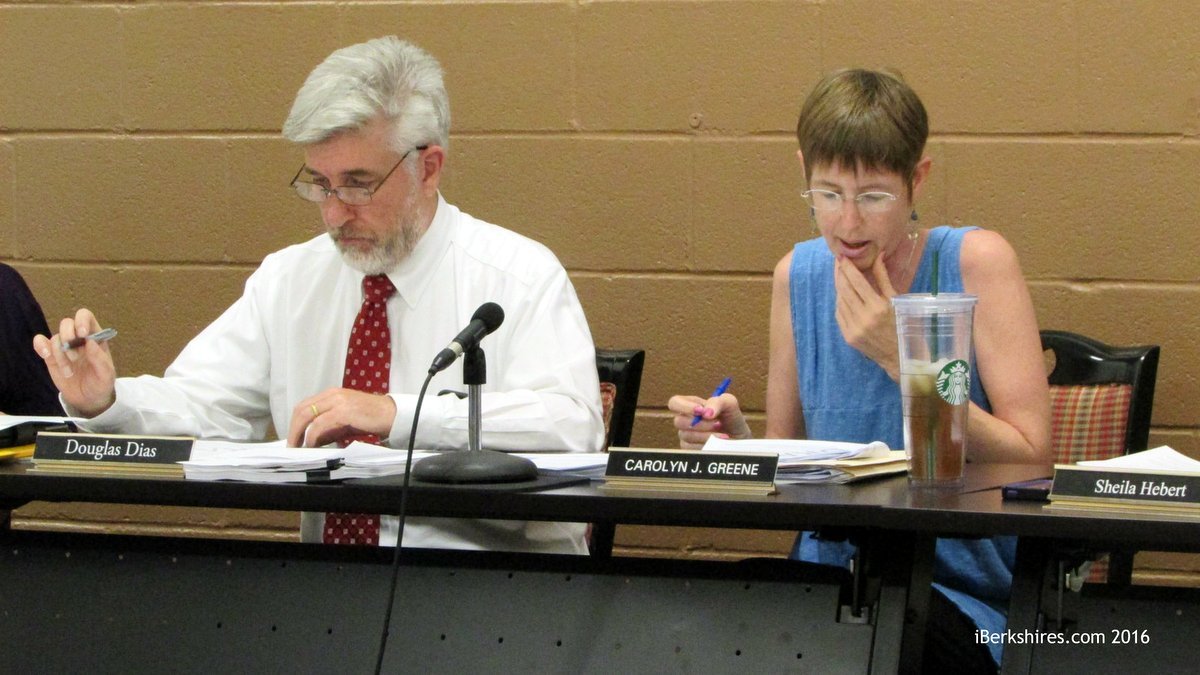
Miller did not join Cohen in offering that compromise, but he did ask if the state had any data about what sorts of grades first-year superintendents receive. After replying that no data was available, Chairwoman Carolyn Greene called an up-or-down vote on a motion to make the majority's grade the grade of the full committee; that motion passed, 4-2.
Throughout the discussion, Cohen repeatedly complained about how Greene excerpted his written comments for a composite evaluation that was distributed to the committee prior to the vote.
As chair, Greene accepted the six written evaluations and grades of her colleagues, synthesized them on one form and distributed that document on Monday to help inform the discussion at the meeting. He also complained that the summative document — without all of his comments — was available for public consumption at the meeting.
"I'm concerned because the document you just handed to the press includes some of my comments but not the more important ones," Cohen said. "I based my ratings on evidence. I think you're doing a disservice by not including the full comments.
"I don't think the chair has discretion to decide which comments are worthy."
Greene said her goal was to distill the comments from all the members into one user-friendly document that balanced all the committee members' input — positive and negative.
"I spent four days on this," Greene said. "The evaluations did not come [back from committee members] all at once. I was constantly rejiggering and trying to put together and aggregate document. This conversation can determine if it should be changed, if you want to change your scores. You can make changes up until voting."
Later in the discussion, Cohen said he was persuaded to change his rankings in the "performance goals" section of the evaluation from the lowest ranking, "did not meet" to the second of five rankings, "some progress," after listening to comments at the meeting from committee member Wendy Penner.
But both Cohen and Miller argued that their full written comments — along with the full written comments of other committee members — should have been distributed prior to the meeting so that everyone had a chance to fully digest their colleagues' input before voting.
Greene said the aggregate form she compiled served that purpose and, since it was communicated through the chair, avoided any Open Meeting Law violations. She also said it was a moot point, since both Cohen and Miller mailed out their full comments to the other members on Monday before the meeting; both also made printed copies of their personal evaluations available to iBerkshires.com.
Both Cohen and Miller were strongly critical of Dias in written comments to support their grades, which consistently fell in the low range of the available spectra.
Miller criticized Dias for being nonresponsive to the School Committee and accused him of giving it "incomplete and misleading" information.
Cohen echoed that sentiment. "The Superintendent's support of the MG School Committee decision-making role has also been unsatisfactory as demonstrated both by the quality of documents that were provided to the Committee and by deficiencies and delays in providing important information."
Both Cohen and Miller relied heavily on negative grades Dias received from administrators who, for the first time in the history of Lanesborough-Williamstown Tri-District, were asked to do a formal evaluation of the superintendent.
"[Six of the seven] members of the admin team indicated that he only 'sometimes' or 'rarely' … 'articulates a clear, inspiring vision for the school system,' " Cohen cites in his comments.
Cohen's evaluation also follows up on a theme that he has consistently raised in School Committee meetings: the role of the committee in directing educational policy.
"At the August 17 MG School Committee meeting, the Superintendent demonstrated a lack of understanding about the School Committee's state-mandated role in making educational policy decisions," Cohen wrote. "Despite repeated discussions on the role of the School Committee during the course of the year, the Superintendent has shown little curiosity about researching the matter and has continued to act as if the School Committee has responsibility for budget decisions but not educational policy."
Miller, a frequent critic of the decision to change the program of the special education preschool at Williamstown Elementary School, cited that controversy throughout his evaluation of Dias, who serves as superintendent at Mount Greylock, Williamstown Elementary and Lanesborough Elementary and is evaluated independently by the three different school committees.
In comments to the Williamstown Committee and online postings, Miller has repeatedly emphasized that he was speaking about the Side-By-Side issue as a private citizen and not in his role as a Mount Greylock School Committee member.
In his evaluation of Dias as a School Committee member, Miller wrote, "His handling and role in the cancellation of the full-day side-by-side program has been abysmal, and indicative of the concerns I have as a school committee member and the concerns members of the community have with his performance."
Miller's comments went so far as to refer to the claim that "$35,000+" has been "raised by the community" to support Side-By-Side, although no grant has actually been reported or offered to the WES Committee. And at Monday's meeting, he specifically asked that Greene add his comments about Side-By-Side to the aggregate document.
All five of the School Committee members who gave Dias high marks acknowledged in their written comments that his first post as a superintendent was not an easy one. Dias was thrown into a Tri-District arrangement in which he was answerable to three different school committees at a time of constricting budgets and in a year when one of the districts, Mount Greylock, was in the middle of the Massachusetts School Building' Authority's feasibility study phase.
"I feel he has done a good job at keeping all three schools at high standards, but has gotten lost in the complexity that each school system brings and therefore some schools have gotten more attention than others," wrote Sheila Hebert, who also serves on the Lanesborough School Committee. "While this is difficult for any superintendent to deal with, Doug can make things work by setting priorities and by keeping communication open with each school committee as difficulties arise with an individual school system that may require more of his attention."
Chris Dodig agreed that the Tri-District post is "a challenging one."
"I think much of the first year was learning on the job and keeping the school(s) moving forward," Dodig wrote. "Dr. Dias' hard work and work ethic was noticed and very much appreciated. I am persuaded the job will become easier for him over time and he has the ability to be an excellent superintendent."
Miller's written comments noted that while he was giving Dias an overall grade of unsatisfactory, he still thought it was possible for Dias to be "a great superintendent for our district."
And Cohen at Monday's meeting characterized his own comments as "constructive criticism."
"I worked hard to bring Doug here," Cohen said. "I was the person, along with [Dodig] who did the due diligence and called many people and got glowing reports. I think in many ways, Doug has been very engaged and has been trying to do a good job ... in an extremely difficult year politically.
"We have someone we call 'doctor' for a reason. ... We expect and should expect that person should be a real leader in terms of education.
"It's a lot easier to not be critical and just accept someone's self-evaluation. I thought it was my obligation to do my best in this process."
Dias largely stayed out of the conversation as the committee debated its final evaluation, but he did note at a couple of points that constructive criticism is a useful tool.
"The purpose of this is to get feedback that will help me grow," Dias said. "I get all the raw data. Some of it I agree with. Some of it I have questions on. But I always interpret feedback as helping me to grow as a first-year superintendent."
Tags: evaluation, MGRHS, superintendent,