As Eclipse Nears, Williams College Crew Prepares
.jpg)
WILLIAMSTOWN, Mass. — Williams College astronomer Jay Pasachoff. is heading one of the largest organized scientific expeditions to study the sun, and the sun's effects on Earth, at the eclipse.
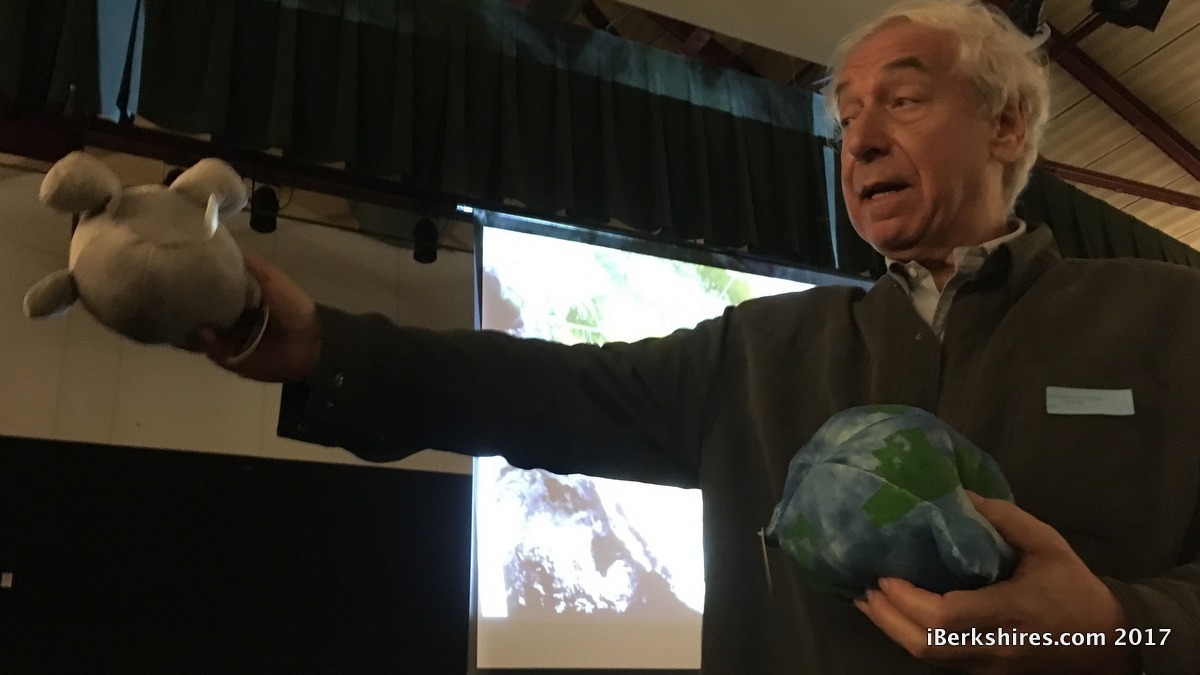
"This summer's total solar eclipse is a bonanza for finding out more about how the sun shines," said Pasachoff, who will take advantage of his experience in observing eclipses, and organizing eclipse expeditions, by taking dozens of students and colleagues with him to Salem, Ore., for the event on Monday, Aug. 21.
"I've chosen the site because it is in the region with the most favorable cloudiness statistics for August, while still having the logistics advantages of a city and of campus support," Pasachoff said. "When I discovered that Willamette University is near the center of totality in the most favorable weather region, and that they are not only giving hospitality on campus but also have an astronomer as their president, we knew that we had found a scientific home-away-from-home."
Pasachoff will be viewing his 66th solar eclipse, the most of anyone ever. He serves as chair of the International Astronomical Union's Working Group on Solar Eclipses, and as such is also helping coordinate visitors from China, Japan, Bulgaria, Venezuela and other countries to the U.S. for eclipse observing.
Pasachoff's observing team had the advantage of a basic research grant awarded almost three years ago by the Committee on Research and Astronomy of the National Geographic Society, which has awarded him 18 research grants dating back to when he assisted his senior mentor, professor Donald Menzel of the Harvard College Observatory, to run a major eclipse expedition to Mexico for the 1970 eclipse, whose path of totality then covered part of the southeastern United States as well as Virginia Beach and Nantucket Island, Massachusetts. For the 2017 total solar eclipse, his scientific capabilities then expanded with the award of a major research grant from the Solar Terrestrial Program of the Atmospheric and Geospace Sciences Division of the U.S. National Science Foundation.
With these grants, the Williams College Expedition is supporting such scientists as Ronald Dantowitz of the Clay Center Observatory of the Dexter Southfield School in Brookline, Mass.; Vojtech Rusin of the Astronomical Institute of the Slovak Academy of Sciences in Tatranská Lomnica, Slovakia; John Seiradakis and Aris Voulgaris of the Aristotle University of Thessaloniki, Greece; Marcos Peñaloza-Murillo of the University of the Andes in Merida, Venezuela; Michael Person and Amanda Bosh of M.I.T.; and Marek Demianski of the Copernicus Institute in Warsaw, Poland.
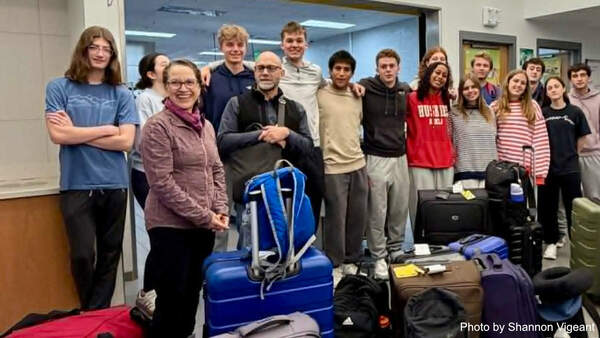
Williams College astrophysics alumni experienced from past eclipse expeditions who will be participating in the observing include Daniel Seaton of the National Oceanic and Atmospheric Administration (NOAA) and the University of Colorado in Boulder; graduate students Muzhou Lu of the University of Colorado in Boulder; Allen Davis of Yale; and David Sliski of the University of Pennsylvania. They will observe from platforms on the Willamette campus that will provide electricity and internet to aid in the telescopes' tracking and the electronic-cameras' data-collecting abilities. They will be joined in the scientific work by eight Williams College undergraduates, who have worked all summer in preparing and testing the eclipse equipment: Declan Daly of Seattle; Brendan Rosseau of Glen Ellyn, Ill.; Ross Yu of Huntington Beach, Calif.; Charles Ide of Natick, Mass.; Cielo Perez of Dallas; Erin Meadors of Albuquerque, N.M.; Christian Lockwood of Quogue, Long Island, N.Y.; and Connor Marti of Cranford, N.J. Aram Friedman of Ansible Technology in Princeton, N.J., is coordinating wide-field video observations.
Four of the students are supported by Pasachoff's NSF grant; others received funds from the NASA Massachusetts Space Grant Consortium, Sigma Xi (the honorary scientific society), the Clare Booth Luce Foundation, and Williams College, including the Freeman Foote Expeditionary Fund.
Their main observations are to study the solar corona, a million times fainter than the everyday sun and normally hidden behind the blue sky.
"Only at a total solar eclipse, when the blue sky goes away because normal sunlight is hidden by the moon, can we see the corona at all this well," Pasachoff said. "And because the sun's magnetic field changes over the 11-year sunspot cycle and erratically as well, each time we look at the corona - -even when we get only a couple of minutes to see it every couple of years somewhere in the world -- we have a new sun to study, just as a cardiologist who looked inside someone's heart in, say, Africa two years ago for a couple of minutes would still have lots to learn by looking at a new patient in the U.S. a couple of years later."
Scientisits are learning more about the sun's influence on the Earth, which they now call "space weather," Pasachoff said.
"Eruptions on the sun can zap and kill satellites in Earth orbit and even cause surges on power lines and blackouts. We want to understand how to predict and monitor solar eruptions that affect us on Earth, and observations during our rare opportunities at total solar eclipses contribute to these goals," he said.
One of the main scientific conundrums that the team will tackle is the cause of the heating of the solar corona to millions of degrees. The scientists will operate special fast cameras that have negligible dead time between high-quality frames, using the POETS (Portable Occultation, Eclipse, and Transit System) devices that were purchased a dozen years ago jointly by M.I.T.'s occultation-research group and Williams College with a NASA equipment grant.
Pasachoff also works with atmospheric scientists Peñaloza-Murillo, who had been a Fulbright Fellow at Williams College five years ago, and Michael Thomas Roman of the University of Michigan to understand the effect of the abrupt shutting off of incident sunlight by the onset of totality on Earth's wind, temperature, pressure, and other weather aspects.
"The temperature dropped 15°F at the 2015 total solar eclipse in Svalbard in the Arctic by the center time of totality, and we are taking special atmospheric-monitoring instrumentation to Oregon with us," Pasachoff said. "We were pleased to publish results of our Svalbard expedition in the Philosophical Transactions of the Royal Society, the world's longest-running scientific journal, and we look forward to publishing our new results not only in astronomical journals but also atmospheric-science journals again."
In addition, this group of our team will perform photometric measurements of the sky to study its brightness, in different directions including the zenith, to see how dark the sky will be.
Pasachoff has also teamed with radio astronomers to use the National Radio Astronomy Observatory's Very Large Array located 60 miles west of Socorro, N.M., to pinpoint emission regions on the solar surface as the moon advances over them and then continues farther, allowing these magnetic regions to become visible again. The localization of solar activity in this way will be the highest ever possible, and will be good to compare with space observations in x-rays and the ultraviolet to pin down just where the emission comes from in the fine-resolution magnetic field on the solar surface. Collaborating scientists include Dale Gary and Bin Chen of the Owens Valley Radio Observatory of the New Jersey Institute of Technology (who will also be observing with telescopes there); Tim Bastian of the National Radio Astronomy Observatory; and Stephen White of the U.S. Air Force's Research Laboratory in New Mexico.
Pasachoff is working with PBS's NOVA on a television program, "Eclipse Across America," to be aired on public television stations that night. Footage from his prior expedition to the most recent solar eclipse--a so-called annular ("ring") eclipse that he viewed from Argentinian Patagonia on February 26 this year; and from a subsequent visit to Dantowitz's lab in Brookline, Mass., where eclipse equipment was tested; will provide a good bit of the program's background, with five or 10 minutes of footage from eclipse day added that afternoon. The New York Times's science reporter Dennis Overbye is helping coordinate 360-degree observations also from their site.
Several other scientists are joining Pasachoff at his site to view the fantastic spectacle that is expected, often accompanied by family members for the show. They include David Hathaway, retired NASA expert on the sunspot cycle; Susan McKenna-Lawlor of Maynooth University in Ireland; Deepto Chakrabarty of MIT; Robert Vanderbei of Princeton; Ruslan Belikov of NASA's Ames Research Center; Edw Ginsberg of the University of Massachusetts at Boston; Robert Lucas of Sydney, Australia; and Phyllis Lugger of the University of Indiana. Douglas George of Cyanogen Productions Inc. in Toronto, a provider of electronic cameras the team will use; and R.J. Smith of Bisque, Inc., of Colorado, a provider of high-quality tracking telescope mounts, are also part of the expedition. Alan Sliski of Lincoln, Mass., is lending his expertise on telescope mounts and on cameras for eclipse use.
Williams College alumni with Ph.D. degrees who will participate include Joey Shapiro Key of the University of Washington at Bothell; Kristen Shapiro Griffin of Northrop Grumman; and with National Science Foundation support: Duane Lee of Vanderbilt University and Marcus Freeman, as well as University of Maryland graduate student in astronomy Amy Steele. Also on site will be 10 Japanese astronomers and 40 of their colleagues coordinated between Pasachoff and Hiroki Kurokawa of the Kwasan Observatory, Kyoto University; and nearby -- mainly in Dallas, Ore. -- will be 25 Chinese astronomers headed by Zhongquan Qu of the Yunnan Observatory.
Pasachoff runs a website for the Working Group on Solar Eclipses of the International Astronomical Union, with many links to maps and other resources for the general public as well as for professional astronomers. His website at http://totalsolareclipse.org includes images and other materials from his past eclipse expeditions.
The Solar Physics Division of the American Astronomical Society will be meeting in Portland, Ore., starting the day after the eclipse, and many of the attendees will travel by bus to the Willamette campus to observe the eclipse, since Portland is outside the zone of totality. Pasachoff will deliver a short paper on first results the day after the eclipse and participate in a press conference on eclipse results on the following morning at 10 a.m. Pacific Daylight Time.
Tags: eclipse, Williams College,